

Introduction
Across industries, organizations continue to hire graduates who appear qualified on paper yet struggle to perform in real client environments. Academic institutions have succeeded in imparting theoretical knowledge, but they often stop short of preparing students for the realities of professional delivery. As businesses accelerate digital transformation and operate in increasingly client-centric ecosystems, the gap between academic readiness and industry readiness has become more visible and more costly.
Employers do not expect graduates to arrive fully formed. They do, however, expect foundational professional competence. Graduates should understand how work flows in real organizations, how client expectations shape decisions, and how accountability operates beyond exams and grades. When these fundamentals remain absent, organizations must invest heavily in post-hire remediation, slowing productivity and increasing attrition risk.
This challenge has elevated the importance of structured industry-aligned training programs. These programs go beyond curriculum completion and focus on professional readiness, delivery confidence, and applied problem-solving. They help graduates move from being course-ready to becoming client-ready.
This blog will talk about why the academia-industry gap persists, how client readiness differs from academic success, what effective training programs do differently, and how organizations can design scalable models that benefit graduates, employers, and clients alike.
Understanding the Academia–Industry Gap
The disconnect between education and employment does not stem from lack of effort or intent. Universities operate under constraints that differ fundamentally from those faced by businesses. Over time, these differences have created structural misalignment.
Academic programs emphasize conceptual mastery, standardized evaluation, and individual performance. Industry environments prioritize applied judgment, collaboration, speed, and accountability to external stakeholders. Graduates often move from one system to another without adequate preparation for this shift.
Research on employability consistently highlights this gap. The World Economic Forum has noted that while formal education builds cognitive foundations, it does not always develop workplace-relevant skills such as communication, adaptability, and problem framing (World Economic Forum, 2023). This gap becomes more pronounced in technology-driven roles where tools, workflows, and client expectations evolve rapidly.
The result is not a lack of intelligence or motivation among graduates. It is a lack of exposure to how knowledge translates into outcomes under real-world constraints.
What “Client-Ready” Really Means
Client readiness often gets confused with employability or basic job preparedness. However, the difference becomes evident the moment a graduate enters a real delivery environment. Client readiness focuses on whether an individual can function effectively in situations where expectations are shaped by external stakeholders, timelines are non-negotiable, and outcomes directly affect business credibility.
In consulting, IT services, and client-facing delivery roles, work rarely follows linear instructions. Professionals must operate within shifting priorities, partial information, and collaborative workflows. Client-ready graduates understand this reality and adjust their behavior accordingly.
Job-Ready vs Project-Ready vs Client-Ready
Client readiness sits at the highest level of professional preparedness. Each stage below represents a distinct capability threshold.
- Job-ready graduates
These individuals possess foundational technical or functional knowledge aligned with a specific role. They understand concepts, tools, and terminology taught through formal education or basic training programs. However, they often depend heavily on detailed instructions, struggle with ambiguity, and view tasks in isolation rather than as part of a broader delivery context. - Project-ready graduates
These graduates can operate within structured internal projects where expectations are mainly controlled. They collaborate with teammates, follow defined processes, and deliver assigned components when provided with guidance and checkpoints. While effective within internal environments, they may still lack exposure to client dynamics such as expectation management, scope changes, and delivery trade-offs. - Client-ready graduates
These professionals can function responsibly in environments where accountability extends beyond internal teams. They understand that their work represents their organization, influences client trust, and contributes to long-term relationships. They balance quality, timelines, communication, and adaptability while remaining receptive to feedback and guidance.
Training programs that aim to build client readiness intentionally push learners beyond the comfort zones associated with academic or internal project work.
Core Capabilities That Define Client Readiness
Client-ready professionals consistently demonstrate behaviors that go beyond academic excellence or technical proficiency. These capabilities reflect how individuals think, communicate, and act in environments where outcomes affect real stakeholders. They develop through deliberate exposure, practice, and feedback rather than solely through theoretical instruction.
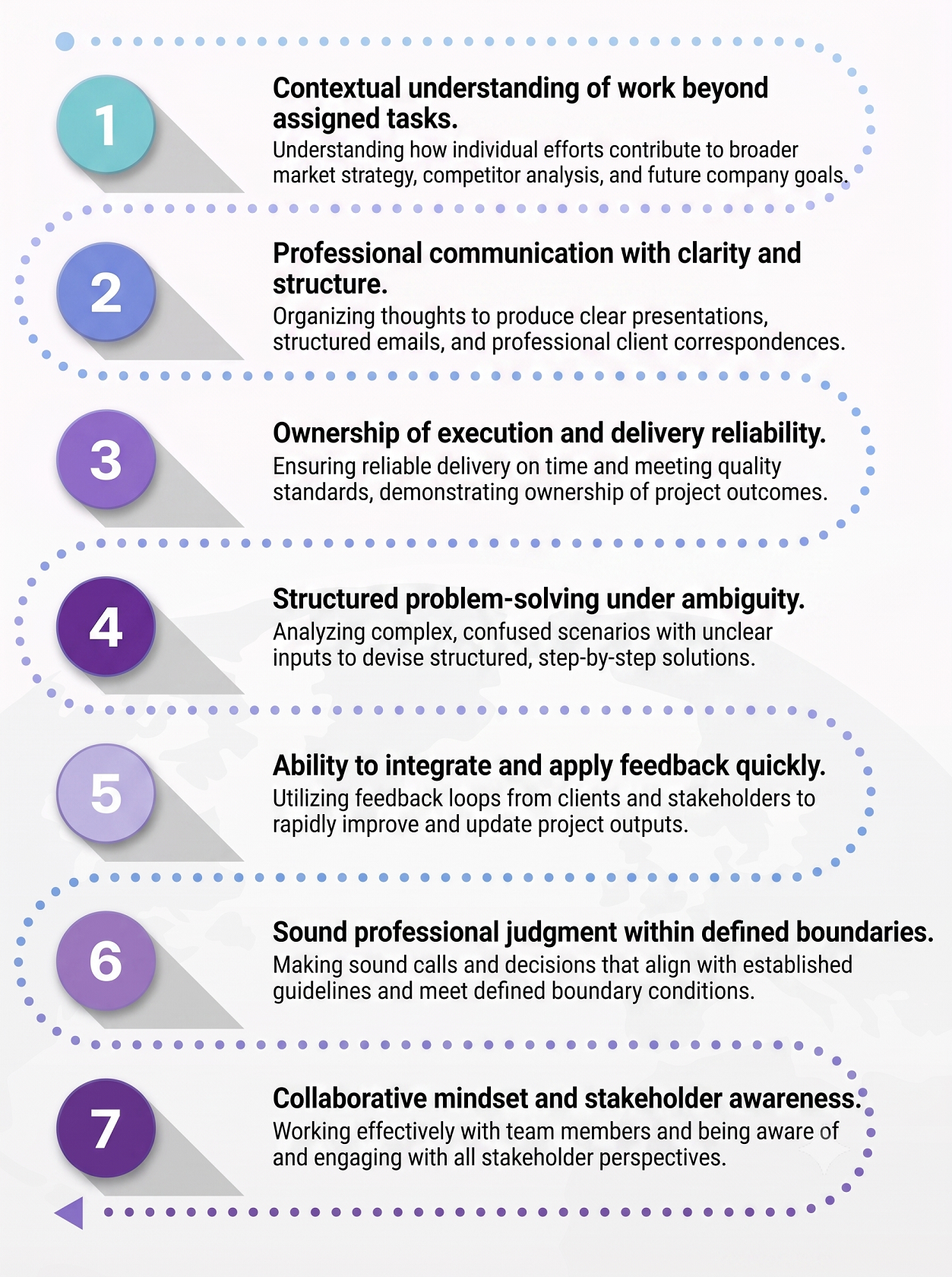
1. Contextual Understanding of Work
Client-ready graduates understand that every task exists within a broader business and delivery context. They look beyond instructions to grasp intent, impact, and interdependencies.
They demonstrate this capability by:
- Interpreting assignments in relation to client goals, business priorities, and delivery timelines rather than viewing them as standalone tasks
- Identifying how their output affects downstream teams, system integrations, or decision-making processes
- Recognizing the difference between what is requested and what is actually needed to solve the underlying problem
- Asking clarifying questions that focus on scope, success criteria, and expected outcomes instead of only technical specifications
- Adjusting effort and depth based on the criticality of the task within the overall engagement
This understanding helps prevent misaligned deliverables that are technically correct but commercially ineffective.
2. Professional Communication Discipline
In client-facing roles, communication directly influences trust, efficiency, and credibility. Client-ready professionals communicate with intent, clarity, and structure across formats.
They exhibit this discipline through:
- Providing clear and timely updates on progress, risks, and dependencies without waiting to be prompted
- Structuring written communication so that key points, actions, and decisions remain immediately visible
- Adapting language, tone, and detail based on whether they are addressing peers, managers, or clients
- Actively listening during discussions to confirm understanding before proceeding with execution.
- Documenting decisions and changes to ensure continuity across teams and time zones
Effective communication minimizes misunderstandings, reduces rework, and accelerates alignment across stakeholders.
3. Execution Ownership and Reliability
Client-ready graduates treat commitments as professional obligations rather than academic deadlines. They understand that reliability forms the backbone of client confidence.
They demonstrate execution ownership by:
- Planning work proactively to meet agreed timelines, even when dependencies exist
- Tracking responsibilities and deliverables across multiple tasks or workstreams
- Following established processes, quality standards, and review protocols without resistance
- Escalating risks, delays, or uncertainties early to allow corrective action
- Delivering work that is complete, reviewed, and ready for consumption rather than minimally acceptable
This consistency allows teams to operate efficiently and reduces the need for constant oversight.
4. Structured Problem-Solving in Ambiguous Environments
Client environments often involve incomplete information, shifting priorities, and competing constraints. Client-ready professionals respond with structured thinking rather than paralysis or guesswork.
They approach ambiguity by:
- Breaking complex or unclear problems into smaller, manageable components
- Identifying assumptions explicitly and validating them before proceeding
- Evaluating alternative solutions and outlining trade-offs rather than defaulting to a single approach
- Communicating uncertainties transparently while still proposing actionable next steps
- Balancing speed and accuracy based on the urgency and impact of the issue
This capability enables progress even when clarity evolves gradually.
5. Feedback Integration and Learning Agility
Client-ready graduates view feedback as a core input to improvement, not as a personal critique. Their ability to learn quickly often matters more than initial performance.
They show learning agility through:
- Receiving feedback without defensiveness and acknowledging gaps openly
- Applying suggestions promptly and accurately in subsequent iterations
- Identifying recurring feedback themes and addressing root causes
- Asking follow-up questions to clarify expectations and success criteria
- Reflecting on outcomes to improve future performance independently
This responsiveness accelerates development and signals readiness for greater responsibility.
6. Professional Judgment and Accountability
Client-ready professionals understand that not every situation comes with explicit instructions. They exercise judgment while respecting boundaries and guidance.
They demonstrate accountability by:
- Making informed decisions within their scope rather than deferring all choices upward
- Understanding when to act independently and when to escalate
- Weighing quality, timelines, and client expectations before taking action
- Owning outcomes, including mistakes, and focusing on resolution rather than blame
- Aligning personal actions with organizational values and client commitments
This judgment builds trust and reduces delivery risk.
7. Collaborative Mindset and Stakeholder Awareness
Client work rarely happens in isolation. Client-ready graduates recognize the importance of collaboration and stakeholder alignment.
They practice this by:
- Coordinating effectively with cross-functional teams and respecting shared responsibilities
- Understanding stakeholder priorities and adjusting communication accordingly
- Managing handoffs smoothly to avoid gaps or duplication
- Supporting team objectives even when individual recognition remains limited
- Maintaining professionalism during disagreements or high-pressure situations
Strong collaboration improves delivery quality and client experience.
What Client Readiness Is Not
As organizations emphasize client readiness, it becomes equally important to clarify what the concept does not represent. Misaligned expectations can undermine both training outcomes and early-career confidence.
Client readiness does not imply:
- Immediate independence without oversight, as early-career professionals still require guidance, review, and structured support while learning organizational standards and client norms
- Deep domain mastery on day one, since expertise develops through exposure, repetition, and mentorship rather than pre-employment training
- Error-free delivery from the outset, because mistakes form a natural part of learning in complex, real-world environments
- Authority to make high-risk decisions, which remain the responsibility of experienced leaders and client stakeholders
- Replacement of formal education, as client readiness builds on academic foundations rather than substituting them
Instead, client readiness reflects how graduates behave when supported, how they respond to expectations, and how responsibly they operate within defined boundaries.
Why Traditional Education Struggles to Deliver Client Readiness
Universities play a critical role in building foundational knowledge, but their structures were never designed to simulate professional delivery environments. Academic systems prioritize conceptual understanding, standardization, and individual evaluation, while client-facing work demands adaptability, collaboration, and accountability to external stakeholders. As industries evolve faster than educational frameworks, the gap between classroom learning and workplace readiness continues to widen. These challenges stem from systemic limitations rather than shortcomings in intent or effort.

Curriculum Rigidity
Academic curricula often struggle to keep pace with industry change due to structural and regulatory constraints. While these safeguards ensure quality and consistency, they also limit responsiveness.
This rigidity affects client readiness by:
- Slowing the introduction of emerging tools, platforms, and methodologies that dominate modern workplaces
- Emphasizing theoretical completeness over practical relevance in rapidly evolving domains
- Creating misalignment between what students learn and what employers actually use
- Preparing graduates to understand concepts deeply but not necessarily apply them in current delivery contexts
As a result, graduates enter organizations with strong foundations but require significant upskilling to meet real-world expectations.
Assessment Models
Assessment methods shape how students prioritize learning. Traditional evaluation systems reward precision, recall, and individual performance, which differ sharply from workplace success metrics.
This mismatch leads to:
- Optimization for grades rather than for problem-solving or collaboration
- Limited exposure to ambiguity, trade-offs, and incomplete information
- Minimal practice in articulating reasoning, defending decisions, or revising work based on feedback
- Reduced emphasis on communication clarity, ownership, and iterative improvement
When assessment does not reflect professional realities, readiness becomes incidental rather than intentional.
Limited Industry Exposure
Internships and industry projects aim to bridge academic learning with practice, but their impact varies significantly.
Common limitations include:
- Short durations that restrict meaningful contribution or accountability
- Assignments focused on observation rather than ownership
- Inconsistent mentoring and feedback mechanisms
- Lack of structured learning outcomes tied to professional competencies
Without intentional design, these experiences provide exposure without transformation.
Faculty–Industry Distance
Faculty expertise forms the backbone of academic education, yet limited recent industry exposure can affect contextual application.
This distance manifests in:
- Teaching examples that reflect historical rather than current industry practices
- Limited discussion of delivery constraints, client dynamics, or operational trade-offs
- Reduced emphasis on professional behaviors such as stakeholder management or execution discipline
- Challenges in translating theory into lived workplace scenarios
This gap affects how students internalize the relevance of what they learn.
These constraints do not indicate failure. They highlight the need for complementary systems that translate academic learning into professional capability without compromising educational rigor.
The Role of Industry-Aligned Training Programs
Industry-aligned training programs bridge the gap between academic learning and professional delivery. While universities build conceptual foundations, these programs focus on translating knowledge into capability by shaping behavior, judgment, and execution confidence in environments that resemble real client engagements.
- Outcome-driven learning design
Unlike traditional education that prioritizes content coverage, industry-aligned programs start with delivery outcomes and design learning experiences backward to ensure relevance and immediate applicability. - Applied, feedback-driven learning
Participants practice skills in realistic scenarios, receive continuous feedback, and improve iteratively rather than progressing through linear, exam-based models. - Transitional ecosystems for early careers
These programs act as structured bridges, exposing graduates to real constraints such as deadlines, dependencies, and quality standards without placing client relationships at risk. - Reduced organizational friction and delivery risk
By addressing readiness gaps early, industry-aligned training shortens time to productivity, lowers supervision overhead, and improves consistency across delivery teams. - Capability-based readiness assessment
Progress is measured through observable behaviors such as deliverable quality, feedback responsiveness, communication clarity, and reliability rather than attendance or certification. - Integration of technical skills with business context
Training embeds client impact and business rationale into technical work, helping learners understand how execution quality influences outcomes, timelines, and trust. - Development of professional habits and mindsets
Programs reinforce accountability, comfort with ambiguity, proactive communication, and ethical awareness—capabilities that remain relevant across roles and technologies. - Strategic workforce readiness for the future
As client expectations rise and delivery environments grow more complex, industry-aligned training enables organizations to scale talent, maintain quality, and adapt without constant rehiring.
Core Elements of Client-Ready Training Programs
Client readiness does not emerge from generic training or isolated skill workshops. It requires programs designed with precision, realism, and accountability. While many training initiatives focus on content delivery, only a few succeed in shaping professional behavior. The difference lies in how closely the learning environment mirrors real delivery conditions and how intentionally it develops judgment, communication, and execution discipline.
Effective client-ready training programs share a set of core elements that consistently translate learning into workplace performance.
Realistic Work Simulations
Simulation forms the backbone of client-ready training because it exposes graduates to the realities of professional work before real stakes are at play. Unlike academic exercises, simulations replicate ambiguity, constraints, and evolving expectations.
Well-designed simulations include:
- Client brief interpretation exercises where requirements remain intentionally incomplete, forcing participants to ask clarifying questions
- Scenarios that introduce scope changes, competing priorities, or time pressure mid-task
- Deliverables that must go through review and revision cycles, reinforcing the iterative nature of client work
- Accountability for outcomes rather than effort, mirroring professional expectations
These experiences normalize uncertainty and teach graduates how to function productively despite it.
Process Literacy and Delivery Awareness
Client-ready professionals understand that work flows through systems, not individuals. Training programs must therefore teach how organizations actually operate.
Strong programs explicitly build process literacy by covering:
- End-to-end project lifecycles, from initiation to closure
- Review, approval, and escalation workflows
- Documentation standards that ensure continuity and auditability
- Role clarity across cross-functional teams
This awareness reduces friction during real engagements and enables graduates to navigate delivery environments confidently.
Communication as a Core Capability
Communication is often treated as secondary to technical training, yet it remains one of the most visible indicators of professionalism. Client-ready programs treat communication as a core capability, not a soft add-on.
They intentionally develop:
- Structured writing skills for emails, documentation, and status updates
- Presentation abilities focused on clarity, logic, and audience awareness
- Stakeholder role-play scenarios that simulate client interactions
- Listening and clarification drills that reinforce alignment before execution
Consistent communication training improves trust, reduces rework, and strengthens delivery credibility.
Feedback-Driven Learning Environments
In professional settings, feedback arrives continuously and often informally. Training programs must prepare graduates to absorb and apply feedback without defensiveness.
Effective programs normalize feedback by:
- Embedding frequent review cycles into all deliverables
- Using structured critique frameworks to ensure clarity and fairness
- Encouraging peer feedback to build collaborative awareness
- Incorporating reflection sessions that link feedback to future improvement
This approach builds resilience, adaptability, and sustained learning momentum.
Integrating Technical Skills with Business Context
Client readiness requires more than technical competence. Graduates must understand why they use specific tools and how their outputs influence decisions, risk, and outcomes. Without this context, even technically strong professionals struggle to deliver value.
Industry-aligned training programs deliberately integrate technical learning with business and client context to close this gap.
They achieve this integration by:
- Framing technical tasks around real business problems rather than abstract exercises
- Explaining how outputs influence operational efficiency, user experience, or strategic decisions
- Highlighting trade-offs between speed, accuracy, and scalability
- Reinforcing the connection between execution quality and client trust
For example, a data analytics module should extend beyond dashboard creation. It should explain how insights support decision-making, mitigate risk, or drive performance. This shift moves graduates from task execution to outcome ownership.
Research from IBM highlights that contextual application significantly improves skill transfer and long-term effectiveness, especially in complex enterprise environments (IBM, 2023).
Designing Training Programs That Scale
As organizations grow, training must evolve from ad hoc interventions to structured systems that deliver consistent outcomes. Scalable client-ready programs preserve rigor while adapting to role diversity, growth, and changing business needs.
- Designing for capability, not completion
Scalable programs move beyond attendance and certification to evaluate real readiness through observable behaviors, such as delivery quality, responsiveness to feedback, collaboration, and performance consistency under pressure. - Behavior-based readiness measurement
Instead of tracking how fast participants finish modules, effective programs assess how individuals improve over time across deliverables, communication clarity, and accountability in varied scenarios. - Modular, repeatable learning architecture
Programs scale best when built around clear competency frameworks, role-aligned learning paths, and standardized feedback mechanisms that remain consistent across cohorts and locations. - Continuous relevance through content refresh
Scalable training avoids stagnation by regularly updating tools, scenarios, and delivery contexts to reflect evolving technologies and client expectations. - Mentorship models that grow with the organization
Strong programs embed mentorship through shared guidelines, review templates, and escalation structures rather than relying on individual managers or informal support. - Long-term impact on graduates
Graduates trained in scalable systems enter client environments with clarity, build credibility early, adapt faster to change, and develop judgment that remains relevant as responsibilities increase. - Enterprise value at scale
Well-designed programs reduce onboarding friction, protect delivery consistency, strengthen client trust during growth phases, and create resilient talent pipelines aligned with market demand.
Graduate Impact: From Classroom Confidence to Client Credibility
Client-ready training programs reshape how graduates enter the workforce. Instead of facing a sharp transition from academic success to professional uncertainty, graduates develop clarity around expectations, accountability, and delivery standards before client exposure. This preparation reduces early anxiety and allows individuals to focus on contribution rather than adjustment.
Over time, graduates trained in client-ready environments build credibility faster. They communicate with intent, respond constructively to feedback, and demonstrate ownership early in their careers. These behaviors accelerate learning, open access to meaningful responsibility, and support long-term professional growth across roles, domains, and technologies.
Conclusion
The academia–industry gap is often misunderstood. It does not exist because education falls short, but because academic systems and professional environments optimize for entirely different outcomes. Universities build knowledge and cognitive foundations. Client-facing work demands application, judgment, communication, and accountability under real constraints.
Industry-aligned training programs bridge this gap by translating learning into capability. They expose graduates to realistic delivery conditions, embed business context into technical instruction, and develop professional behaviors that sustain performance. When designed with discipline and scaled thoughtfully, these programs benefit graduates, employers, and clients alike.
As technology evolves and delivery complexity increases, client readiness will matter more than credentials alone. Organizations that invest in



.png)