Introduction
Enterprises, globally, are at a pivotal moment in their digital transformation journeys. Nearly every organization today is investing in cloud platforms, data analytics, AI-driven systems, and automation. Chatbots handle customer queries, predictive models inform business decisions, and modern platforms promise faster innovation and scale.
Yet a persistent challenge threatens these ambitions: most transformation efforts stall not because of technology, but because of people.
Across industries, from healthcare and financial services to manufacturing, retail, and logistics, leaders report the same friction point. They have ambitious digital roadmaps, but not enough professionals who can execute them. Teams built for legacy systems now face cloud-native architectures. Developers trained in traditional stacks must adapt to DevOps, microservices, and AI integration. Business users are expected to work with data, automation, and intelligent systems without having been trained to do so.
This is not a hiring shortage. It is a skills gap.
Enterprises can recruit aggressively, but they still struggle to find talent that aligns with modern platforms, regulatory demands, and production-scale systems. Meanwhile, employees feel increasing pressure to remain relevant as job roles evolve faster than traditional career paths.
Upskilling programs have emerged as one of the most powerful ways to resolve this tension. When designed strategically, they align workforce capabilities with business priorities while giving professionals a path to grow without starting over.
This blog explores how upskilling programs can bridge the enterprise skills gap in the US in a sustainable, scalable way. It examines why the gap exists, why upskilling has become a strategic imperative, and how organizations can prepare their workforces for 2026 and beyond.
Understanding Tech Talent Gap
Why the Enterprise Skills Gap Exists
- Digital Has Become Core to Business
Technology no longer sits at the edges of organizations. Cloud platforms run mission-critical systems, data informs every decision, and AI shapes customer experience. Digital capability now determines revenue growth, resilience, and competitiveness. - The Nature of Work Has Fundamentally Changed
Modern roles demand more than execution. Engineers must think in systems, analysts must convert data into action, and product teams must integrate AI responsibly. Every function now intersects with security, compliance, and governance. - The Gap Is Structural, Not a Talent Shortage
The enterprise skills gap is not caused by a lack of people. It stems from a misalignment between how skills are developed and how work evolves. Jobs change faster than traditional learning models can keep up.
Legacy Training Models Lag Behind Modern Work
Most professionals entered the workforce when technology stacks were stable and roles predictable. Education and early-career training prepared them for environments that no longer exist.
Today’s enterprises require fluency in cloud platforms, automation pipelines, security frameworks, and data ecosystems. Many employees were never trained in these areas and are expected to adapt in real time, often without structured support. The result is stalled initiatives, fragile systems, and heavy dependence on external consultants.
Skill Obsolescence Accelerates Across Roles
Technology lifecycles have compressed. Skills that defined enterprise value five years ago no longer differentiate organizations.
- Developers must move from monolithic systems to distributed, cloud-native architectures.
- Operations teams must shift from manual infrastructure to automated environments.
- Analysts must evolve from reporting to advanced data interpretation.
Without continuous learning, even top performers fall behind. The gap widens not because people lack ability, but because change outpaces development.
Hiring Alone Cannot Close the Gap
Recruitment remains important, but it is no longer sufficient.
- Competition for experienced talent inflates costs without guaranteeing long-term fit.
- New hires still require time to learn internal systems and workflows.
- Skills hired today may become outdated within a few years, restarting the cycle.
This approach fragments teams, erodes institutional knowledge, and slows transformation.
Global workforce research shows that a significant share of today’s employees will require reskilling or upskilling to remain effective (World Economic Forum, 2023). In the US, where enterprises carry decades of technical debt, the impact is amplified.
The enterprise skills gap is not a temporary labor market anomaly. It is a structural challenge rooted in how work evolves faster than traditional development models. Solving it requires a shift, from treating skills as static hiring criteria to viewing capability as a continuously built asset.
Upskilling becomes the bridge between legacy workforces and modern enterprise demands.
Why Upskilling Has Become a Strategic Imperative
Upskilling has moved from being a learning and development initiative to a core business priority. It refers to structured, ongoing learning programs that help employees acquire new or advanced skills aligned with changing job roles and technology demands. Unlike one-time training sessions, effective upskilling focuses on building long-term capability that evolves with the organization and the market.
For organizations, upskilling introduces stability in an unpredictable talent landscape by reducing dependence on external hiring. For employees, it creates career continuity by enabling growth into new roles without requiring a change in employer or industry.
Several forces make upskilling unavoidable in today’s environment.
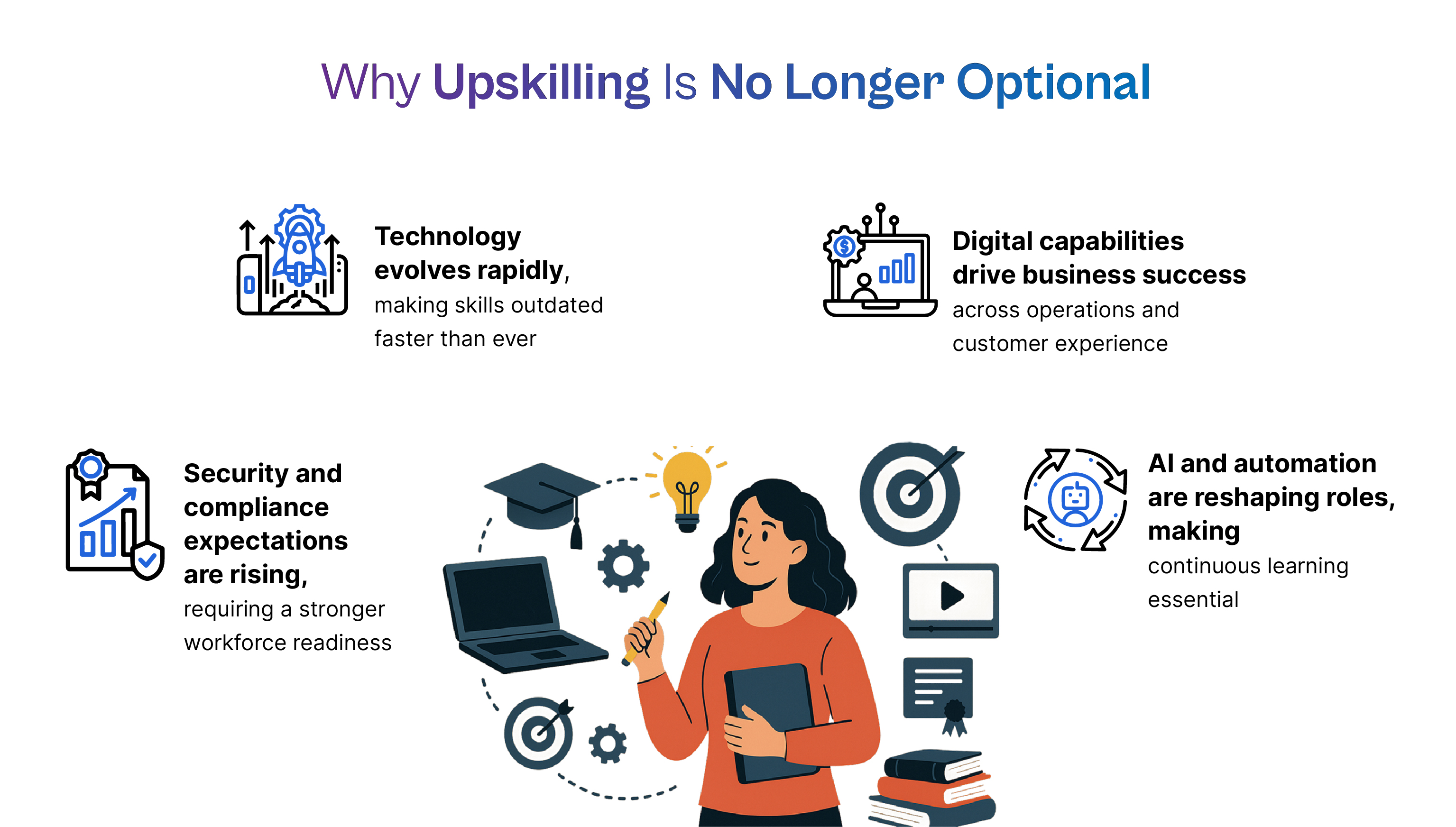
- Technology lifecycles continue to shrink
Technical skills now lose relevance within a few years, not decades. Organizations that rely only on hiring struggle to keep pace with this rapid evolution. - Digital capabilities now shape core business outcomes
Cloud platforms, data analytics, and automation directly influence customer experience, revenue generation, and operational resilience. Technology no longer operates in the background as a support function. - Regulatory and security expectations are rising steadily
As systems become more interconnected, organizations need professionals who understand compliance, governance, and ethical responsibility alongside technical execution. - Workforce disruption is becoming the norm rather than the exception
Shifts driven by AI, automation, and platform-based models continuously redefine roles. Continuous learning helps employees and organizations adapt without repeated structural upheaval.
Research from the World Economic Forum underscores that a large share of the global workforce will require reskilling or upskilling to remain relevant in the coming years (World Economic Forum, 2023). For US enterprises, where legacy systems, regulatory complexity, and rapid innovation converge, proactive upskilling is not optional. It is a strategic lever for sustaining growth, competitiveness, and workforce resilience.
How Upskilling Programs Address the Talent Gap
Upskilling programs close the enterprise skills gap by bringing structure to how organizations grow capability over time. Instead of treating skills as static requirements filled through hiring, upskilling reframes them as assets that can be deliberately built. This approach connects what the business needs today, what the workforce can already do, and what the organization will require in the future. When these three forces move together, enterprises replace short-term fixes with long-term momentum and create teams that evolve in step with technology.
- Business priorities
- Existing workforce capabilities
- Future skill demand
Aligning Skills With Business Strategy
Upskilling delivers the most significant impact when it connects clearly to business priorities. Organizations must first identify which capabilities directly support their strategic objectives and long-term transformation plans.
- Companies modernizing their infrastructure focus on cloud architecture, platform reliability, and security engineering to ensure scalable, resilient systems.
- Data-driven organizations prioritize analytics engineering, data governance, and AI model operations to convert data into actionable insights.
This alignment ensures that learning initiatives translate into measurable business outcomes instead of remaining theoretical or disconnected from real work.
Accelerating Time to Productivity
One of the most immediate benefits of upskilling lies in faster productivity gains. Employees who already understand organizational systems, workflows, and stakeholders can apply new skills more quickly than external hires.
- Targeted training builds on existing context, reducing the learning curve for new tools and platforms.
- Teams achieve faster project execution because learning integrates directly into ongoing work rather than delaying delivery.
By shortening the time between learning and contribution, upskilling improves both efficiency and confidence across teams.
Reducing Attrition and Improving Engagement
Upskilling also addresses one of the most persistent challenges in the tech sector: employee retention. Professionals who see visible growth opportunities within their organization are more likely to stay and invest in their roles.
- Clear learning pathways signal long-term commitment to employee development rather than short-term role fulfillment.
- Continuous learning fosters trust, motivation, and a sense of shared future between employees and employers.
LinkedIn’s Workplace Learning Report highlights that access to learning opportunities ranks among the strongest drivers of employee retention (LinkedIn, 2024). Upskilling, therefore, strengthens both organizational capability and workplace culture.
By embedding upskilling into workforce strategy, organizations move from managing talent shortages to actively preventing them. This shift enables companies to build internal capabilities, retain institutional knowledge, and remain competitive in a rapidly changing technology landscape.
Shared Benefits of Upskilling for Employers and Employees
Upskilling delivers its most significant impact when it creates value for both organizations and their workforces. Rather than serving as a one-sided intervention, effective upskilling programs build a mutually reinforcing cycle. Employers gain resilient, future-ready teams, while employees gain relevance, confidence, and sustainable career growth. When learning aligns with real work and long-term goals, it strengthens both organizational performance and individual motivation.
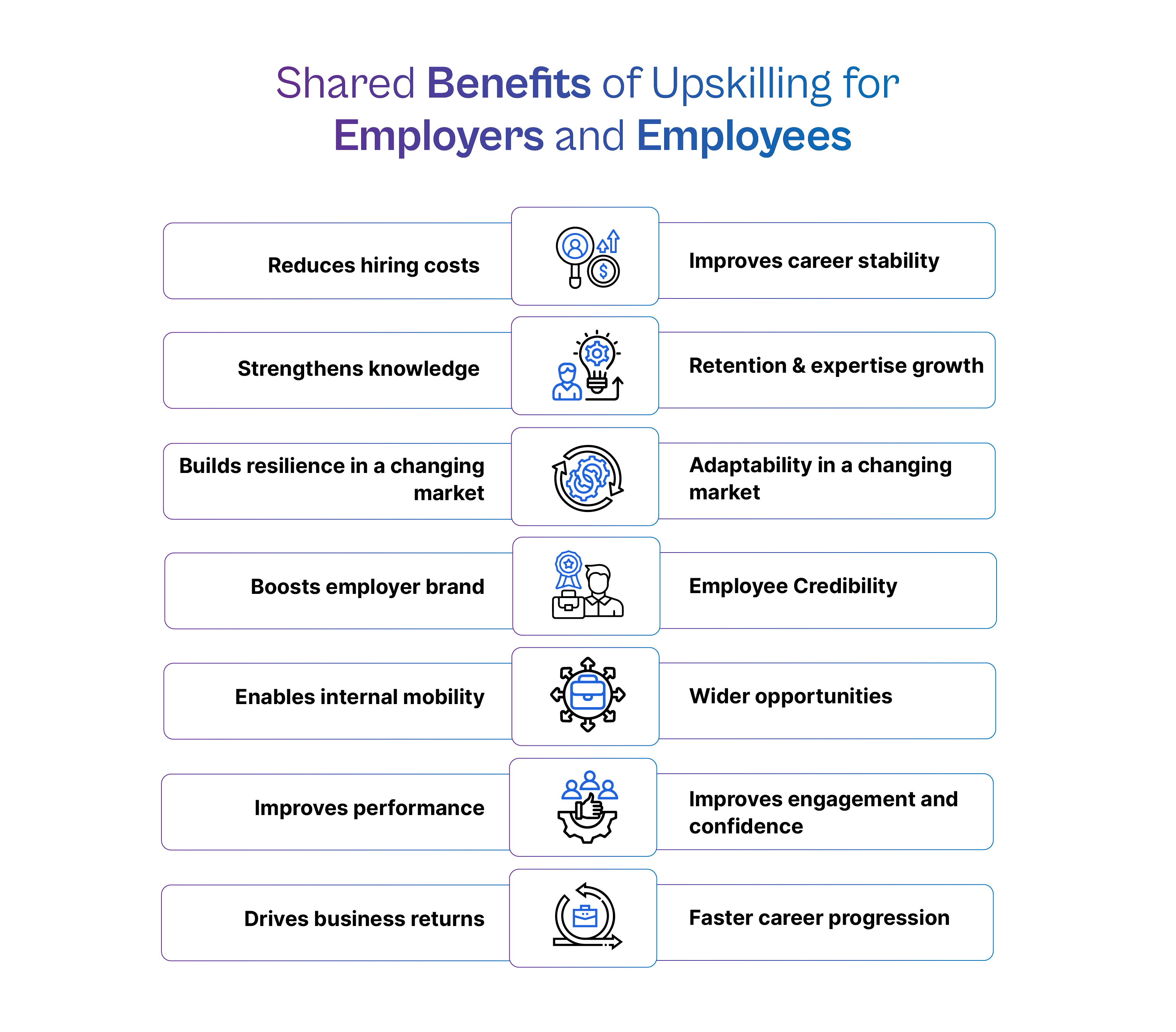
- Cost efficiency and career stability
For employers, upskilling reduces long-term hiring and onboarding costs by building internal talent pipelines. For employees, it creates job security by enabling growth without repeated role or company changes. - Organizational resilience and professional adaptability
Upskilled teams respond faster to market shifts and technological change. Employees develop the adaptability needed to succeed as roles and tools continue to evolve. - Knowledge retention and professional depth
Organizations preserve institutional knowledge while enhancing technical capability. Employees deepen their expertise within familiar environments rather than starting over elsewhere. - Stronger employer brand and personal credibility
Companies known for learning attract motivated, high-quality talent. Employees associated with learning-driven organizations gain stronger professional identities and market credibility. - Internal mobility and expanded opportunity
Employers benefit from flexible workforce deployment across projects and functions. Employees gain access to broader roles, leadership tracks, and cross-domain experiences. - Engagement, confidence, and performance
Continuous learning strengthens trust and motivation within teams. Employees who understand emerging technologies participate more actively in innovation and decision-making. - Financial returns and career progression
Organizations see improved performance from skilled contributors. Employees with in-demand capabilities often receive better compensation and faster advancement.
Research from McKinsey & Company shows that employees who engage in continuous learning demonstrate greater adaptability and long-term employability, while organizations benefit from a more resilient, future-ready workforce (McKinsey & Company, 2022).
Common Challenges in Implementing Upskilling Programs
Despite its benefits, upskilling presents challenges that organizations must address deliberately.
- Time Constraints: Employees often struggle to balance learning with daily responsibilities. Organizations must allocate protected learning time rather than treating upskilling as an afterthought.
- Measuring ROI: Learning outcomes can feel intangible. Organizations need metrics that connect skill development to performance, productivity, and business outcomes.
- One-Size-Fits-All Approaches: Different roles require different skills. Generic programs dilute impact and reduce relevance.
- Resistance to Change: Some employees fear that learning exposes skill gaps. Psychological safety and supportive environments encourage participation.
The Role of Employers in Closing the Gap
Employers ultimately set the tone for whether upskilling succeeds or stalls. When learning is treated as a long-term investment, it changes how organizations allocate budgets, involve leaders, and sustain programs over time. Upskilling stops being a side initiative and becomes part of how the business grows.
This shift also requires integrating learning into workforce planning. Upskilling should support succession pipelines, innovation roadmaps, and long-term strategy, rather than existing in isolation. When development aligns with where the organization is headed, learning feels purposeful instead of optional.
Partnerships further strengthen this effort. Collaborating with learning providers, technology platforms, and industry bodies keeps programs relevant and scalable. Organizations that build ecosystems around learning move faster, adapt better, and avoid reinventing capability from scratch.
The Role of Employees in Upskilling Journey
Employees are not passive participants in upskilling. Ownership matters.
Professionals must take responsibility for their learning paths. Curiosity, adaptability, and willingness to experiment define success more than prior expertise.
Employees should actively seek feedback, apply new skills on the job, and share knowledge with peers. Learning becomes more powerful when it turns into a collective capability.
Harvard Business Review emphasizes that individuals who treat learning as a continuous process rather than a periodic requirement adapt more effectively to workplace change (Harvard Business Review, 2023).
Preparing for 2026: Skills That Will Matter Most
As organizations look ahead, upskilling strategies must anticipate future demand rather than react to current gaps. By 2026, several trends will shape the enterprise workforce across the US.
- AI and Human Collaboration: AI will augment rather than replace most roles. Professionals who understand how to work alongside AI systems will deliver greater value than those who focus only on automation.
- Cloud and Platform Engineering Maturity: Basic cloud skills will no longer differentiate professionals. Advanced capabilities in platform reliability, security automation, and cost optimization will become increasingly important.
- Cybersecurity as a Core Skill: Security will integrate into every role. Developers, analysts, and architects will need foundational security awareness rather than relying solely on specialized teams.
- Data Literacy Across Roles: Data skills will extend beyond specialists. Business users, managers, and technical teams will need the ability to interpret and act on data insights.
- Learning Agility as a Meta-Skill: The most valuable skill will be the ability to learn quickly. Organizations will prioritize adaptability over narrow expertise.
Upskilling programs that embed these trends prepare both employers and employees for sustained relevance.
Building a Sustainable Upskilling Ecosystem
Sustainable upskilling requires long-term commitment.
Organizations should embed learning into daily workflows, performance management, and leadership development. Learning must feel natural, not disruptive.
Employees should view learning as part of their professional identity rather than a response to a crisis. This mindset shift creates resilience at scale.
The enterprise skills gap will not disappear overnight. However, organizations that invest in structured, strategic upskilling will narrow it faster than those that rely solely on hiring.
Conclusion
The enterprise technology landscape continues to evolve at a pace that challenges traditional workforce models. The skills gap reflects not a lack of people but a misalignment between skills and opportunity. Upskilling programs offer a practical, scalable way to address this challenge, benefiting both organizations and professionals.
For employers, upskilling strengthens resilience, reduces costs, and builds future-ready capabilities. For employees, it provides relevance, confidence, and long-term career growth. When organizations align learning with business strategy, and employees take ownership of development, upskilling becomes a competitive advantage rather than a compliance exercise.
As 2026 approaches, the organizations that succeed will not be those with the largest hiring budgets but those with the strongest learning cultures. Bridging the enterprise skills gap begins with a shared commitment to continuous growth, thoughtful investment, and the belief that people remain the most valuable technology asset.
Future-Proof Your Career with the Right Skills
Technology is evolving faster than traditional career paths. Continuous learning is the key to staying relevant in a cloud-driven, AI-enabled world. Through industry-focused programs, Cogent University equips professionals with the practical skills needed to grow in modern technology roles.
Explore Now!



.png)