

Introduction
For more than two decades, a tech degree, especially in computer science or engineering, was considered the safest path into a stable, high-growth career. Parents encouraged it. Colleges marketed it. Employers filtered for it. The equation felt simple: get the degree, get the job.
That equation no longer feels so clear.
Students today are asking uncomfortable but valid questions. Is a four-year tech degree still worth the time and cost? Can skills learned through bootcamps or self-study compete with formal credentials? Why do some graduates struggle to get jobs while others without traditional degrees seem to succeed?
The anxiety is understandable. Technology moves faster than education systems. Hiring patterns are shifting. And headlines about skills-first hiring often sound like a verdict against degrees altogether.
But that conclusion would be misleading.
The real question in 2026 is not “degree or no degree?”
It is “how do you prove you can do the work?”
Why this debate exists at all
If tech degrees were clearly failing, the conversation would be simple. But they are not. In fact, many of the world’s most capable engineers still come from traditional degree programs.
So why are students, parents, and career switchers questioning their value now?
The answer lies in a shift in how hiring decisions are made, not in whether degrees have suddenly become useless.
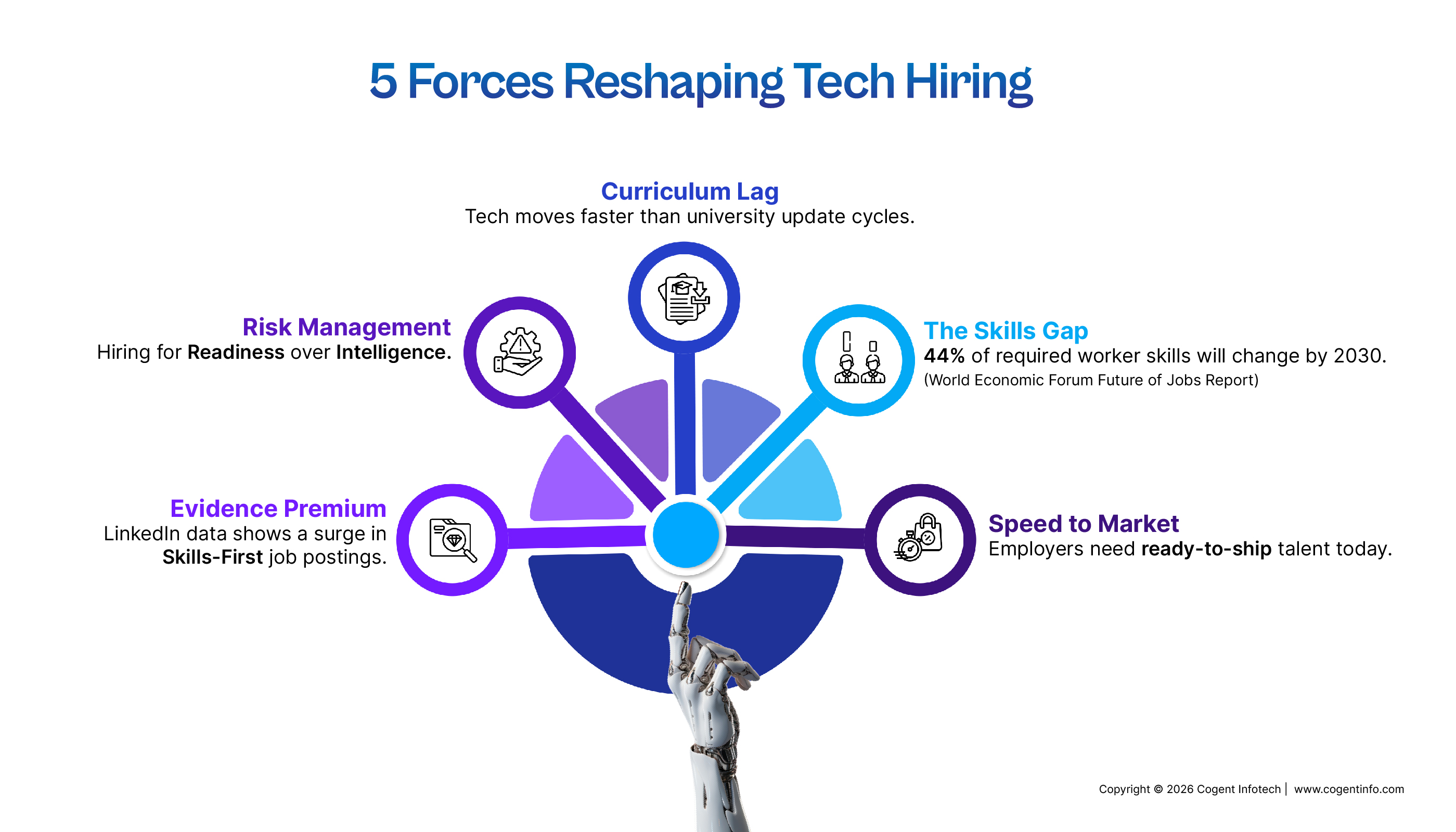
According to the World Economic Forum Future of Jobs Report, nearly 44% of skills required for workers will change within a five-year period, with technology-driven roles among the fastest evolving. Education systems, by design, move more slowly than industry.
This gap creates friction. Degrees teach foundations that remain relevant over decades. Employers, meanwhile, are under pressure to ship products, secure systems, and adapt quickly to new tools.
When graduates struggle to meet immediate job expectations, the degree itself comes under scrutiny, even if the problem lies elsewhere.
Hiring has shifted toward skills demonstration
One of the most important changes in tech hiring over the past few years is the move away from credential-first screening toward skills demonstration.
This does not mean degrees are ignored. It means they are no longer sufficient on their own.
Hiring managers increasingly ask questions such as:
- Can this person build and ship something functional?
- Can they debug when things go wrong?
- Can they work inside real systems with real constraints?
- Can they explain what they did and why?
These questions are difficult to answer using transcripts alone.
Data from LinkedIn shows a steady rise in job postings that emphasise skills, portfolios, and hands-on experience over rigid educational requirements, particularly for entry- and mid-level tech roles. This trend is most visible in software development, cloud operations, cybersecurity, and automation-related positions.
What this signals is not the end of degrees, but the end of degrees as proxies for job readiness.
What a tech degree still gives you - clearly and undeniably
Despite the noise, it is important to say this plainly: a tech degree still has real, lasting value.
The value just looks different than it did before.
Strong fundamentals that compound over time
A well-designed computer science or engineering degree builds conceptual foundations that are difficult to acquire through fragmented learning alone. Topics such as algorithms, data structures, operating systems, networking, databases, and systems thinking form the backbone of long-term technical growth.
These concepts age slowly. While tools and frameworks change, foundational ideas remain relevant. Many senior engineers credit their degree-level understanding for their ability to adapt repeatedly over long careers.
This is one reason degrees continue to matter for roles involving complex systems, research, infrastructure, or long-term product development.
Structured learning and discipline
Degrees impose structure. Deadlines, assessments, peer competition, and progressive difficulty force students to develop discipline and problem-solving stamina.
This matters more than it sounds.
One of the biggest challenges with self-learning paths is not access to information, but consistency. Many learners start strong and stall midway. Degree programs, for all their flaws, provide an environment where learning is sustained over time.
Access to networks, internships, and placements
In many regions, colleges remain a primary gateway to internships, industry exposure, and early-career hiring pipelines. Campus placements, alumni networks, faculty referrals, and industry partnerships still play a meaningful role in how opportunities are distributed.
This advantage is uneven, it varies by institution quality and geography, but where it exists, it is significant.
Parents are often right to value this signalling function. A degree does not just certify learning; it signals persistence, baseline competence, and the ability to operate within formal systems.
Eligibility for certain employers and roles
Some employers, especially in regulated industries, government projects, research labs, and legacy enterprises, continue to require formal degrees as a baseline filter.
This is not always about skill superiority. Often it is about risk management, compliance, or long-standing hiring policies.
For students aiming at such roles, a degree still reduces friction.
Where degrees fall short - and why the question keeps coming up
If degrees were sufficient on their own, the debate would not exist. The fact that it does tells us where degrees struggle to keep pace.
Curriculum lag is real
University curricula are not designed to update every year. Industry tools, however, evolve rapidly. This creates a gap between what is taught and what is used on the job.
Graduates often understand concepts but lack familiarity with modern development workflows, cloud environments, security practices, or deployment pipelines. Employers then spend months bridging this gap, or choose candidates who have already done so independently.
This mismatch is not a failure of education. It is a structural reality.
Limited hands-on portfolio work
Many degree programs emphasise exams and theoretical assignments over end-to-end project ownership. Students graduate having solved problems, but not necessarily having built systems that run in real environments.
As a result, they struggle to show evidence of their capabilities in interviews.
Employers are not questioning intelligence. They are questioning readiness.
Graduation does not equal job-readiness
Perhaps the most uncomfortable truth is that a degree alone no longer guarantees employability.
This does not mean degrees are useless. It means the hiring bar has moved.
Companies expect graduates to arrive with some exposure to real-world constraints: messy requirements, imperfect tools, security concerns, and trade-offs between speed and quality.
When these expectations are unmet, frustration emerges on both sides, and degrees take the blame.
What employers actually use to decide in 2026
To understand how degrees and skills interact today, it helps to look at how hiring decisions are actually made.
Across industries, employers consistently evaluate four dimensions.
First, can you build and debug?
This includes writing functional code, understanding systems, and diagnosing issues when things break.
Second, can you work with others?
Modern tech work is collaborative. Communication, documentation, and the ability to receive feedback matter as much as individual output.
Third, do you understand basic best practices?
Security awareness, version control discipline, and responsible use of tools, especially AI, are increasingly expected even at junior levels.
Fourth, can you learn fast?
No employer expects new hires to know everything. They do expect them to learn quickly without constant supervision.
These criteria explain why portfolios, internships, and project work now carry so much weight. They provide observable proof across all four dimensions.
Research highlighted by Gartner consistently shows that adaptability and learning agility are among the most critical capabilities for technology roles facing automation and AI-driven change. Degrees support these capabilities. They do not replace the need to demonstrate them.
Reframing the debate: skills versus credentials is the wrong framing
Framing this as “skills versus degrees” creates a false choice.
Degrees are not obsolete. Skills are not optional. The real issue is how the two are combined.
A degree without applied skills struggles in today’s market. Skills without foundational understanding often hit ceilings later. The strongest outcomes come from blending both.
This is why employers increasingly talk about skills-first hiring, not degree-free hiring.
They are signalling a preference for evidence, not rejecting education.
Where this leaves students and parents
For students deciding on a college path, and for parents helping them weigh long-term outcomes, the takeaway from above is simple but important.
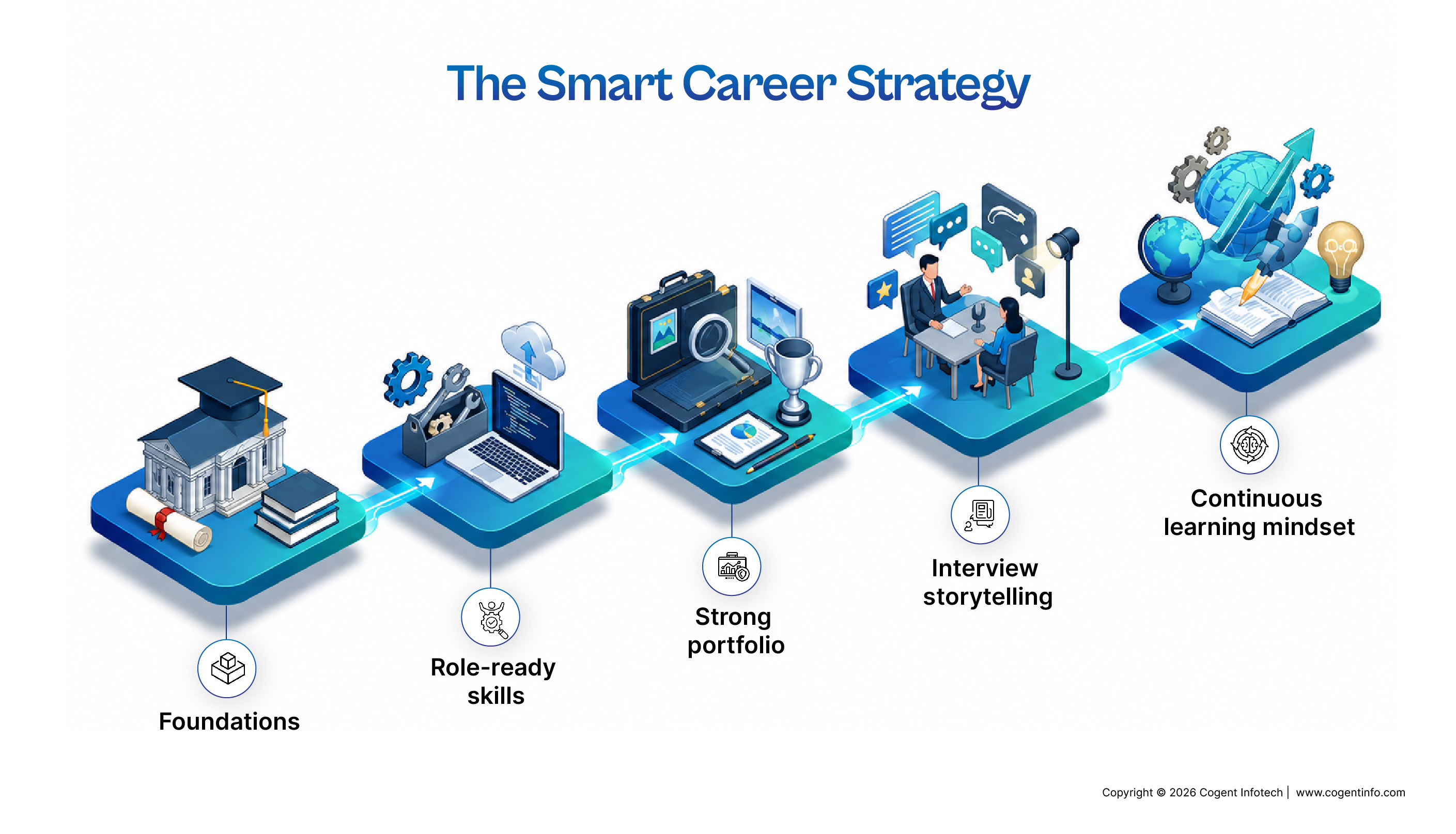
A tech degree is still worth it when it is treated as a foundation, not a finish line.
It provides structure, credibility, and conceptual depth. But it must be supplemented with hands-on work, portfolio building, and interview readiness to translate into opportunity.
Is a Tech Degree Still Worth It in 2026?
Earlier, we established a critical point: the debate is not really about degrees versus skills. It is about how employers decide whom to trust with real work.
Forward moves from diagnosis to decision-making. If you are a student choosing an education path, a parent trying to guide responsibly, or a professional considering a pivot, the goal is not to pick the “perfect” option. The goal is to choose a path that fits your timeline, resources, learning style, and target role, and then strengthen it intelligently.
Degrees, bootcamps, self-learning, certifications: a fair comparison
Each pathway into tech solves a different problem. Confusion arises when one path is treated as a universal replacement for the others.
Degrees: depth, credibility, and long-term flexibility
A formal tech degree remains the strongest option for building deep conceptual understanding. It offers long-term flexibility, especially for careers that may evolve toward architecture, research, leadership, or complex system design.
From a hiring perspective, degrees still act as a credibility signal, particularly for early screening. Large organisations, global enterprises, regulated sectors, and government-linked roles often retain degree requirements, not necessarily because they doubt alternative paths, but because degrees simplify risk management.
Data from the Organisation for Economic Co-operation and Development consistently shows that, on average, degree holders still enjoy higher lifetime employability and mobility. However, the same data also highlights growing variation within degree holders, outcomes depend heavily on applied skills and experience.
In short, degrees are strong foundations. They are not automatic job guarantees.
Bootcamps: speed, focus, and structure
Bootcamps exist because traditional education often moves too slowly for immediate market needs. Their value lies in compression, taking learners from zero or near-zero to role-ready within a defined timeframe.
Bootcamps work best for:
- Career switchers with prior work experience
- Graduates who already have theoretical foundations
- Learners who benefit from structure, deadlines, and mentorship
Their weakness is depth. Bootcamps prioritise tools and workflows over theory, which can limit long-term flexibility if learning stops at graduation.
According to hiring insights shared by LinkedIn, bootcamp graduates perform best when they supplement training with real projects or internships. Employers value the applied focus, but still look for signs of independent problem-solving.
Bootcamps are accelerators, not substitutes for learning fundamentals.
Self-learning: flexible, affordable, but demanding
Self-learning has never been more accessible. High-quality courses, documentation, and open-source projects are widely available. The barrier is not information, it is discipline and direction.
Self-learning suits:
- Highly motivated individuals
- Working professionals learning alongside jobs
- Learners comfortable building without constant guidance
Its biggest risk is inconsistency. Without structure, many learners stall, skip fundamentals, or chase trends without building coherence.
Employers are open to self-taught candidates, but scrutiny is higher. Proof-of-work matters more. Portfolios must be strong, well-documented, and defensible in interviews.
Self-learning works best when paired with mentorship, community, or structured milestones.
Certifications: useful signals, not outcomes
Certifications occupy a middle ground. They can validate foundational knowledge and signal seriousness, especially in areas like cloud, cybersecurity, and networking.
However, certifications are increasingly viewed as supporting evidence, not proof of readiness.
Research and hiring commentary from Gartner repeatedly notes that certifications are most effective when paired with hands-on experience. Without projects, they risk being treated as checkbox achievements.
Certifications answer the question “Have you studied this?”
Projects answer the question “Can you use it?”
Why the hybrid approach is becoming the default
Across hiring data and employer interviews, one pattern stands out: hybrid profiles outperform pure ones.
Hybrid does not mean doing everything at once. It means combining strengths.
For degree students, this means:
- Treating the degree as a foundation, not an endpoint
- Adding internships, live projects, and portfolio work
- Preparing intentionally for interviews, not assuming placements will carry everything
For non-degree candidates, it means:
- Building foundational understanding deliberately
- Creating strong, defensible portfolios
- Using certifications selectively to strengthen credibility
Hybrid profiles reduce risk for employers. They signal both learning ability and practical readiness.
This is why many hiring managers now say, informally, that they “hire skills but like degrees”, a nuance often lost in public debate.
What a strong portfolio looks like in 2026
Portfolios have become the most powerful equaliser in tech hiring. But not all portfolios are equal.
A credible portfolio typically includes two to three focused projects, not many scattered ones.
At least one project should demonstrate end-to-end ownership: planning, building, deployment, and iteration. This could be a simple web application, a cloud-hosted service, an automation workflow, or a security-focused system.
One project should include deployment and basic security considerations. This signals awareness beyond local development.
Documentation matters. Clear READMEs, architecture explanations, and decision rationales show communication and thinking depth.
Optional but powerful additions include demo videos, issue tracking, or post-project reflections.
Hiring managers often say the same thing: they are less interested in how complex a project is, and more interested in whether the candidate understands what they built.
Addressing common fears directly
Many parents worry that non-degree paths are risky. Many students worry degrees will become obsolete.
Both fears are understandable, and overstated.
Degrees are unlikely to disappear because they solve problems beyond skills training: signalling, discipline, and social trust. At the same time, degrees alone are unlikely to regain their old guarantee because work itself has changed.
Career switchers often fear being “too late.” In tech, adaptability matters more than age. Many organisations value professionals who bring domain knowledge and maturity alongside technical skills.
The most dangerous mistake is not choosing the “wrong” path. It is choosing a path and then assuming the work is done.
What hiring trends suggest for the next decade
Looking ahead, hiring trends point toward skills-first, not credentials-free models.
The World Economic Forum highlights adaptability, analytical thinking, and technological literacy as among the fastest-growing skills across industries. These capabilities are cultivated through both education and experience.
Similarly, Gartner projects that roles will increasingly evolve faster than job descriptions, reinforcing the need for continuous learning regardless of entry path.
This reinforces a central idea: credentials open doors; skills keep you inside.
A practical takeaway for students and parents
If you are choosing a tech degree in 2026, choose it with eyes open. Expect to supplement it. Demand internships, projects, and exposure. Treat the degree as a launchpad, not a landing zone.
If you are choosing an alternative path, take fundamentals seriously. Build proof-of-work. Learn to explain your decisions. Do not skip the hard thinking just because tools feel accessible.
If you already have a degree, do not assume it will speak for you. Let your work do that.
And if you do not have one, do not assume doors are closed. Many are open, but they require stronger signals.
Closing thought: Credentials open doors. Skills decide how far you go.
By 2026, the conversation around tech careers will feel very different from the one most parents grew up with. The old certainty, that a single credential guarantees stability, has faded. But that does not mean the system has become chaotic or unfair. It has simply become more evidence-driven.
A tech degree is no longer a finish line. It is a foundation. In many cases, it remains a strong one, offering structure, conceptual depth, and access to networks that are difficult to replicate elsewhere. For students who can invest the time and resources, degrees continue to make sense, especially when paired with internships, applied projects, and intentional career preparation.
At the same time, the industry has become more honest about one uncomfortable truth: graduation alone does not equal job readiness. Employers are operating in fast-moving environments, where tools evolve quickly, systems are interconnected, and mistakes carry real consequences. As a result, they look for proof, proof that a candidate can build, debug, communicate, and learn.
This is why skills-first hiring has gained momentum. Not because degrees have lost value, but because skills are observable, while credentials are only predictive. A portfolio shows how someone thinks. A project shows how someone handles ambiguity. An interview story reveals judgment, not just knowledge.
For parents, this shift can feel unsettling. It challenges familiar benchmarks. But it also opens new possibilities. A student who struggles in traditional academic settings is not automatically excluded from a tech career. A career switcher is not automatically “too late.” What matters is whether learning continues and whether capability is demonstrated.
For students, the message is both demanding and empowering. There is no shortcut anymore, but there is also no single gatekeeper. Whether you choose a degree, a bootcamp, or a self-directed path, responsibility has shifted toward the individual. You must show what you can do, explain how you learned it, and demonstrate that you can grow beyond it.
The strongest outcomes increasingly come from hybrid paths. Degree holders who build real projects alongside coursework. Bootcamp graduates who deepen fundamentals instead of stopping at placement. Self-taught learners who take structure seriously and document their progress. These reminds employers that learning is not a phase, it is a habit.
It is also worth remembering that tech careers are long. Early decisions matter, but they are rarely irreversible. Many successful professionals took indirect routes, paused, pivoted, or rebuilt. What distinguished them was not perfection at the start, but consistency over time.
Still thinking about what makes a tech career sustainable today?
Explore how Cogent University helps learners turn education into real-world readiness, without shortcuts, hype, or false promises.
Start Now!


.png)
