
.jpeg)
Introduction
By the end of 2025, artificial intelligence had become part of everyday academic and professional life. Students used AI to summarize lectures, plan projects, generate drafts, and test ideas. Recruiters screened applications with algorithms. Teams across marketing, consulting, operations, and HR embedded generative tools into daily workflows. AI stopped feeling like an experiment and started behaving like infrastructure.
This shift changed what “being good at AI” means. Technical knowledge still holds value, especially for engineering roles. Yet most graduates entering the workforce do not train models or build systems from scratch. They guide tools, interpret outputs, design workflows, and decide when human judgment must lead. Employers now look for graduates who can think with AI, shape its use, and translate its capabilities into outcomes.
Market signals reflect this change. The World Economic Forum identifies analytical thinking, technological literacy, and creative problem-solving as core future skills (World Economic Forum, 2024). LinkedIn’s global skills analysis shows a sharp rise in demand for AI literacy across non-technical roles (LinkedIn, 2024). Organizations want people who understand how intelligence flows through work.
This blog explores the non-coding AI skills students must master in 2026. It traces what changed in 2025, outlines the trends shaping the year ahead, and breaks down the capabilities that will differentiate adaptable graduates. The sections that follow examine prompt literacy, analytical reasoning, problem framing, workflow design, ethical thinking, product acumen, and creative synthesis, with practical guidance for building each skill.
What 2026 Changed About AI Readiness
AI adoption accelerated faster than education systems could respond. Teams integrated copilots into research, planning, writing, and analysis. Knowledge work began to resemble collaboration between humans and systems.
Three shifts defined the year.
AI moved from tool to teammate. Students and professionals began delegating cognitive tasks such as research, drafting, and planning. At the same time, business adoption outpaced formal training. McKinsey’s workplace research shows that most organizations deploy generative AI in at least one function, while far fewer employees receive structured guidance (McKinsey & Company, 2024). Many interns in 2025 learned through observation rather than instruction.
Risk awareness matured. Public errors, hallucinations, and biased outcomes highlighted the need for governance and evaluation. Ethics became operational.
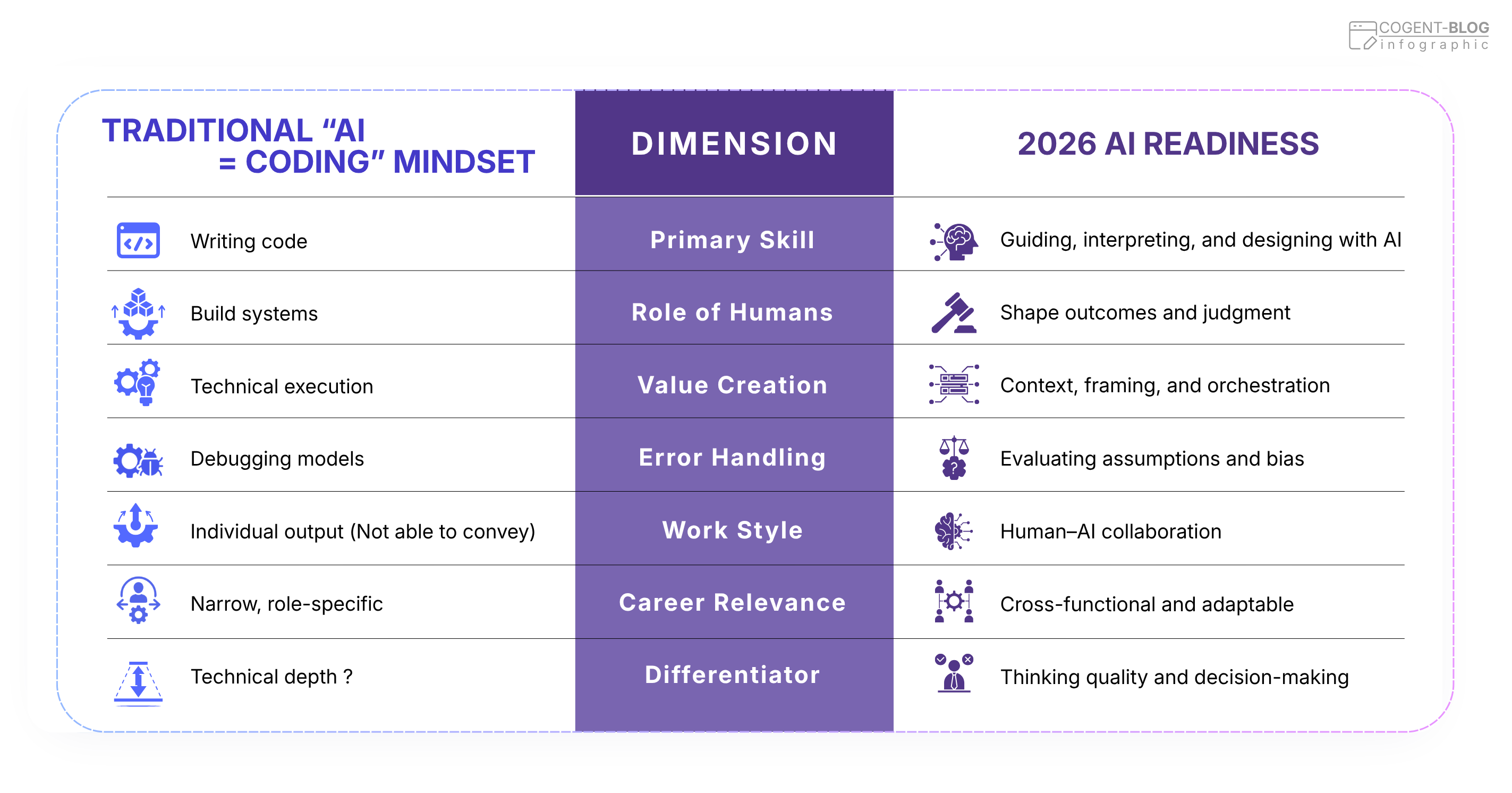
These changes revealed a core truth. Success with AI depends on how people think, not only on how systems work. The most valuable contributors understand context, ask better questions, interpret results, and design human–machine systems.
The Skill Stack for 2026
AI readiness in 2026 will resemble a layered capability stack. Coding forms one layer for certain roles. Most students will operate above it.
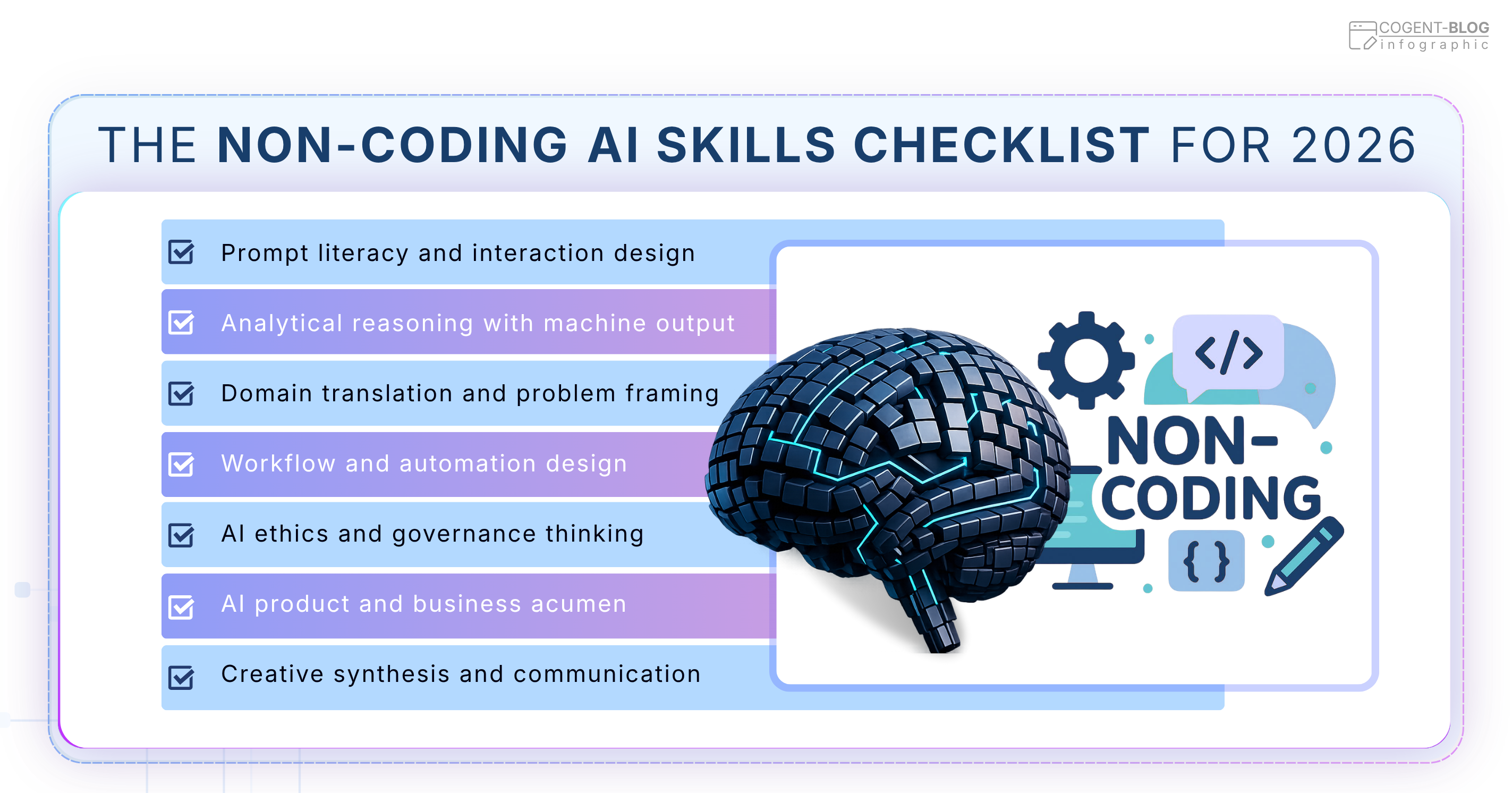
Seven domains define this stack:
- Prompt literacy and interaction design
- Analytical reasoning with machine output
- Domain translation and problem framing
- Workflow and automation design
- AI ethics and governance thinking
- AI product and business acumen
- Creative synthesis and communication
Each domain reflects how work unfolds in AI-enabled environments.
1. Prompt Literacy and Interaction Design
Prompting as a Professional Skill
In 2026, the quality of work produced with AI will depend on how well humans guide it. Prompts will function as professional briefs that shape scope, tone, accuracy, and risk. Students who can structure intent, provide context, and iterate thoughtfully will influence outcomes across marketing, research, operations, and strategy. Prompting becomes a visible marker of thinking quality and professional maturity.
The Anatomy of a High-Impact Prompt
High-impact prompts share a structure that mirrors professional briefs. They convert ambiguity into direction. They also reduce reviewers' cognitive load by producing outputs that align with expectations.
A well-formed prompt typically contains:
- A clear objective that states the decision or deliverable the output will support. This prevents the model from drifting into generic commentary.
- Relevant context about audience, domain, and constraints, which anchors language and depth in real conditions.
- Role framing that positions the model as an analyst, marketer, researcher, or planner, shaping tone and perspective.
- An output format, such as a table, memo, outline, or slide-ready structure, that saves downstream effort.
- Quality thresholds that define rigor, tone, and level of detail align output with professional standards.
- Verification cues that ask the model to surface assumptions, risks, or limitations, creating space for human judgment.
This structure trains students to think before they ask.
Prompting Across Roles
Different domains require different prompting strategies because each field carries its own standards and risks.
Marketing
- Prompts must specify brand voice, target audience, and channel so outputs align with positioning rather than sounding generic.
- Requests for multiple variants enable rapid testing and a broader range, mirroring how teams iterate on campaigns.
- Clear constraints on claims and tone protect brand trust and regulatory compliance.
Research
- Prompts should define acceptable sources and time frames to reduce the risk of outdated or irrelevant material.
- Asking for uncertainty notes encourages transparency around gaps and assumptions.
- Separating exploratory prompts from synthesis prompts preserves nuance before conclusions form.
Operations
- Step-by-step framing turns abstract processes into executable flows.
- Requests for edge cases surface failure points early.
- Risk flags prepare teams for exceptions that automation often misses.
Students who adapt prompts to context demonstrate situational awareness.
Practice Framework
Students can build prompt literacy through deliberate routines:
- Rewrite every task as a brief before engaging AI, clarifying goal, audience, and constraints.
- Maintain a prompt log that records what improves quality across different tasks.
- Compare structured prompts with casual ones to observe shifts in depth and relevance.
- Design multi-step conversations that move from exploration to refinement to verification.
This practice makes thinking visible and prepares students for AI-centered workplaces.
2. Analytical Reasoning With Machine Output
Why Machine Output Requires Human Judgment
As AI delivers fluent and confident responses, the real skill lies in interpreting them. Students must learn to question assumptions, validate claims, and trace logic before acting. Analytical reasoning transforms outputs into insight, protecting teams from subtle errors and bias. In AI-enabled workplaces, judgment becomes the safety layer.
How Professionals Evaluate AI Responses
Experienced teams treat AI output as a draft for thinking rather than a finished artifact. They apply review habits similar to those used with junior analysts.
Effective evaluation includes:
- Assumption checking, where readers identify what the model presumes about market conditions, user behavior, or constraints.
- Logic tracing, which examines whether conclusions follow from evidence or rely on vague generalizations.
- Source awareness, ensuring that claims align with verifiable knowledge and the current context.
- Boundary testing, where edge cases and exceptions are considered.
- Bias recognition is especially important in people-related domains such as hiring, education, or health.
These steps convert output into a starting point for reasoning.
The Cost of Uncritical Acceptance
Errors rarely announce themselves. They hide inside plausible phrasing. In enterprise settings, small inaccuracies compound.
A flawed market summary can misdirect a product roadmap. A biased candidate profile can distort hiring decisions. An incomplete policy outline can expose organizations to compliance risk. These failures often trace back to moments when no one paused to ask whether the output deserved trust.
Graduates who develop review discipline protect teams from invisible drift. Their value lies in vigilance.
Practice Framework
Students can strengthen analytical reasoning by building structured review habits:
- After every AI-generated answer, write a brief critique that identifies assumptions and open questions.
- Compare outputs across multiple prompts to observe variance and stability.
- Validate key claims against external sources before reuse.
- Practice rewriting conclusions in your own words to test understanding.
These routines train students to remain intellectually active after the answer appears.
3. Domain Translation and Problem Framing
From Ambiguity to Structure
Most workplace challenges arrive ambiguously. Students who can translate messy realities into structured problems enable AI to deliver value. This skill bridges domain knowledge and system capability, defining what needs to be solved, how success looks, and where automation fits. Clear framing turns uncertainty into direction.
The Role of the AI Translator
Organizations increasingly rely on individuals who bridge domain knowledge and technical capability. These “AI translators” understand enough about both sides to align them.
They:
- Interpret business goals into operational questions that systems can address.
- Recognize where automation supports judgment and where human decision-making must remain central.
- Define boundaries that prevent overreach into sensitive or unsuitable areas.
This role shapes outcomes. A well-framed problem invites useful solutions.
Framing Problems for Machines
Effective framing clarifies the decision at stake, identifies constraints such as time, cost, and ethics, segments work into stages, and defines success in observable terms. This process converts abstract ambition into executable design.
Practice Framework
Students can develop framing ability by:
- Writing problem statements before starting any project.
- Mapping workflows visually to expose bottlenecks.
- Reframing everyday frustrations as solvable systems.
- Explaining a problem to peers until its structure becomes clear.
These habits prepare students to guide intelligent systems rather than react to them.
4. Workflow and Automation Design
Designing Human–AI Workflows
Productivity in 2026 will depend on how well people orchestrate tasks between humans and machines. Students who see work as a flow, intake, processing, review, decision, design systems that amplify impact. Workflow thinking shifts AI from a shortcut into an operational engine.
Where Automation Delivers the Most Impact
Automation generates leverage by removing friction from repetitive or high-volume work while preserving human judgment when the stakes rise.
High-impact zones include:
- Information aggregation is the process by which systems collect and summarize large volumes of material that would otherwise consume hours of human attention. This allows teams to begin work with structured inputs rather than raw noise.
- Draft generation, which accelerates the creation of initial versions of reports, emails, plans, and documentation. Teams shift effort from blank-page creation to refinement and strategy.
- Monitoring and alerts that enable continuous scanning for anomalies, trends, or risks that humans cannot track at scale.
- Standardized reporting, where consistency and timeliness matter more than originality, such as weekly metrics or compliance summaries.
Each zone benefits from human checkpoints that validate relevance, accuracy, and tone. Automation amplifies capacity when it respects decision boundaries.
Practice Framework
To build this skill, students should:
- Map their study or project process step by step, from idea to submission.
- Identify tasks that consume time without adding insight.
- Assign AI a role within each stage based on risk and value.
- Define checkpoints where human judgment must intervene.
Designing workflows builds systems thinking. It prepares graduates to improve operations, not just complete tasks.
5. AI Ethics and Governance Thinking
Ethics as a Daily Design Decision
Every AI interaction carries consequences. Students must recognize how data choices, task automation, and scale affect people. Ethical thinking becomes operational, guiding everyday decisions about fairness, privacy, and accountability. Graduates who embed responsibility into design build trust.
Where Risk Enters AI Systems
Risk rarely begins at deployment. It enters quietly at earlier stages.
Common points of exposure include:
- Data selection, where incomplete or skewed inputs embed bias into outcomes that appear neutral.
- Task choice, when teams automate decisions that affect dignity, access, or opportunity without safeguards.
- Opacity, where users cannot understand how conclusions form, making accountability difficult.
- Scale, which amplifies small errors into systemic harm across thousands of interactions.
These risks do not arise from malice. They arise from speed, assumption, and oversight. Students who recognize these patterns help teams pause before harm becomes routine.
Thinking in Terms of Accountability
Ethical maturity means tracing how outputs travel from model to decision, defining review points, and clarifying ownership of consequences. Graduates who think this way strengthen organizational resilience and build trust.
Practice Framework
Students can cultivate ethical thinking by:
- Writing short impact notes for projects that use AI.
- Asking how an output might affect different stakeholders.
- Practicing consent-aware data use in academic work.
- Discussing edge cases in group assignments.
These habits prepare students to navigate responsibility in environments where technology acts at scale.
6. AI Product and Business Acumen
Understanding AI as a Product Layer
AI will exist as a layer inside products and processes. Students who understand value, adoption, and trade-offs think like owners. They align intelligence with outcomes, shaping systems that fit human behavior and business goals. This mindset moves graduates toward leadership.
Why Adoption Determines Value
Organizations often deploy powerful tools that teams underuse. The gap between capability and impact emerges from poor alignment with human behavior.
Adoption falters when:
- Interfaces disrupt established workflows.
- Outputs lack transparency or explainability.
- Users cannot tell when to trust results.
- Systems demand more effort than they save.
Students who understand these dynamics design with people in mind. They recognize that success depends on how comfortably humans integrate intelligence into routines.
Thinking Like a Product Owner
Product thinking involves continuous alignment between need, behavior, and outcome.
Students can adopt this mindset by:
- Defining the user and their primary decision.
- Identifying what success looks like for that user.
- Considering where AI assists rather than overwhelms.
- Designing feedback loops that improve performance over time.
A graduate in HR may frame AI as a screening assistant that surfaces patterns rather than replaces judgment. A marketing student may treat a content generator as a collaborator that accelerates iteration. A policy student may design systems that support analysis while preserving accountability.
Practice Framework
Students can build product acumen by:
- Evaluating AI tools in terms of user value rather than novelty.
- Redesigning existing workflows as if they owned the experience.
- Documenting how outputs influence decisions.
- Gathering feedback from peers on usability and clarity.
This approach trains students to align intelligence with impact.
7. Creative Synthesis and Communication
From Output to Insight
AI generates volume. Humans create meaning. Students who connect ideas, prioritize insight, and communicate clearly transform information into action. In environments rich with machine output, synthesis and storytelling become leverage. These skills turn contributors into leaders.
Storytelling in an AI Workplace
Work increasingly revolves around decisions made from machine-supported insight. These decisions still require persuasion, alignment, and clarity.
Effective communicators:
- Frame data within a narrative that explains why it matters.
- Translate complexity into language suited to each audience.
- Present trade-offs rather than absolute answers.
- Clarify uncertainty without eroding confidence.
Students who develop these habits guide conversations. They help teams move from information to action.
Communication as Leverage
In AI-enabled environments, attention becomes scarce. Meetings fill with dashboards, summaries, and recommendations. The individuals who create clarity earn influence.
Communication becomes leverage when it:
- Distills large volumes of content into direction.
- Explains reasoning behind choices.
- Surfaces risks without paralysis.
- Builds shared understanding across functions.
Graduates who communicate well amplify every tool they use.
Practice Framework
Students can strengthen synthesis and communication by:
- Writing short executive summaries for every major project.
- Explaining AI-supported work to non-technical peers.
- Practicing visual organization of complex ideas.
- Reflecting on how their framing shapes interpretation.
These habits prepare students to lead in environments rich with intelligence and noise.
8. Education, Hiring, and the Shape of Work in 2026
In AI-enabled environments, work no longer centers on individual output. It becomes orchestration. Professionals guide systems, collaborate with tools, and integrate machine output into collective outcomes. Education in 2026 must mirror this reality. Courses need to move beyond banning or loosely allowing AI. They must teach students how to design with it. The classroom becomes a rehearsal space for work.
Future-ready programs will embed AI into every stage of learning. They will:
- Design assignments that require human–AI collaboration rather than isolated output.
- Grade reasoning, structure, and judgment alongside final answers.
- Teach prompt design as a writing skill.
- Integrate ethical review into project rubrics.
- Simulate workplace workflows rather than abstract exercises.
A marketing course might ask students to build a campaign pipeline. A management class could require redesigning a process to automate it. A journalism program may evaluate how students verify machine-generated research. These approaches teach students to think in systems.
This shift matters because the gap between academia and enterprise widened in 2025. Tools changed faster than curricula. Graduates entered workplaces fluent in interfaces but uncertain about expectations. Industry-aligned training closes this gap by reflecting real tool stacks, using briefs rather than abstract prompts, incorporating feedback cycles, and emphasizing decision-making over output volume. Programs that mirror professional environments produce graduates who contribute immediately. They understand pace, accountability, and consequence.
Educational institutions can begin by redesigning assessments to include AI-supported workflows, training faculty in orchestration-based pedagogy, partnering with industry to align scenarios with reality, and teaching students to document their reasoning. In 2026, employability will depend on how well education prepares students to lead intelligent systems.
That same shift reshapes how organizations evaluate talent. By 2026, work and hiring will reflect a shared reality: professionals operate inside intelligent systems. AI will live inside documents, dashboards, inboxes, and decision tools. Interfaces will fade. What will remain visible is how people reason, decide, and take responsibility.
Interviews will mirror this environment. Employers will stop asking whether candidates “know AI” and start observing how they think with it. Candidates may receive:
- An ambiguous business brief that resembles how real projects begin.
- Access to an AI tool without step-by-step instructions, reflecting workplace autonomy.
- A flawed or incomplete output that demands judgment rather than obedience.
The objective will center on thinking. Interviewers will observe how applicants interpret the problem, structure their approach, guide the system, and decide when to intervene. Evaluators will look for whether candidates clarify objectives, ask context-building questions, structure prompts deliberately, identify assumptions, validate claims, recognize limitations, articulate trade-offs, and explain decisions clearly.
Students can prepare by treating every AI interaction as a rehearsal for work:
- Solve open-ended problems where no single answer exists.
- Document why one output serves the goal better than another.
- Practice verbal walkthroughs of reasoning.
- Review past AI-supported projects to identify decision points.
- Rewrite outputs in personal language to test understanding.
- Simulate interviews using ambiguous briefs and time constraints.
Graduates who narrate their thinking demonstrate maturity. They show awareness, structure, and responsibility.
This reflects the broader shape of work in 2026. Systems will generate options continuously. The differentiator will not be access to tools. It will be the ability to guide them. Work will revolve around framing, evaluating, synthesizing, and deciding. Productivity will depend on how well individuals orchestrate flows of intelligence across people and machines.
Professional capability in this environment includes:
- Defining purpose before acting.
- Questioning outputs without slowing momentum.
- Recognizing ethical boundaries.
- Designing workflows that respect human attention.
- Communicating insight across functions.
These qualities transcend roles. They apply to marketers, analysts, consultants, designers, managers, and educators. Graduates who cultivate them move quickly from contributors to leaders. They influence how systems behave.
Conclusion
The future of work does not belong only to those who build AI. It belongs to those who can think with it.
2025 revealed that access to tools does not guarantee readiness. 2026 will reward professionals who understand how intelligence moves through systems, decisions, and people.
Prompt literacy, analytical reasoning, problem framing, workflow design, ethical thinking, product acumen, and creative synthesis form a new foundation for professional relevance. These skills enable graduates to ask better questions, design more effective processes, and lead with clarity.
Education must evolve to reflect this reality. Learning must mirror work. Training must emphasize orchestration over output.
Students who adapt will enter the workforce prepared to guide intelligent systems with purpose and responsibility. They will not fear automation. They will direct it.
Ready to build the AI skills employers will actually hire for in 2026?
Join Cogent University and learn how to think, communicate, and lead with AI, without needing to code.
Explore Our Programs


.png)