Thank you! Your submission has been received!
Oops! Something went wrong while submitting the form.

.jpeg)
Every generation entering the workforce faces uncertainty. But for students and early-career professionals looking at tech careers today, the confusion feels sharper than usual. On the one hand, technology is everywhere. On the other hand, landing a tech job feels harder, slower, and more unpredictable than it did just a few years ago.
This contradiction leads to a dangerous conclusion: that tech careers are shrinking or becoming inaccessible. That conclusion is wrong.
The reality is more nuanced. Tech careers are not disappearing. They are being redefined. And unless you understand what is driving that redefinition, it is very easy to prepare for the wrong future.
Between 2026 and 2030, companies will continue to hire engineers, developers, security professionals, and cloud specialists. But they will not hire them based on the same expectations that shaped the last decade. Tools will matter less than judgment. Titles will matter less than capability. And learning how to adapt will matter more than mastering any single technology.
For a long time, tech hiring followed a predictable pattern. Learn a programming language, get comfortable with a framework, practice some interview questions, and you had a reasonable chance of entering the industry. That model worked when technology stacks evolved slowly and roles were clearly separated.
That world no longer exists.
Today, technology changes faster than hiring cycles. New tools emerge, peak, and fade within a few years. Companies have learned, often the hard way, that hiring purely for tool familiarity creates fragile teams. What they need instead are people who can operate within changing systems.
This shift is visible in hiring data. According to the World Economic Forum Future of Jobs Report, nearly 44% of core skills required across roles are expected to change by 2027, with technology-driven roles seeing the fastest transformation. This is not because people are under-skilled, but because the nature of work itself is changing.
In practical terms, employers are no longer asking only, “Do you know this technology?” They are asking, often implicitly, “Can you understand context, make decisions, and work across boundaries?”
This is why many candidates with certifications and coursework still struggle. Preparation focused solely on tools does not translate into confidence in real-world performance.
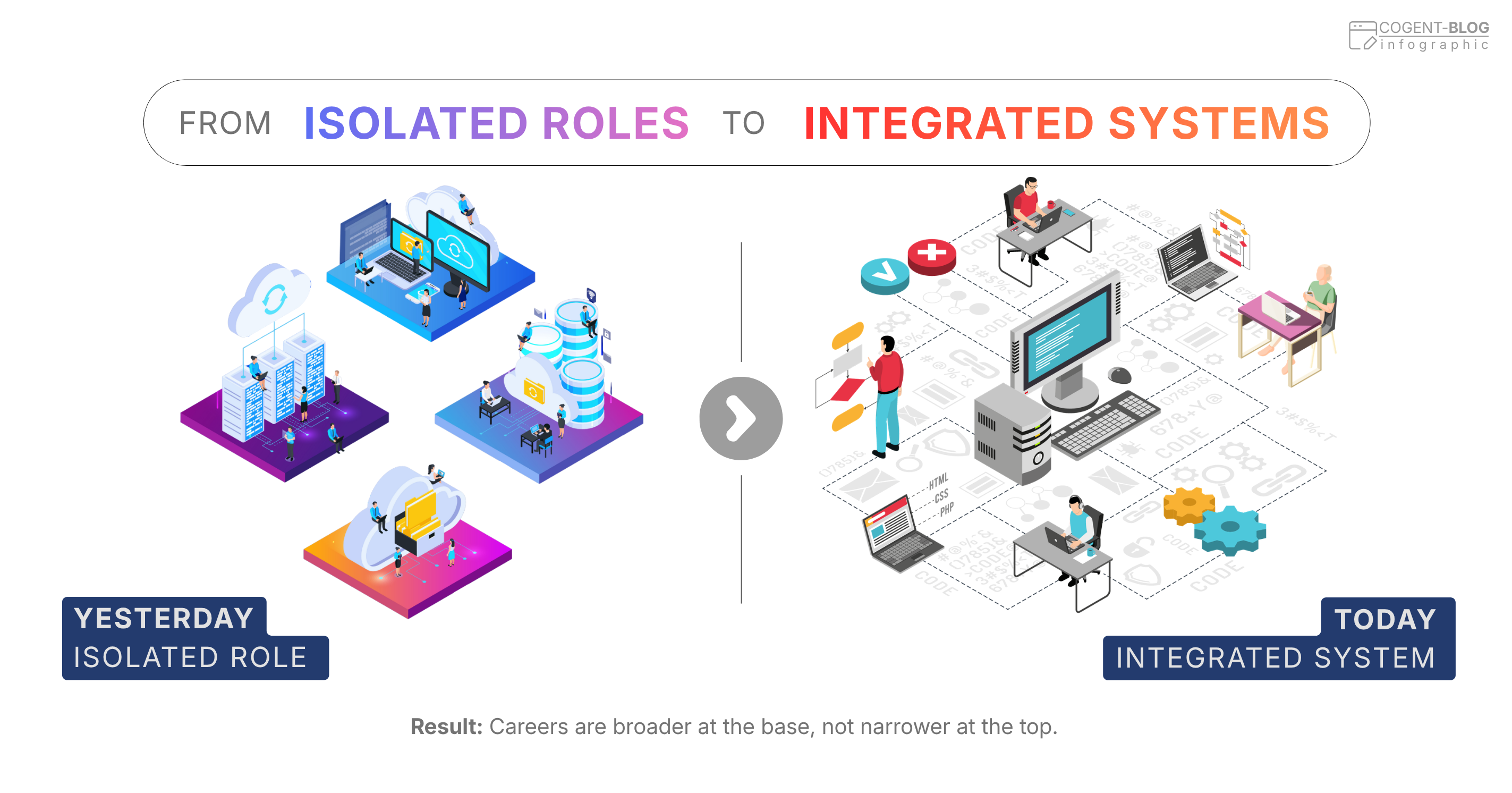
One of the most important but least discussed changes in tech careers is the disappearance of rigid role boundaries.
Earlier, responsibilities were neatly divided. Developers wrote code. Operations teams handled infrastructure. Security teams stepped in when something went wrong. Data teams worked separately on analytics and models.
Today, these divisions are collapsing.
Modern digital systems are complex, interconnected, and always running. Decisions made in one area affect performance, costs, security, and user experience in other areas. As a result, companies increasingly expect technologists to understand systems, not silos.
This does not mean everyone must become an expert in everything. It means every role now requires awareness of adjacent concerns. Developers need to think about deployment and security. Cloud engineers need to think about cost and reliability. Security professionals need to understand how software is actually built.
Careers are becoming broader at the base, not narrower at the top.
Artificial intelligence dominates conversations about the future of work, often framed in extremes. Either it will replace most jobs, or it will create unlimited opportunity. Neither view is accurate.
What AI is actually doing is removing routine effort while increasing the importance of human oversight.
Across industries, AI tools are now embedded into everyday workflows: code assistance, testing, customer support, analytics, content generation, and internal operations. Yet very few organizations are fully comfortable trusting AI outputs without human judgment.
This has created a new kind of demand, not for more AI researchers, but for professionals who can work alongside AI responsibly.
Importantly, most AI-related roles emerging today are not deeply mathematical or research-heavy. They involve integrating AI into products, designing workflows, monitoring outcomes, and managing risks. Titles like AI application developer, AI operations analyst, or AI governance specialist reflect this shift.
The Gartner has repeatedly noted that by the second half of this decade, a majority of AI failures will result not from model quality, but from poor integration, unclear governance, and misuse. That insight explains why companies increasingly value professionals who understand context, ethics, and system-level impact, not just algorithms.
For students, this is an important signal. You do not need to become a data scientist to work in AI-driven environments. You need to understand how AI fits into real business and technical workflows.
For much of the last decade, cloud adoption was driven by speed. Companies rushed to migrate systems, launch products faster, and scale without worrying too much about efficiency.
That phase is over.
Today, cloud costs are one of the biggest pain points for technology leaders. Poorly designed architectures, unused resources, and lack of visibility have led to massive inefficiencies. According to industry estimates frequently cited by Gartner, a significant share of enterprise cloud spending is wasted due to mismanagement rather than necessity.
This reality is reshaping cloud-related careers.
The future cloud professional is no longer judged by how quickly they can deploy infrastructure, but by how well they can run, optimize, and justify it. Skills related to monitoring, cost optimisation, reliability, and performance are becoming central, not optional.
This shift has given rise to roles such as cloud operations engineers and FinOps analysts, but it also affects traditional developer roles. Engineers are increasingly expected to understand how their design decisions impact long-term cost and stability.
For early-career professionals, this means that cloud knowledge must go beyond surface-level familiarity. Understanding why a system is designed a certain way matters as much as knowing how to deploy it.
Cybersecurity is often portrayed as a highly specialised domain, separate from mainstream engineering. In practice, this separation is disappearing.
Rising cyber incidents, stricter data protection laws, and growing public scrutiny have forced organisations to rethink security as a design principle rather than a response mechanism. Security is moving earlier in the development lifecycle, closer to everyday engineering decisions.
This does not mean every technologist must become a security expert. But it does mean security literacy is becoming a baseline expectation.
Developers are expected to understand secure authentication, access control, and basic vulnerability prevention. Cloud engineers must think about identity and data protection by default. Even non-technical roles increasingly interact with security and compliance requirements.
The persistent global cybersecurity talent gap, often estimated in the millions, exists not only because of a lack of experts, but because organisations need people who can bridge security and engineering. These hybrid roles are growing quietly and steadily.
For students, this is an opportunity. Security-related understanding adds durability to any tech career because it aligns with long-term regulatory and risk pressures that are unlikely to disappear.
Perhaps the most overlooked change in tech careers concerns entry-level work.
Tasks that once defined junior roles, manual testing, repetitive reporting, routine system checks, are increasingly automated. This has led to the perception that entry-level opportunities are shrinking. In reality, the nature of entry-level contribution is changing.
Instead of performing repetitive tasks, new professionals are expected to build, maintain, or improve the automation itself.
This shift favours those who can think logically about processes, identify inefficiencies, and translate them into scripts or workflows. These skills often sit at the intersection of development, operations, and business understanding.
Interestingly, many strong tech careers now begin in these automation-heavy roles because they offer visibility into how organisations function end-to-end. While these roles may not always carry glamorous titles, they build a foundational understanding that supports long-term growth.
Hiring platforms offer useful clues about where the market is heading. Analysis published by LinkedIn consistently shows growth in roles related to platform engineering, cloud operations, cybersecurity, and AI-adjacent functions rather than narrow tool-specific positions.
What stands out is not the disappearance of traditional roles, but their evolution. Job descriptions increasingly emphasise adaptability, cross-functional collaboration, and problem-solving over rigid checklists of technologies.
This reflects a broader truth: companies are hiring for capability trajectories, not static skill sets.
By now, one thing should be clear: the future of tech careers is not about predicting the perfect job title. It is about building career resilience.
Most students and early-career professionals worry about choosing the right skill. Employers worry about something else entirely, whether a candidate can grow, adapt, and contribute inside real systems.
This gap in expectations explains why hiring feels inconsistent. Many candidates prepare for interviews as if jobs are static. Companies hire as if roles are evolving.
Further, we focus on closing that gap. We’ll look at what employers are quietly prioritising, how to prepare using a skills-first approach, and how to build evidence that actually matters in hiring decisions.
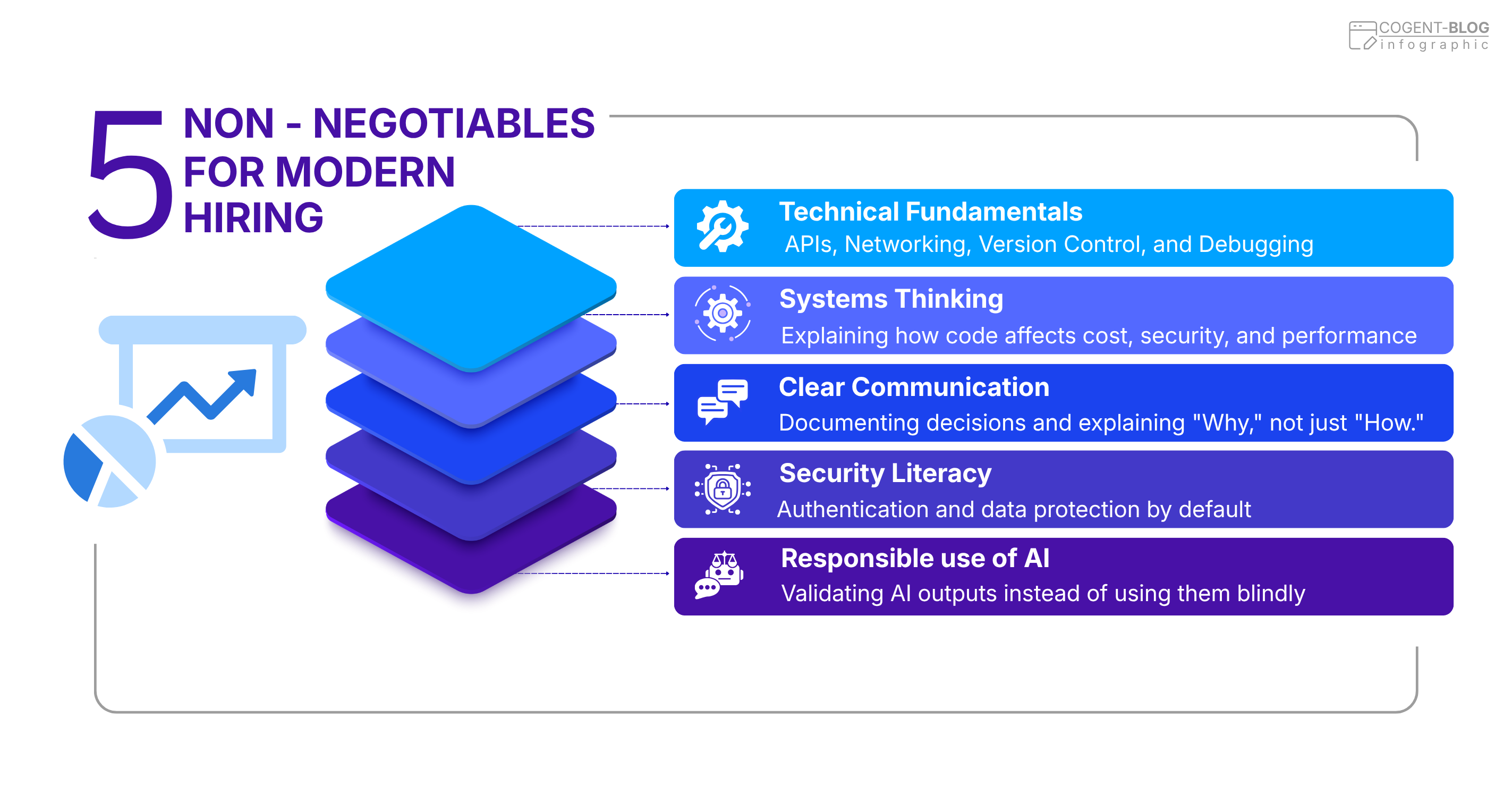
Despite the variety of job titles, hiring expectations are converging. Whether the role is development, cloud, cybersecurity, automation, or an AI-enabled function, employers are increasingly aligned on a few core capabilities.
This does not mean memorising syntax or chasing every new framework. It means understanding how things work underneath. Concepts like version control, APIs, basic networking, debugging, and cloud fundamentals are no longer optional. They are assumed.
Hiring managers increasingly treat these fundamentals as signals of long-term learning ability. Someone who understands why systems behave a certain way is easier to upskill than someone who only follows instructions.
Modern tech work happens inside complex environments. Code interacts with infrastructure. Infrastructure interacts with cost. Cost interacts with business decisions. Employers value candidates who can explain how a change in one part of a system affects the rest.
This is why interview conversations increasingly include “why” questions instead of only “how” questions. Candidates who can articulate trade-offs stand out quickly.
As tech becomes more embedded in business operations, communication has become a core skill rather than a soft add-on. Employers want people who can document their work, explain decisions, and collaborate across teams.
This does not mean becoming a polished presenter. It means being able to write clear notes, explain technical choices in simple language, and ask the right questions at the right time.
Security is no longer the responsibility of a single team. Understanding basic authentication, access control, data protection, and secure design principles is now expected even in junior roles. This trend is driven as much by regulation as by risk.
Using AI to speed up work is encouraged. Using it blindly is not. Companies increasingly care about whether candidates understand AI’s limitations, biases, and risks. The ability to explain how AI was used matters more than whether it was used at all.
According to the World Economic Forum, analytical thinking, adaptability, and technological literacy rank among the fastest-growing skills across industries. Notably, these are meta-skills, they support learning new tools rather than replacing them.
One of the quietest but most important changes in tech hiring is the declining importance of credentials as standalone proof.
Degrees still matter. Certifications can still help. But neither guarantees employability on its own.
Employers are increasingly sceptical of resumes filled with tools but lacking evidence. They want to see what you have built, improved, or solved.
This shift is reflected in hiring platform trends. Data shared by LinkedIn shows growing emphasis on skills demonstrations, portfolios, and project-based evaluation, especially for early-career roles. In many organisations, technical interviews now revolve around real scenarios rather than abstract puzzles.
The implication is clear: preparation must move from accumulation to application.
Preparing for the future of tech careers does not require extreme discipline or constant upskilling. It requires structured focus.
The most effective approach is to start by choosing one primary track, rather than trying to prepare for everything at once. This choice is not permanent. It simply gives direction.
Broadly, most early-career tech paths today fall into four overlapping tracks: development and cloud, cybersecurity, automation and operations, and AI-enabled product or workflow roles.
Once a track is chosen, the next step is to build two to three meaningful projects. Not toy exercises, but small systems with clear outcomes. Projects should demonstrate thinking, not just execution.
A project does not need to be complex to be effective. What matters is whether it shows understanding. A simple application with proper authentication, deployment, and monitoring often signals more readiness than a complex app that only works locally.
The third step is optional but useful: one entry-level credential.
Certifications work best when they reinforce practical experience rather than replace it. A basic cloud or security certification can help establish foundational knowledge, especially when paired with hands-on projects.
The final step is interview readiness, which is often misunderstood.
Interview preparation is not about memorising answers. It is about learning to tell clear stories: what problem you faced, how you approached it, what trade-offs you made, and what you learned. Employers remember stories far more than technical jargon.
Many candidates build projects, but few build the right projects. Hiring managers rarely expect perfection. They look for clarity, reasoning, and learning ability.
A strong project in the development or cloud track might involve a simple web application hosted on the cloud with a basic CI/CD pipeline. The value lies not in the app itself, but in demonstrating deployment, version control, and automation. A security-oriented project could focus on implementing secure login, role-based access, and basic audit logging. Explaining why certain security choices were made matters more than covering every edge case. For automation or operations roles, a monitoring dashboard with alerts or a script that automates a repetitive task can be very effective. These projects show efficiency thinking, a skill organisations value highly.
AI-enabled projects do not need to involve model training. A project that integrates an existing AI API into a workflow, documents limitations, and handles errors responsibly often sends a stronger signal than complex experimentation without guardrails. Across all tracks, documentation matters. Clear README files, diagrams, and explanations show communication skills and professionalism, qualities employers consistently seek.
Students often feel pressured to learn everything: multiple languages, frameworks, cloud platforms, AI tools, and security concepts, all at once.
This pressure is counterproductive.
In reality, employers do not expect entry-level candidates to know everything. They expect strong fundamentals and evidence of learning ability.
The perception of “skills inflation” is partly caused by job descriptions that list every tool used internally. These lists reflect team environments, not individual expectations.
What matters more is whether a candidate can:
This is why companies increasingly hire for potential rather than checklists, especially in early-career roles.
If there is a single pattern that defines successful tech careers over time, it is not brilliance or speed. It is consistency.
People who develop a steady learning rhythm, small projects, regular reflection, gradual skill expansion, outperform those who sprint from one trend to another.
This observation aligns with labour market research. Analysis by Gartner repeatedly highlights adaptability and learning agility as critical capabilities in technology-driven roles, particularly as automation accelerates change.
Adaptable learners are not overwhelmed by new tools because they understand underlying principles. They are not threatened by AI because they see it as an assistant. They are not derailed by role changes because they understand systems, not just tasks.
The future of tech careers between 2026 and 2030 will reward those who prepare thoughtfully rather than reactively.
The winning approach is not to chase every trend, but to:
Technology will keep changing. Job titles will keep evolving. But professionals who understand how systems work, and how their work creates value, will remain in demand.
The opportunity is not shrinking. It is shifting.
Those who recognise that shift early will find themselves not chasing jobs, but choosing between them.
Preparing for the future of tech careers doesn’t require doing everything at once, it requires doing the right things in the right order.
Discover how Cogent University helps students and early-career professionals build real, evidence-based tech skills.
Start Now!
.png)
Dedicated to your professional growth, Cogent University offers comprehensive tech training. We combine practical, project-based learning with elite career support to build tomorrow's developers.