Introduction
January is a good time to think about your career, start over, and be honest about it.
As the new year begins, many professionals take a moment to think about where they are, only to realize that they feel stuck even though they have years of experience, perseverance, and commitment. Promotions seem to take a long time, growth has stopped, and the excitement that used to drive their work has faded.
AI is also changing the way people do their jobs. Headlines often talk about job loss, but the truth is more complicated. AI is not eliminating people; it's changing how they work. Routine tasks are being automated, but this change is also making it possible for people to do more meaningful, hands-on, problem-solving work that combines technology with human judgment.
This shift has made clear a crucial fact: IT employment is no longer limited to coders. Today's most valuable workers are those who can solve problems, collaborate with various teams and tools, and provide meaningful outcomes.
This moment is important if you think your job could be automated, your career has stalled, or your workplace doesn't match your values anymore. The job market is changing quickly, so learning new skills or moving into tech-enabled jobs can help you get back on track, boost your confidence, and find a new sense of purpose.
The Impact of AI on Employment: Job Replacement Projections for 2030
According to a survey by the investment bank Goldman Sachs, AI has the potential to replace 300 million full-time jobs. In the US and Europe, it might replace 25% of employee tasks. However, it may also lead to increased productivity and employment generation.
Additionally, it might eventually result in a 7% rise in the general yearly value of products and services produced worldwide. According to the study, about 25% of all jobs might be completely automated by AI, whereas in the US and Europe, two-thirds of employment is exposed to some level of AI automation.
By 2026, artificial intelligence is expected to replace up to two million manufacturing workers, according to Forbes. A McKinsey Global Institute study predicts that developments in robotics, AI, and digitization will force at least 14% of workers worldwide to change their jobs by 2030.
How AI Is Redefining Employment and Career Paths
The employment market is changing due to artificial intelligence, which is improving and producing new job types. It's essential to understand how AI is impacting the job market, the types of new occupations emerging, and the potential effects on unemployment rates and the overall economy as it evolves and changes.
By 2030, AI is predicted to provide 20–50 million new jobs worldwide, according to a McKinsey & Company estimate. These new positions will be found in a variety of industries such as manufacturing, finance, and healthcare. AI is creating several new job roles, such as:
- AI Trainers: These people are in charge of instructing and training AI systems. They create new AI systems and applications and ensure the accuracy and efficacy of AI algorithms.
- Human-Machine Teaming Managers: As AI becomes more common in the workplace, there is a growing need for people who can oversee human-machine interactions. To increase production and efficiency, human-machine teaming managers make sure AI systems collaborate well with human workers.
- AI Ethics & Policy Specialists: The demand for people who can discuss the ethical and policy implications of AI is increasing as it becomes more common. Experts in AI ethics and policy ensure that AI systems are created and applied ethically.
Strategies for Career Relevance in the AI Era
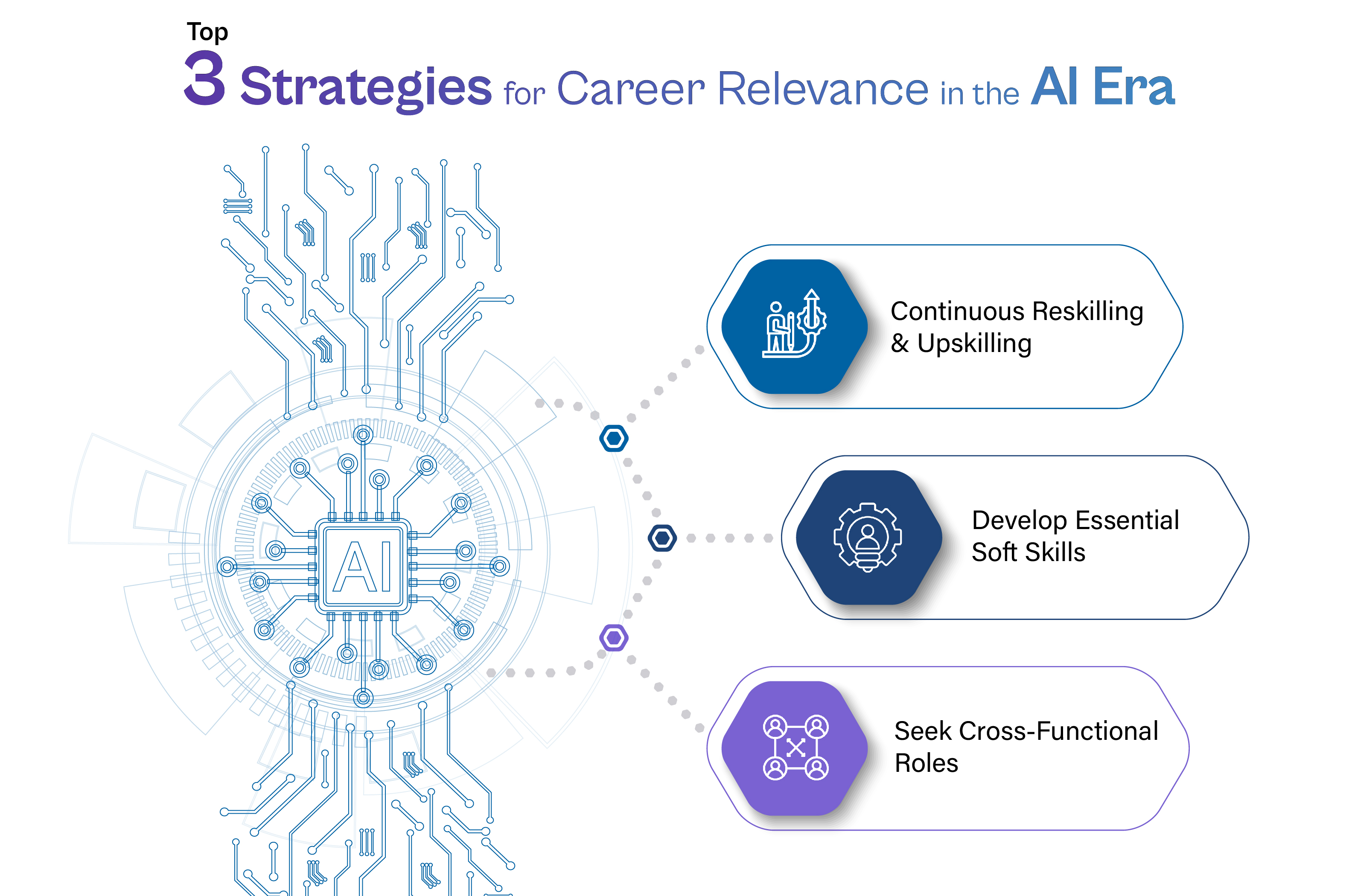
Continuous Reskilling & Upskilling
Updating your skill set regularly is one of the best ways to remain relevant. Here are some points to think about:
- Data Literacy: It is essential to know how to handle data. Learn the fundamentals of statistical techniques, data analysis, and data visualization.
- AI and Machine Learning: You can learn the fundamentals of machine learning and artificial intelligence and investigate real-world uses for these technologies with the help of these courses.
Develop Essential Soft Skills
Soft skills are just as important for career growth as technical ones. Focus on improving:
- Critical Thinking: The capacity to evaluate problems and reach informed decisions is valuable.
- Adaptability: You can navigate the changing job landscape by being flexible and eager to pick up new skills and methods.
- Communication: To work with different teams and convey complicated ideas to stakeholders who are not technical, strong communication skills are crucial.
Seek Cross-Functional Roles
Because of the interdisciplinary nature of AI, cross-functional positions are more prevalent. Think about positions that let you operate at the intersection of AI and your present industry, like:
- AI Project Manager: Supervising AI initiatives and making sure they complement corporate objectives.
- AI Consultant: Giving businesses advice on how to use AI technology to enhance their operations.
- Data Analyst: Utilizing AI technologies to gather knowledge from data and guide business plans.
AI’s Influence on Entry-Level Roles in the Tech Industry
The IT sector is changing quickly. Every industry and team is starting to include tools that automate, recommend, and optimize work processes into their daily operations. According to a PwC analysis, almost 40% of companies have already used generative AI and experienced a productivity improvement.
What does that mean for those just starting in the tech industry?
It implies that entry-level positions now differ from those of five years ago. Fixing bugs and cleaning datasets are examples of tasks that were formerly the foundation of junior employment but are now being streamlined. However, this does not imply a decrease in employment. It simply indicates that the tasks are not the same.
Strategic thinking, problem-solving, and creating meaningful things have additional space. You have a distinct advantage if you're just beginning your tech profession because you're learning how to operate in this new environment right now.
Entering the Tech Industry With No Technical Experience
The key to success is to prioritize real-world tools and practical abilities over abstract theories.
The primary difference is as follows:
Learn the right tools – Python for automation, ChatGPT for ideas and content, and Excel for data.
- Develop a portfolio – Use a practical AI project to show your abilities.
- Get certified – Recognized qualifications are still valued by companies.
- Get support – Your journey can be accelerated with career counselling, job search assistance, and interview preparation.
Choosing the Best Learning Path When Moving into a Tech Career
Because of the technology industry's rapid expansion, there are several chances for those in non-technical professions to shift into high-demand IT careers. Many people from non-technical backgrounds are pursuing new careers in cybersecurity, data analytics, cloud computing, and other fields due to the growing demand.
A career shift to IT could open access to profitable and fulfilling possibilities, regardless of your experience in customer care, sales, promotion, or human resources.
In the current job environment, is it still feasible to make the transition to technology? Certainly. Choosing the appropriate study path is all that is required.
Identify Your Transferable Skills
Make a list of the skills you already possess before concentrating on coding courses or enrolling in an expensive boot camp. Even if you didn't have a background in technology, you can still use some hard and soft skills:
- Expertise in Project Management: Jobs in supply management, technology operations, and management of products, where implementation, collaboration, and planning are crucial, are directly related to jobs in other industries.
- Data Analysis and Management Skills: Professionals in operations, research, or finance are ideally suited for positions in data science, business intelligence, and analytics.
- Problem-Solving Abilities: Debugging, system optimization, and solution design all depend on the development of complicated decision-making or operational difficulties.
- Proficient Communication Skills: Facilitate requirement collecting, cross-functional cooperation, and the explanation of technical ideas to non-technical stakeholders.
- Process Thinking: Helps in comprehending workflows, enhancing system effectiveness, and supporting automation and digital transformation projects.
- Stakeholder Management Experience: Makes it possible for business teams, technical teams, and other partners to effectively coordinate, which is essential for the majority of technology-driven roles.
You can reduce your learning curve and prevent wasting time on irrelevant subjects if you already know what is in demand in the technology industry.
Determine Your Target Job Role
Casting a wide net might increase your chances of landing a tech employment, but the opposite is actually true. Without a clear objective, jumping in leads to scattered learning that doesn't prepare you for any particular profession.
Take your time looking into a tech job option that matches your skill set. For instance, data analysis, cybersecurity, software engineering, or UX design. Examine the hiring requirements, common tools, and regular responsibilities of these positions.
Although it doesn't have to take months, this research stage helps in concentrating. You'll save time and make sure the tasks you concentrate on are relevant to your future applications if you take a focused strategy.
Selecting the Best Learning Approach
You can proceed and acquire the required talents once you've determined which role is appropriate for you. While some people do better in structured bootcamps with set schedules, others thrive in self-paced online courses that offer flexibility.
Academic-style coaching is usually meant for younger students, but if you work well with structure and transparency, it can be just as helpful for adult learners.
The basic principles of structured support, mentorship, and individualized learning are perfectly suited to assisting you in developing certain abilities according to your objectives, experience, and free time. You may avoid typical pitfalls and receive feedback and support from the correct coach, which is especially helpful when making the switch to a tech career.
AI Career Roadmap 2026: Step-By-Step to Make a Career Switch to AI
The focus of modern technology is artificial intelligence, which is changing various sectors worldwide. There has never been a more pressing need for companies to automate, optimize, and innovate. This is why there is a greater need than ever for qualified AI specialists.
Given AI's explosive growth and transformational potential across various industries. It is an admirable objective to change careers to the field. This transition involves acquiring new information, developing pertinent abilities, obtaining real-world experience, and carefully navigating the job market. This is a thorough explanation of how to switch to an AI career:
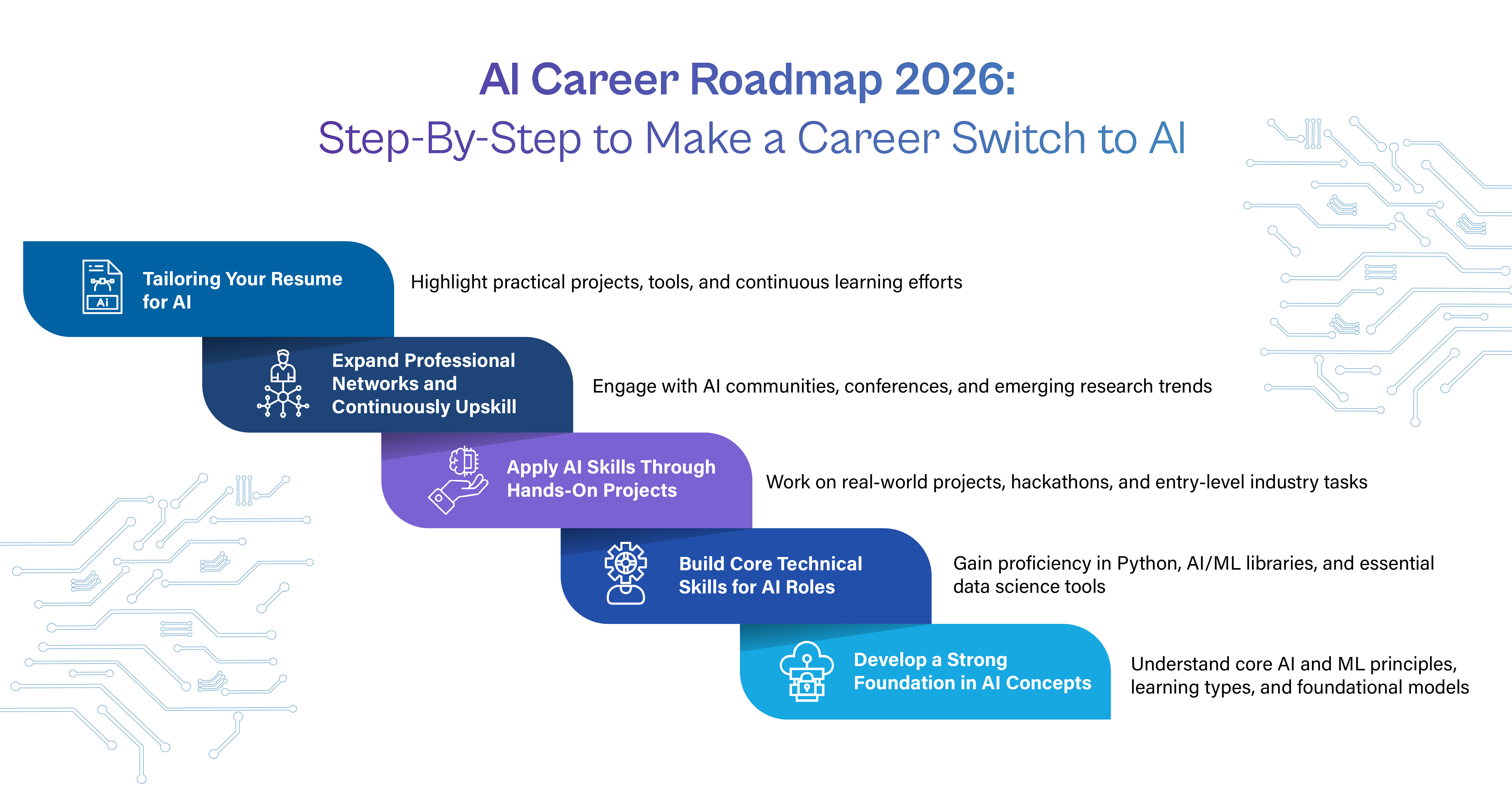
1. Develop a Strong Foundation in AI Concepts
- Fundamental Ideas and Theories: Recognize AI and ML, as well as the many forms of machine learning (supervised, unsupervised, reinforcement learning).
- Algorithms and Models: Look at the fundamental algorithms of artificial intelligence, such as decision trees, neural networks, and deep learning-based models.
- Online Learning Resources: Make use of the free and paid courses offered by sites. The "Introduction to Deep Learning" course at MIT and Andrew Ng's "Machine Learning" course at Stanford are highly recommended.
2. Build Core Technical Skills for AI Roles
The foundation of an AI job is technical expertise:
- Programming Languages: While Python is a must, familiarity with Java, C++, and R might also be helpful.
- AI and ML Libraries: Learn how to use TensorFlow, PyTorch, Scikit-learn, and Keras.
- Data Science Skills: Use Matplotlib and Seaborn, as well as Pandas and NumPy, to manipulate and analyze data.
3. Apply AI Skills Through Hands-On Projects
- Individual Projects: Begin with simple tasks, such as creating an image classifier or chatbot, and progressively add complexity.
- Hackathons and Competitions: Use online resources like Kaggle to take on real-world tasks and compete.
- Internships & Entry-level Jobs: If you want useful industry experience, look for positions in both established companies and emerging startups.
4. Expand Professional Networks and Continuously Upskill
It's essential to stay updated with AI breakthroughs:
- Professional Networking: Participate in online (Reddit, LinkedIn groups) and offline (meetups, workshops) AI communities.
- Conferences & Workshops: Attend AI and technology conferences to network with other professionals and acquire knowledge from experts.
- Keep Up with AI Research: Read articles and follow prominent AI researchers on social media to stay up to date on the most recent findings.
5. Tailoring Your Resume for AI
Your AI skills should be highlighted on your resume:
- Emphasize Relevant Skills: List the programming languages, AI/ML libraries, and data analysis tools in which you are skilled.
- Showcase Projects: Provide complete descriptions of the AI projects you've worked on, including the technologies employed and the issues resolved.
- Emphasize Ongoing Education: List any AI and ML-related courses, certifications, and workshops you've completed.
Roles Where AI Supports Humans (Not Replaces Them)
AI is improving several aspects of the software development lifecycle, including full-stack development, quality assurance (QA), data operations, and cloud/DevOps support. It also streamlines procedures, automates monotonous tasks, and offers intelligent insights.
Full-Stack Development with AI Support
Integrated Development Environments (IDEs) are progressively incorporating AI capabilities to help developers:
- Code Generation & Autocompletion: By using machine learning to recommend lines of code or complete functions based on context and comments, tools like GitHub Copilot and Amazon CodeWhisperer speed up development and reduce syntax errors.
- Automated Debugging: By analyzing codebases, AI algorithms may identify and predict flaws and suggest fixes before the code is even executed, enhancing the stability and quality of the code.
- UI/UX Design Assistance: By analyzing user behavior data, AI tools can offer recommendations for enhancing accessibility, UI design, and user experience.
AI-Enabled Quality Assurance and Testing
AI is revolutionizing quality assurance by improving the effectiveness and completeness of testing:
- Intelligent Test Automation: The amount of manual effort needed to create comprehensive test suites can be greatly decreased by using AI-driven solutions that can automatically create test scripts.
- Predictive Bug Detection: By identifying high-risk code segments through the analysis of past bug data, machine learning models enable QA teams to more efficiently concentrate their testing efforts.
Data Operations
AI is essential to contemporary data operations since it allows for improved data management and insights:
- Automated Data Cleaning & Preparation: By automatically identifying and fixing errors, eliminating duplication, and formatting data, AI systems may significantly reduce the time spent on data manipulation.
- Business Intelligence & Predictive Analytics: AI supports data-driven decision-making in organizations by analyzing massive datasets to predict trends and offer useful insights.
AI-Supported Cloud & DevOps Operations
In cloud environments, AI simplifies application deployment, monitoring, and management:
- AIOps (Artificial Intelligence for IT Operations): Massive amounts of operational data (logs, metrics, events) are analyzed by AI to find irregularities, identify the root causes of problems, and even automate remediation, often before human intervention is required.
- Predictive Maintenance: Based on previous information, AI models can predict possible capacity problems or infrastructure breakdowns, allowing DevOps teams to proactively manage resources to prevent outages.
- Security & Compliance Monitoring: AI technologies provide ongoing protection and reporting by monitoring for security risks, policy infractions, and compliance problems in cloud settings.
Common Tech Pathways Suitable for Career Switchers
Software Developer / Software Engineer
Developers create, build, and manage desktop, mobile, and web software applications. The median annual salary for a software engineer in the United States is around $132,000, indicating that this career choice is well-compensated. Due to demand in fields like cloud services, artificial intelligence, and mobile apps, it is also one of the fastest-growing professions, with a forecast 17–18% increase from 2023 to 2033. Opportunities for software engineers are found in almost every field, and they frequently benefit from remote work and flexible schedules.
Data Analytics & Data Science Professionals
To assist organizations in making decisions, data professionals gather and examine data. While data scientists create prediction models and algorithms, data analysts often perform activities including creating reports, querying databases (SQL), and visualizing data. These positions are in great demand and pay well. Data scientist employment is expected to increase by 36% between 2023 and 2033, making it one of the fastest-growing professions.
Cloud Engineer & DevOps Engineer Role
These positions include automating software deployment procedures and managing cloud computing services. DevOps engineers use tools like Docker, Kubernetes, and CI/CD pipelines to streamline the collaboration between development and IT operations, while cloud engineers create and manage cloud infrastructure (e.g., on AWS, Azure). As businesses switch to cloud solutions, demand is considerable (BLS estimates "faster than average" growth for related roles like network architects at ~15% over the decade).
What “Job-Ready” Really Means in 2026
Getting ready for a job in 2026 means a lot more than just getting certificates or finishing online courses. Employers no longer see credentials as proof of real ability, even though they can show intent and effort. The most important thing is whether a candidate can use their skills in real-life projects at work and make a difference right away.
Difference Between Certificates & Competence
The difference between certification and competence is getting bigger. A lot of professionals know the theory, but they have a hard time putting it into practice in real life. Employers don't care how many classes you've taken; they care about how well you can do the job.
They look for candidates who demonstrate:
- Hands-on project experience that reflects real business problems
- An understanding of workflows, systems, and dependencies
Being ready for work today is closely linked to being able to solve problems in the real world. Work is rarely straightforward or predictable, and employers expect professionals to be able to handle uncertainty with ease. This means knowing not just how to use tools or write code, but also why a solution exists and who it helps.
Being job-ready involves:
- Applying code with context, not in isolation
- Improving outcomes based on feedback and testing
Why Structured Programs Outperform Self-Learning for Switchers
Iteration is no longer an option; it's a necessary skill for the workplace. Employers prefer people who can change, improve, and refine their work over people who want to get it right the first time.
Structured learning programs consistently outperform self-learning for career switchers, particularly those transitioning into technology or AI-enabled positions. Self-study can help you learn, but it doesn't always have real limits, direction, or responsibility.
Structured programs help by offering:
- Realistic projects aligned with industry expectations
- Exposure to professional workflows and tools
In the end, being job-ready in 2026 means being able to get a job, not just having a certificate. It shows that you can work in real teams, solve important problems, and add value in a fast-paced work environment.
Being ready for a job means you're not only ready to get hired, but also to do the job, learn, and stay relevant.
How Mentorship Contributes to Future Leadership Development
A key component of training future leaders is mentoring, which provides priceless direction and assistance throughout their development. The following are some ways to see it:
Guidance & Support
By providing specific guidance and practical insights, mentoring plays a critical role in the development of essential leadership abilities. Mentors improve communication techniques, refine strategic thinking, and help mentees navigate difficult decision-making processes. This practical advice enables leaders to use these abilities in their positions.
For example, Satya Nadella's leadership style was greatly influenced by his mentorship with Bill Gates. Nadella's capacity to lead Microsoft through a pivotal time was greatly influenced by Gates' guidance towards empathy and teamwork, demonstrating how mentorship fosters essential skill development.
Personal & Professional Growth
By improving self-awareness and confidence, mentoring greatly aids in personal development. In addition to improving leaders' emotional intelligence, mentors are crucial in helping them recognize their areas of strength and growth.
This personal development is essential to developing good leadership skills.
Nurturing Talent & Leaders
By seeing and fostering potential, mentors play a crucial role in developing new talent. They are crucial in helping mentees develop essential leadership abilities and self-assurance by providing tailored feedback and growth plans.
Future leaders will be well-prepared for more responsibility because of this fostering role.
Networking & Exposure
Mentorship is very important for getting more professional experience and making strong connections. Mentors help mentees find new opportunities, meet important people in their field, and share useful tips they have learned from their own experiences.
Mentors help mentees grow their careers and achieve long-term success by teaching them how to build and use professional relationships.
Conclusion
As artificial intelligence continues to reshape industries, switching careers into AI or tech should be seen as a strategic decision, not a risky leap. For many professionals, this transition is less about starting over and more about repositioning existing skills for a future-driven workforce. The key lies in understanding how roles are evolving and preparing accordingly, rather than reacting to change out of fear or urgency.
Choosing the right learning partner plays a critical role in this journey. Programs that combine structured learning, hands-on projects, and career guidance help bridge the gap between knowledge and employability. More importantly, they provide clarity, direction, and confidence at a time when the job market can feel uncertain.
As you reflect on your next career move, focus on building practical skills, real-world experience, and a mindset aligned with continuous growth. If you’re considering a structured, job-focused transition into tech, programs designed for career switchers like those at Cogent University can help turn uncertainty into momentum and transform ambition into a sustainable AI career.
Ready to future-proof your career in 2026?
Join Cogent University’s job-focused programs built for career switchers, structured learning, hands-on projects, and mentorship that gets you truly job-ready.
Start your transition today.


.png)