

Introduction
In 2026, web applications will no longer be judged solely by features; they will be measured by speed, security, scalability, and their ability to adapt to AI-driven and cross-platform demands. Behind every high-performing digital product is a strong development framework that enables teams to build faster, reduce errors, and ship reliable software in shorter cycles. As AI-assisted development, edge computing, and stricter security requirements reshape the industry, choosing the right framework has become a strategic decision rather than a technical afterthought.
The best web development frameworks 2026 play a critical role in this shift, offering structured , reusable components, and proven best practices to manage growing complexity. By 2027, spending on development technologies is expected to reach between $175 billion and $250 billion, adding an estimated two to six percentage points of growth across the sector, underscoring the scale and urgency of framework selection decisions.
In this blog, we explore the best web development frameworks of 2026, selected based on adoption trends, community support, performance benchmarks, and real-world user feedback. The list is organized into frontend, backend, and full-stack categories, with each framework evaluated on key capabilities, ideal use cases, pricing considerations, and practical pros and cons, helping you make an informed choice for your next development initiative.
Web Development Framework: Quick Overview
A software framework created to facilitate the creation of web applications, such as web services, web resources, and web application programming interfaces (APIs), is termed a web framework or web application framework. These web frameworks facilitate the development of online applications, such as content management systems, some mobile development tools, and some portal tools, that are based on a single programming language or on native-language programmable packages built around a specific user application.
The frameworks assist in automating the overhead related to tasks frequently carried out in web development. For instance, a lot of web frameworks support code reuse and contain libraries for database access, templating frameworks, and session management. They can be applied to static websites even though they are typically utilized for the creation of dynamic ones.
Why Do You Need to Use Web Frameworks?
A web framework can help you achieve faster development and efficiency, a more organized and structured codebase, increased security, easier database interaction, better community support and resources, scalability, and reduced expenses.
Let's examine the benefits that web app development frameworks offer developers:
- Web application development is significantly facilitated by frameworks, which offer pre-built components, libraries, and tools.
- They create well-organized, scalable, and manageable codebases by enforcing standard principles of architecture (like MVC).
- To protect applications against common vulnerabilities, such as SQL injection, cross-site scripting (XSS), and cross-site request forgery (CSRF), many web frameworks include built-in security measures and best practices.
- Object-Relational Mappers (ORMs) or comparable abstractions are provided by the majority of frameworks, which streamline database interfaces and reduce the need for manual SQL queries.
- Scalability and future-proofing are improved by choosing the appropriate framework depending on the complexity and long-term requirements of your application.
Things to Consider Before Choosing a Web Development Framework
When selecting a web development framework, businesses should take into account a number of aspects, such as whether the framework has the necessary functionality, has well-documented code, or has an active community. But while choosing the ideal framework for web development, other specific requirements are frequently overlooked, such as:
1. Hosting Needs
Does the framework function in shared hosting scenarios, or does it need a dedicated server for the application? Certain frameworks, like Django and Ruby on Rails, require more unique, non-shared configurations.
2. Core Code Library
The core library of a framework should have the necessary functionality if its main purpose is to support development. To have the kind of precise oversight required, it should also be possible to modify those features or replace certain components with others from another library.
3. Unit Testing
To ensure optimal performance, unit tests are the cornerstone of any testing setup and are often conducted during development and maintenance. Search frameworks that support the creation of custom unit tests or that already contain core tests.
Why Using a Web Application Framework is Beneficial?
It is advantageous to utilize a web application framework because it offers a structured base that simplifies and expedites development. Frameworks reduce errors and repetitive coding by providing built-in capabilities like database administration, routing, and security.
Additionally, they increase consistency, scalability, and maintainability, which helps developers create reliable apps more quickly.
1. Enhanced Efficiency
In the development of web applications, efficiency is vital. You can use these frameworks' pre-made functionalities instead of completing all the work yourself, which will ultimately reduce the amount of time you spend developing the app. Your development team can concentrate on other important tasks that will improve your web application's efficiency.
2. URL Mapping
Website ranking is everything on the internet. A website will receive more traffic the higher it appears on search engine results pages. One of the main strategies for improving SERP ranking is URL mapping. Web frameworks provide URL mapping, which can index your website based on an enticing name and raise its ranking.
3. Cost-Effective
The creation of web apps is expensive. Several of the top frameworks in the field are available for free. They significantly reduce the total cost of development by making code easier and hassle-free. The consumer can obtain the app for less money when the whole cost is reduced.
The Growing Influence of AI on Web Development Frameworks
Many industries are already being profoundly changed by artificial intelligence, and in the years to come, its impact on web development frameworks will only increase.
- These days, GitHub Copilot, Tabnine, and Amazon CodeWhisperer can produce code blocks, recommend modifications, and simplify repetitive chores.
- AI-powered helpers that optimize code, offer real-time advice, and suggest best practices based on project requirements may be included in frameworks in the future.
- Codebases can be scanned for potential defects, performance issues, and security flaws using AI.
- AI-driven test libraries that create automated test cases and replicate user interactions could be a component of AI-based web development languages and frameworks.
With the help of the frameworks, developers might be able to design unique user interfaces that adjust to each user's unique tastes, behaviors, and devices.
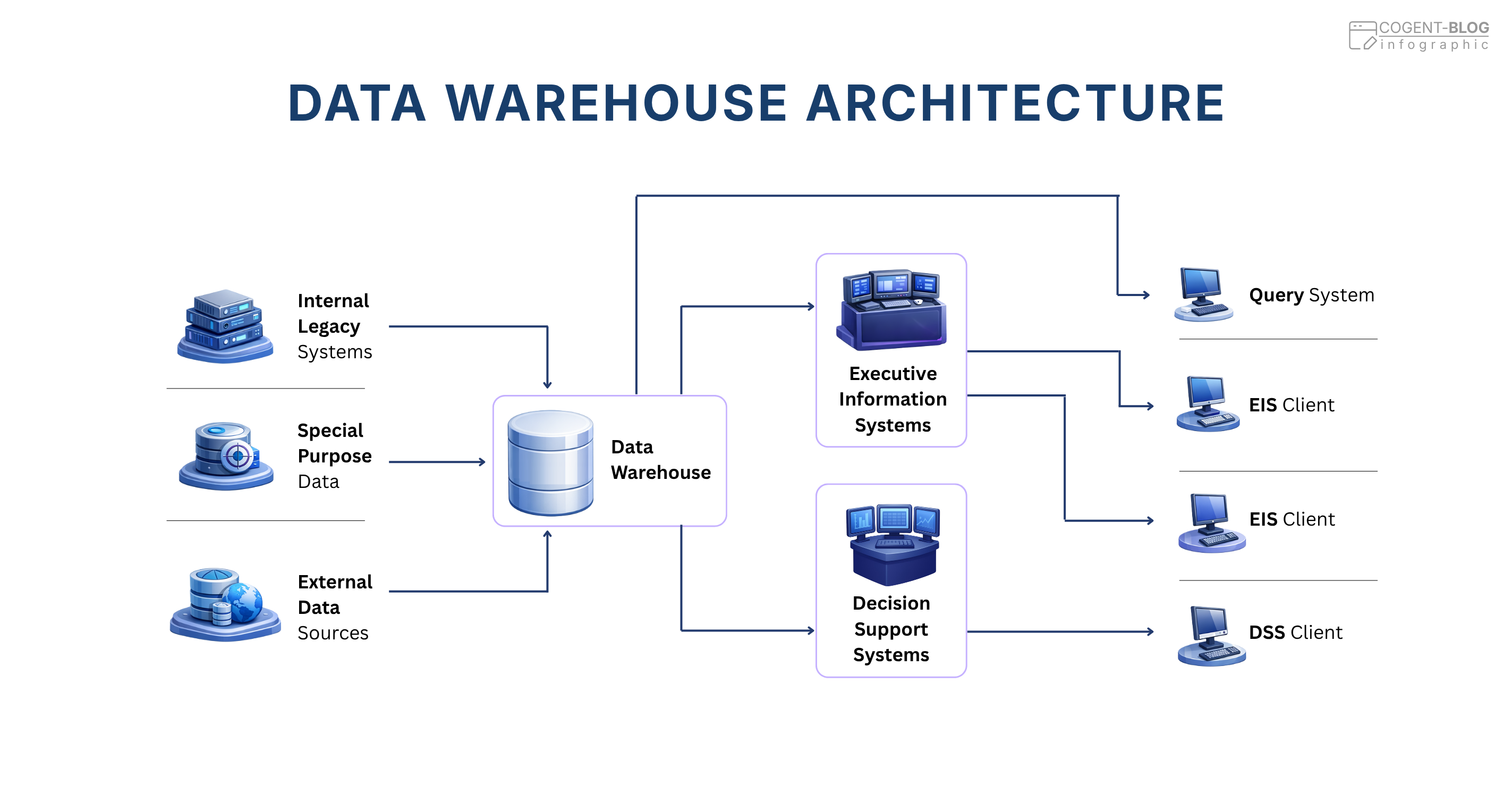
Enterprise data warehouse architecture
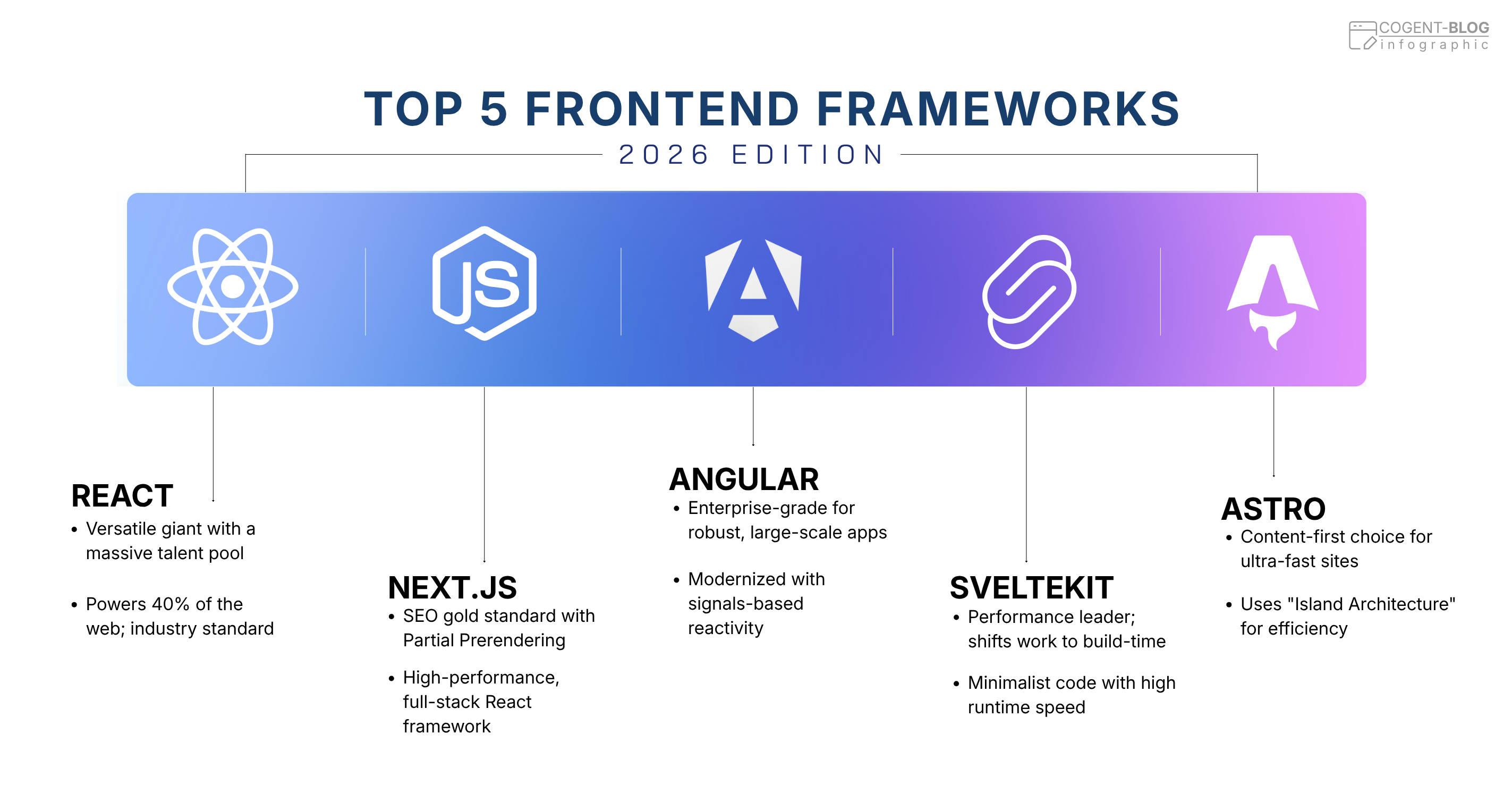
Leading Frontend Frameworks Powering Web Development in 2026
Front-end web frameworks are essential if you want to build a prototype and a strong responsive design. Let's talk about the top five frameworks for front-end development.
1. Angular
You can create dynamic, one-page web applications with Angular, a JavaScript web framework. Angular is a feature-rich framework that offers tools and functionality for all phases of the development process, from creating interfaces for users to testing and deployment.
Google maintains Angular, which is based on TypeScript, a superset of JavaScript that gives the language more features and capabilities. Angular is well-known for its modular architecture, which makes it simple to break down apps into smaller, reusable components.
When to use Angular framework for building applications:
- Angular's modular architecture, strong data binding, templating capabilities, and capacity to create scalable online apps make it a great option if you're trying to develop a large-scale, complex web application with lots of interactivity and dynamic content.
- Angular's compatibility with web, mobile, and desktop platforms makes it a desirable option for your project if you're interested in creating cross-platform applications that can run on many devices and scenarios.
- Angular is a good choice for developing enterprise-grade apps that need high performance, dependability, and scalability because of its extensive feature set, robust typing, and reactive programming features.
- Creating dynamic, responsive user interfaces that can manage complicated data and interactions is made simple by Angular's templating and data binding capabilities.
2. SvelteKit
SvelteKit is a modern web application framework built on top of Svelte, designed for creating fast, efficient, and highly interactive web applications. Unlike traditional frameworks that rely heavily on runtime JavaScript, SvelteKit shifts much of the work to build time, resulting in smaller bundles and improved performance.
Maintained by the Svelte team, SvelteKit supports server-side rendering (SSR), static site generation (SSG), and full-stack application development out of the box. Its file-based routing, seamless data loading, and built-in support for modern deployment platforms make it easy to build scalable applications with minimal configuration.
When to use SvelteKit for building applications:
- SvelteKit is an excellent choice for performance-focused applications where fast load times and smooth user experiences are critical, thanks to its compile-time optimizations and minimal runtime overhead.
- Its support for SSR and SSG makes it well suited for SEO-friendly websites, content-heavy platforms, and marketing-driven applications.
- SvelteKit is ideal for teams that want to build full-stack applications using a single framework, with built-in routing, data fetching, and backend integration.
- Developers looking for a simpler, more intuitive development experience will benefit from SvelteKit’s clean syntax and reduced boilerplate, especially for interactive and reactive user interfaces.
3. React
The most popular frontend technology available now is still React. Because it enables teams to create scalable, rich, and quick user interfaces without fighting the framework, it is still at the top. React development services are widely used by big businesses like Meta, Netflix, and Shopify, and because of continuous enhancements like Server Components and Concurrent Rendering, its architecture still feels contemporary. Additionally, React consistently ranks as the top downloaded frontend library on npm. Something basic is reflected in such consistency. It is trusted by the industry.
Hiring availability is another useful feature that founders value. React talent can be found everywhere. Compared to specialty frameworks, this makes it easier to scale a team, outsource a feature, or onboard additional engineers. React is a simple option when speed is important, and you want a UI foundation that will still appear relevant in three years.
Key strengths:
- A huge pool of talent
- Flexible enough to work for both large-scale SaaS and basic apps
- Supported by a consistent, long-term ecosystem.
4. Next.js
The benchmark for full-stack React applications is still Next.js. It is one of the most potent production-ready frameworks in 2026 because of its server components, edge rendering, and hybrid routing strategy.
Highly visited websites, SEO-driven platforms, multi-page corporate websites, blogs, e-commerce stores, and enterprise solutions requiring both performance and maintainability are all perfect matches for Next.js.
The following features are provided by the open-source framework Next.js:
- High-performance application architecture
- SEO-optimized rendering
- Built on Node.js
- React-based framework
- Native support for Server-Side Rendering (SSR)
- Static Site Generation (SSG)
- Automatic code splitting
- Built-in CSS and styling support
Next.js is a powerful framework built on React that offers both static site generation (SSG) and server-side rendering (SSR). Next.js is the recommended option for creating quick and optimized websites due to its capabilities, which enhance performance and SEO. Additionally, pre-configured features like routing and API routes make the setup process easier.
5. Vue.js
Teams who want to work quickly without compromising maintainability or clarity will find Vue appealing. It has a simple syntax that facilitates development, is lightweight, and is simple to learn. Vue.js is widely used by businesses, demonstrating that it can expand well beyond side projects. Additionally, developers can create more complex interfaces with the expressive capability provided by Vue's Composition API.
Because Vue.js enables teams to release quickly, founders frequently choose it. The framework stays out of the way, the learning curve is mild, and the development process is pleasant. Vue.js is a good choice if your objective is to launch a polished interface without the overhead associated with some larger frameworks.
Key strengths:
- Quick development and simple onboarding
- Highly effective and lightweight
- Excellent for mid-scale and startup products
Top Backend Frameworks for Building Scalable Web Development
The infrastructure required to create server-side systems that are safe, scalable, and dependable is provided by backend frameworks. Data processing, API management, authentication, and external service integration are all under their supervision.
1. Express.js
Because of its basic and opinionated architecture, Express.js continues to be the most popular backend framework in 2026, used by about 20% of developers. It is now the recommended option for developing the "plumbing" of AI-agent backends and acts as the standard basis for Node. js-based microservices.
Infinite server customization and scalability are made possible by its user-friendly API and smooth middleware features. It is the foundation of contemporary full-stack solutions, together with MongoDB and React, with an emphasis on cross-platform functionality and performance.
2. Django
Django experienced a huge comeback in 2026 due to Python's dominance in the AI era. Its "batteries-included" approach, which simplifies the development of intricate, data-driven apps and API features, makes it popular. Django decisively tackles contemporary security threats, guarding against problems like SQL injections, CSRF, and XSS.
It is especially well-suited for building large-scale apps and smooth GraphQL connections because it was created by skilled engineers. It is the top option for businesses developing intelligent, data-centric online platforms because of its excellent documentation and capacity to manage the ML lifecycle.
3. Node.js
Developers can create server-side JavaScript applications with Node.js, an open-source, cross-platform JavaScript runtime environment. It is lightweight and effective because of its event-driven, non-blocking I/O approach, which makes it perfect for creating real-time, scalable, and high-performance applications.
Since its initial release in 2009, Node.js has grown in popularity among web developers because it enables them to construct both the front-end and back-end of web applications using just JavaScript. With its package manager, Node.js offers access to thousands of third-party modules and packages and boasts a sizable and vibrant developer community.
4. Spring
A popular and extensively utilized open-source Java framework for creating reliable and scalable business applications is known as the Spring Framework. Since its launch in 2002, it has developed into a feature-rich, modular framework that offers a variety of tools and functionality for creating Java-based applications.
It is a powerful Java framework that provides a variety of tools and frameworks for creating applications at the enterprise level. Because of its great modularity, developers can select the components they need. Code modularity and testability are improved by Spring's heavy emphasis on aspect-oriented programming and dependency injection.
For developers who are inexperienced with Java or enterprise programming, Spring's complexity and steep learning curve may pose problems. Building large-scale, enterprise-level applications in sectors like e-commerce, telecoms, and finance is best done with Spring.
5. Laravel
PHP is the foundation of Laravel, another open-source framework for creating web applications. It is an array of files, classes, and methods that programmers can utilize and modify to add new features. The MVC design pattern in Laravel facilitates easier access to app changes. With built-in security and authentication capabilities, it is among the greatest PHP frameworks.
Rely on an experienced Laravel development firm like Excellent Web World to help you create effective and cutting-edge PHP solutions for customized web development using Laravel capabilities. The PHP framework Laravel is notable for its advanced syntax and wide range of capabilities, including routing, ORM, and authentication. It makes routine activities like database migrations, caching, and session management easier. The built-in features of Laravel, such as Eloquent ORM and Blade templating, improve code readability and efficiency. Particularly for large and complicated applications, its performance needs to catch up to competing frameworks.
Web Development Framework Trends You Shouldn’t Ignore in 2026
With the advancement of technology, shifts in user behaviour, and evolving trends, web development frameworks are changing more and more. The impact of AI, the development of new technologies, and the trend of 2026 and beyond are some of the major factors that will drive the web development frameworks trend forward in the future.
The top frameworks may seem familiar, but our use of them is always evolving. There are three distinct patterns.
1. TypeScript First Mindsets
Instead of using TypeScript as an optional add-on, more teams are making it the default. React, Next.js, Angular, and contemporary Node backends are particularly impacted by this. Typed code is often mentioned in community conversations as a significant productivity increase, and makes editing huge frontends and microservices safer.
2. Meta Frameworks as The New Normal
Teams use meta frameworks that offer routing, rendering, and data fetching methods rather than putting together numerous separate libraries. The most obvious example is Next.js, although Nuxt, Remix, and SvelteKit all adhere to the same principle. These frameworks, which are built on top of React or Vue, greatly streamline server-side rendering and streaming.
3. Developer Sentiment and UGC Signals
Reading official documents is insufficient. In community spaces, real-world experience is evident. For instance, after years of using React, Vue, Angular, and other emerging possibilities, developers' opinions are captured in this community conversation regarding the state of JavaScript front-end frameworks.
Conclusion
Selecting the right backend, or any web development framework, is no longer just a technical decision; it is a strategic business choice. As AI-driven development, cloud-native architectures, and microservices ecosystems become the norm, the frameworks organizations choose will directly influence scalability, performance, security, and long-term adaptability.
To remain competitive in 2026 and beyond, businesses must evaluate frameworks through a broader lens, considering not only development speed but also operational costs, reliability, and AI readiness. The best web development frameworks 2026 are those that balance innovation with stability, enabling teams to build scalable applications while supporting evolving business goals.
Cogent Infotech helps organizations evaluate, design, and implement modern frontend, backend, and full-stack frameworks that align technology decisions with business outcomes. Whether launching a new digital platform or modernizing an existing system, our teams ensure your application architecture is optimized for performance, resilience, and AI-driven growth, positioning your business for success in the next generation of web development.
Want to stay future-ready in 2026?
Master the frameworks and skills companies are hiring for, with hands-on learning, real projects, and job-focused training.
Explore Cogent University Programs
Frequently Asked Questions About Web Development Frameworks
1. Why use a web development framework?
There are numerous advantages to using a web development framework, including
- Reduced time for development
- Higher-quality code
- reduce development expenses.
It offers an organized method for creating web applications that ensures the application's scalability and consistency.
2. How to choose the right web development framework?
The kind of application you are creating, the size of the development team, your skill set, and the particular requirements of the project are all important considerations when selecting the best web development framework. It's critical to consider the advantages and disadvantages of several frameworks and select the one that best fits your requirements.
3. Is Java a web framework?
No. Enterprise web development frequently uses Java, a programming language. Although Java is used to create frameworks like Spring and Struts, Java is not a framework in and of itself.


.png)