

Introduction
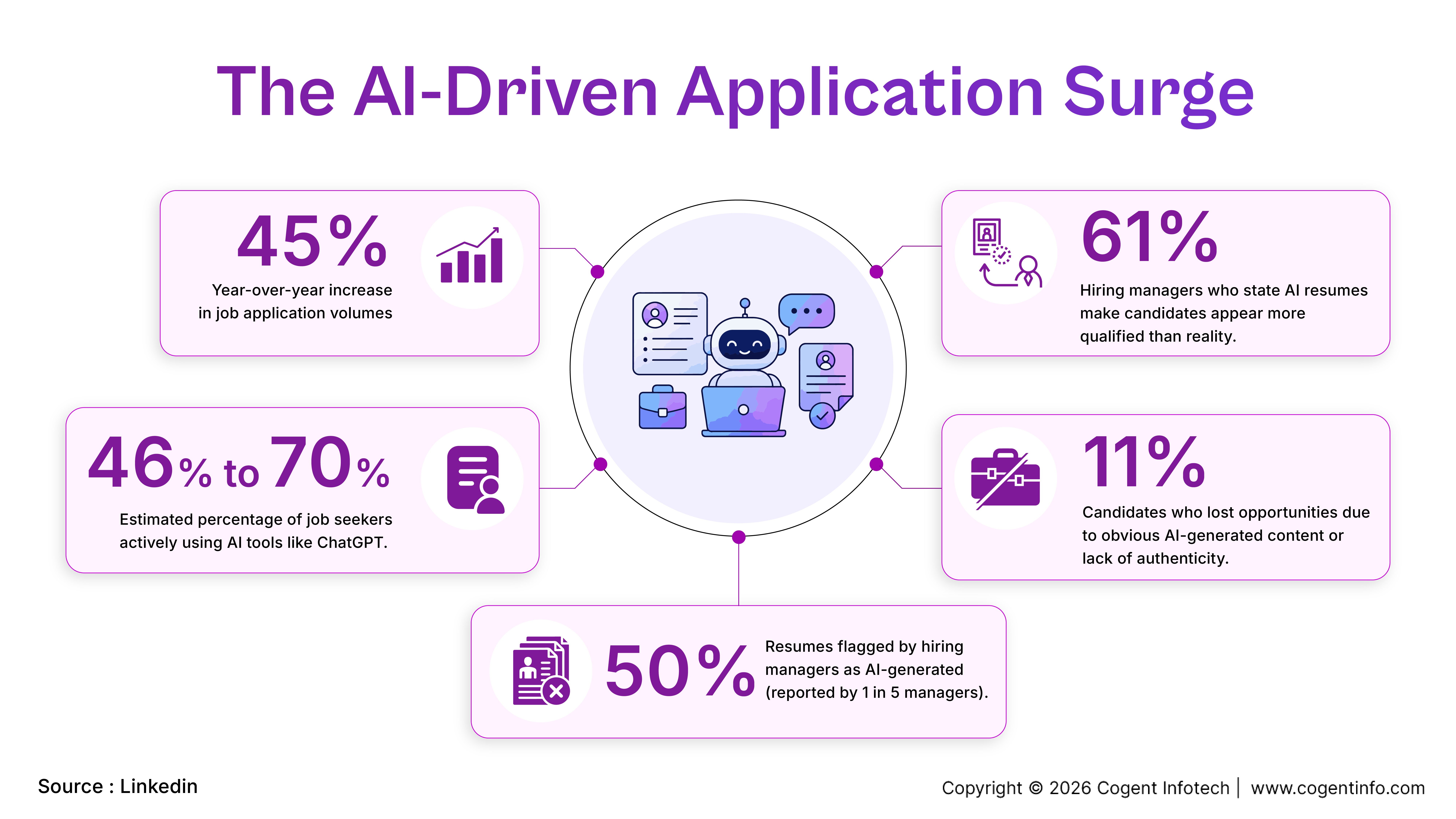
In 2026, a single job posting could attract hundreds, sometimes thousands, of applications within days. LinkedIn reported application volumes increasing by more than 45% year-over-year, while recruiters increasingly found themselves sorting through an overwhelming number of candidates for the same role.
At first glance, that sounds like a job market problem. But it isn't .
It's an attention problem.
A recruiter can only spend so much time reviewing applications. Yet job seekers are submitting more applications than ever before, aided by tools that can generate resumes, cover letters, LinkedIn summaries, and interview answers in minutes. What once required hours of effort can now be accomplished during a coffee break.
As a result, applying for jobs has never been easier.
Recent estimates suggest that between 46% and 70% of job seekers now use AI tools such as ChatGPT during the application process. That means the majority of candidates are no longer competing solely on experience, skills, or qualifications. They're often relying on the same technology to tell their stories.
And that's where an uncomfortable question begins to emerge: If everyone is using AI to sound better, what happens when everyone starts sounding the same?
The answer may explain why some candidates are landing interviews while others are disappearing into the crowd.
The Great Job Application Flood
Imagine you're a recruiter.
You post a marketing internship. Within 24 hours, applications start pouring in. Within three days, there are hundreds. Within a week, there are thousands.
This isn't an exaggeration. Generative AI has dramatically lowered the effort required to apply for jobs. A candidate can now generate a resume, cover letter, LinkedIn message, follow-up email, and interview preparation notes in less time than it takes to watch an episode of a sitcom. According to a 2024 Resume Builder survey, more than half of job seekers reported using AI tools during their job search process.
At first glance, this sounds like a good thing. Better writing. Faster applications. More confidence. For candidates who struggle to put their experiences into words, AI can feel like a lifesaver.
But there's a side effect nobody talks about.
When applications become easier to create, people submit more of them. A lot more. Many recruiters report receiving significantly higher volumes of applications than they did before generative AI became mainstream. Roles that once attracted a few hundred applicants can now attract several times that number, simply because the barrier to applying has become so low.
The result? Recruiters now spend less time on each application because they simply don't have enough hours in the day.
Think about that for a moment. Job seekers believe AI is helping them get more attention. But because everyone is using it, recruiters are paying less attention than ever before. It's a strange paradox: the easier applications become to create, the harder they become to evaluate.
The Rise of the Fake Perfect Candidate
ChatGPT has created another interesting problem: it can make ordinary experiences sound extraordinary.
A class project becomes a "cross-functional strategic initiative." A student presentation becomes a "high-impact communication exercise." Running an Instagram page becomes "executing digital audience engagement strategies." Technically, these descriptions aren't always false, but they often stretch reality just enough to create a misleading impression.
The problem is that recruiters don't hire descriptions, they hire people.
Reality has a habit of showing up during interviews.
Recruiters ask questions. They want details, context, and depth. They want to understand what role you actually played, what challenges you faced, and what you learned from the experience. Candidates who rely heavily on AI-generated descriptions often find themselves struggling at this stage because the application sounds far more impressive than the experience behind it.
Hiring managers notice this quickly.
The moment a recruiter feels your resume is overselling your experience, trust begins to disappear.
And once trust disappears, recovering from it becomes incredibly difficult.
As Warren Buffett famously said:
"It takes 20 years to build a reputation and five minutes to ruin it."
In hiring, that five minutes can be a single interview.
Recruiters Are Learning the Language of AI
Recruiters may not always know with certainty whether ChatGPT was used, but they are becoming increasingly skilled at spotting applications that feel generic or over-engineered. In fact, some hiring surveys suggest that around 11% of candidates have lost opportunities specifically because recruiters identified obvious AI-generated content or felt the application lacked authenticity.
That number may sound small until you realize what it means. For every hundred applicants, several may be removing themselves from contention not because they lack skills, but because their application sounds artificial.
Recruiters frequently point to the same warning signs:
- Excessive buzzwords
- Vague achievements
- Overly polished language
- Lack of measurable outcomes
- Generic introductions
- Identical sentence structures
After reading enough applications, AI-generated content begins to feel familiar. It's like hearing the same song played repeatedly on the radio. You eventually recognize it without even trying.
What's particularly interesting is that recruiters rarely care whether candidates used AI. Most understand that AI is now a normal part of professional life. They know students and professionals alike are using tools to improve their writing, organize their thoughts, and prepare for interviews.
What recruiters actually care about is whether the application genuinely reflects the candidate behind it. They want to know if the achievements are real, the experiences are authentic, and the voice belongs to an actual person rather than a polished template.
The strongest applications don't sound perfect. They sound believable.
Students and Graduates Are Losing Their Biggest Advantage
Experienced professionals can rely on years of work history, but students cannot. Fresh graduates often enter the job market with limited experience, fewer accomplishments, and shorter resumes. At first glance, this may seem like a disadvantage. In reality, it isn't.
Their biggest strengths are usually:
- Curiosity
- Creativity
- Adaptability
- Personality
- Potential
Ironically, these are often the first things AI removes. Why?
Because AI is designed to optimize for professionalism, consistency, and structure. It smooths out rough edges, removes quirks, and turns unique experiences into language that sounds safe and corporate.
The problem is that recruiters hiring entry-level talent aren't looking for polished executives. They're looking for promising humans.
Nobody expects a fresh graduate to have ten years of leadership experience. Nobody expects a student to sound like a management consultant. Employers understand that early-career candidates are still learning.
What they want to see is evidence that you're curious, willing to learn, capable of solving problems, and able to communicate your ideas clearly. They want signs of initiative, not perfection. A student who organized a college event, managed a student club, volunteered for a social cause, or taught themselves a new skill often has far more to offer than they realize.
Potential is one of the most valuable qualities a graduate can have. Unfortunately, it's also one of the easiest things to hide behind AI-generated language.
The weird joke of modern recruiting is that many students are trying to sound like senior executives, while recruiters are simply trying to find people with enthusiasm, adaptability, and the willingness to grow.
The Interview Is Where Everything Falls Apart
A resume gets you an interview, but a conversation gets you a job. And this is where overreliance on AI becomes dangerous.
Many candidates spend hours perfecting documents but very little time understanding what those documents actually say. They submit applications filled with polished language, impressive descriptions, and carefully crafted achievements. On paper, everything looks strong. The resume is concise, the cover letter sounds professional, and every experience appears carefully positioned to impress a recruiter.
The problem is that interviews have a way of exposing the gap between appearance and reality.
Recruiters don't stop at what is written on a resume. They want details, stories, and examples. They want to know what role you actually played in a project, what challenges you faced, how you solved them, and what you learned from the experience. A candidate may describe a university project as a "cross-functional strategic initiative" on paper, but when asked to explain it in simple terms, the answer often reveals whether the description reflects reality or simply sounds impressive.
The moment an interviewer starts digging deeper, polished language stops mattering and real experience takes over.
This is where many candidates run into trouble. Their application sounds one way, but they sound another. The achievements listed on their resume become difficult to explain because the language used to describe them isn't their own. What looked like a strength during the application stage suddenly becomes a weakness during the interview.
Recruiters notice these mismatches surprisingly quickly. When the person sitting in front of them struggles to explain experiences that supposedly demonstrate leadership, problem-solving, or technical expertise, doubt begins to creep in. And once doubt appears, trust becomes much harder to establish.
A disconnect between your resume and your interview doesn't make recruiters question your writing, it makes them question your credibility.
At that point, the issue is no longer AI. The issue is authenticity. And authenticity is remarkably difficult to fake for an entire interview.
The Five Phrases Recruiters Are Tired of Reading
Let's be honest: some phrases should probably retire.
Not because they're incorrect, but because they've been repeated so often that they've lost almost all meaning. Recruiters read hundreds of applications every week, and many of those applications contain exactly the same descriptions. After a while, phrases that were once considered impressive become little more than background noise.
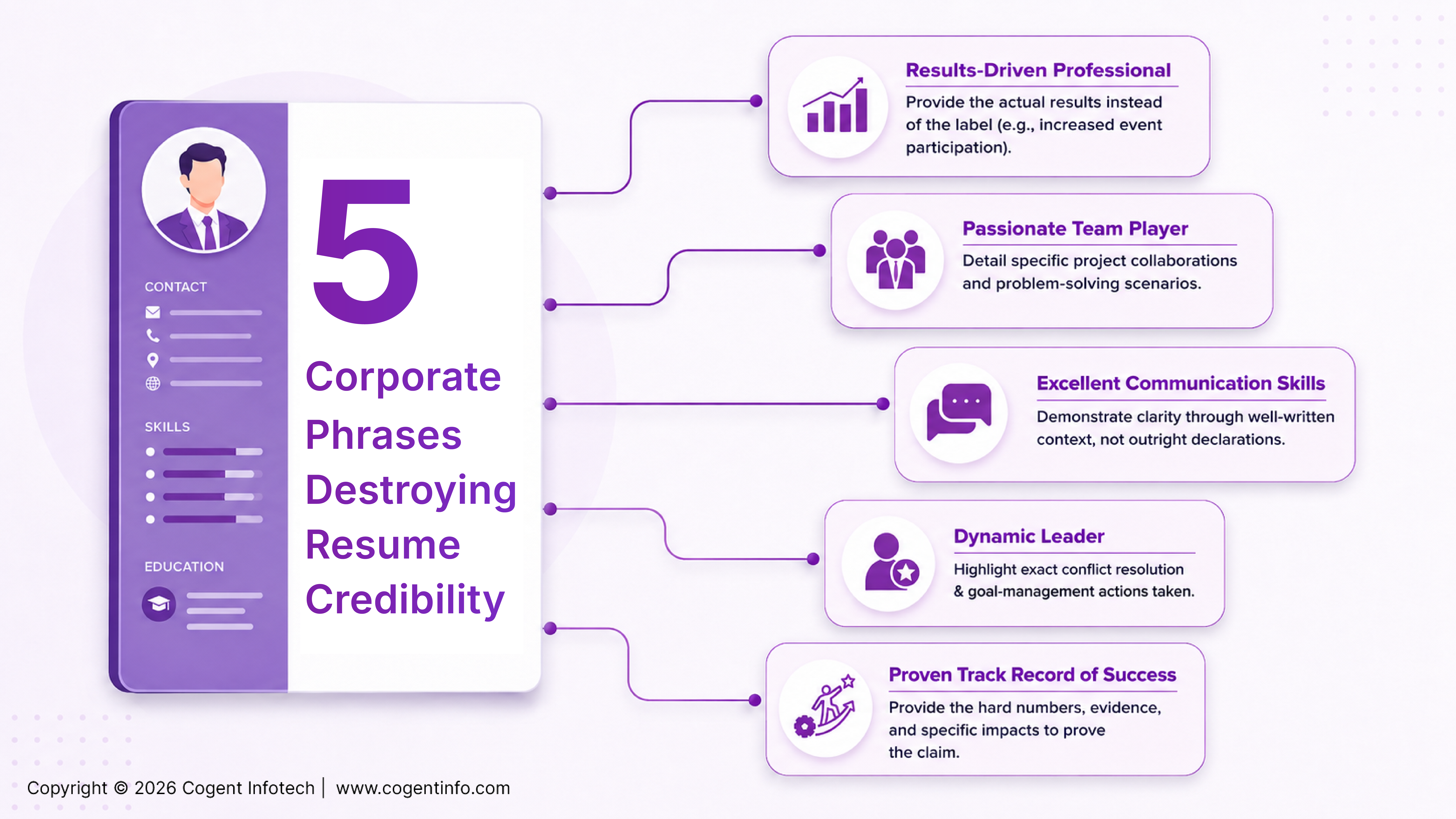
1. Results-Driven Professional
Every applicant seems to be results-driven. The phrase appears so frequently that it has become one of the most predictable lines in modern resumes. The problem is not that recruiters dislike the phrase. The problem is that it tells them nothing.
Recruiters don't care that you're results-driven. They care about the results themselves.
Instead of claiming to be focused on results, show them. Did you increase event participation? Grow a social media page? Improve a process? Achieve a specific outcome? Evidence will always be more convincing than a label.
2. Passionate Team Player
Passion is valuable. Teamwork is valuable. But simply stating that you're a passionate team player doesn't prove either one.
Recruiters would rather read about the time you collaborated with classmates to organize a festival, complete a project, or solve a difficult problem than read another generic statement about teamwork. Stories create credibility. Labels don't.
3. Excellent Communication Skills
This phrase is particularly ironic because communication skills should reveal themselves naturally throughout an application.
A well-written resume, thoughtful examples, and a strong interview demonstrate communication skills far more effectively than announcing them outright. Saying you have excellent communication skills is like saying you're funny and then explaining the joke.
4. Dynamic Leader
Leadership isn't something you declare. It's something you demonstrate.
Recruiters are much more interested in hearing how you led a team, resolved a conflict, managed responsibilities, or motivated others toward a goal. Leadership becomes believable when it's attached to actions rather than adjectives.
5. Proven Track Record of Success
This phrase often appears without any proof following it, which defeats the entire purpose.
If your success is proven, provide the evidence. Mention the achievement. Share the numbers. Explain the impact. Let the recruiter arrive at the conclusion themselves.
Stories are memorable. Buzzwords are forgettable.
And in a hiring market where recruiters may review hundreds of applications for a single role, being memorable matters far more than sounding impressive.
The Human Story Is Becoming More Valuable
Here's the irony nobody saw coming.
The more AI-generated content enters the hiring process, the more valuable authentic human experiences become.
Recruiters may forget dozens of polished applications by the end of the day, but they rarely forget stories. They remember the student who built a small business while studying full-time. They remember the graduate who organized a campus event despite having no budget. They remember the candidate who failed at something, learned from it, and tried again. These experiences reveal far more about a person than a perfectly worded paragraph ever could.
As AI-generated applications become increasingly common, recruiters are becoming less interested in polished language and more interested in evidence. According to an AI Resume Builder survey, one in five hiring managers reported that more than half of the resumes they receive are AI-generated, while 61% said AI-generated resumes often make candidates appear more qualified than they actually are.
That's a problem because hiring has never been about finding the best-written application. It's about finding the right person.
And when every application sounds impressive, impressive stops meaning anything.
What Recruiters Actually Want
One of the biggest misconceptions among students and graduates is that recruiters are searching for perfection.
They're not.
Most recruiters understand that entry-level candidates are still figuring things out. They don't expect years of experience, flawless resumes, or extraordinary achievements. What they're searching for is evidence that someone can learn quickly, solve problems, work with others, and contribute to a team.
Unfortunately, many candidates try to compensate for limited experience by making their applications sound bigger than they really are. A college project becomes a strategic initiative. A classroom presentation becomes executive communication. An internship task becomes transformational leadership.
The result is often the opposite of what they intended.
Instead of sounding impressive, applications start sounding generic. Instead of appearing qualified, candidates become indistinguishable from everyone else using the same language.
Recruiters don't hire adjectives. They hire proof.
That's why a candidate who clearly explains how they managed a student event, handled a difficult project, or learned a new skill often leaves a stronger impression than someone hiding behind corporate jargon.
The Bigger Problem Nobody Talks About
The real danger isn't that ChatGPT writes bad resumes.
The real danger is that it creates the illusion that job searching is primarily a writing problem.
It isn't.
Job searching is an evidence problem.
A perfectly written application cannot compensate for a lack of substance. It cannot replace skills. It cannot replace experience. And it certainly cannot replace the ability to explain your own work during an interview.
Yet many candidates are spending more time optimizing prompts than building portfolios. More time generating cover letters than developing skills. More time polishing descriptions than creating accomplishments worth describing.
Meanwhile, recruiters are becoming overwhelmed. LinkedIn has reported a dramatic surge in applications, with application volume rising by more than 45% year-over-year, a trend many recruiters partially attribute to AI-assisted applications and automation tools.
The result is a hiring environment where candidates are applying to more jobs, recruiters are reviewing more applications, and neither side feels like the process is working better.
AI made applying easier. It did not make standing out easier.
Conclusion: The New Competitive Advantage
For years, job seekers believed the biggest challenge was writing the perfect resume. Today, anyone can generate a polished application in minutes. As good writing becomes easier to access, it stops being a competitive advantage.
The advantage now lies in genuine experiences, real skills, critical thinking, and the ability to communicate authentically. When everyone sounds polished, recruiters remember what feels real.
In a world full of AI-generated applications, being human is becoming a competitive advantage.
Ready to build the skills, confidence, and real-world experience that employers actually value?
Explore the learning opportunities at Cogent University.


.png)
