Thank you! Your submission has been received!
Oops! Something went wrong while submitting the form.


Not long ago, pursuing a technology career typically meant working for a software company or an IT department. Today, that reality has changed dramatically.
Technology has become the foundation of modern business across virtually every industry. Hospitals rely on advanced data systems to improve patient care. Financial institutions use artificial intelligence to detect fraud. Retail companies analyze customer behavior through data analytics. Manufacturers automate production processes using smart technologies. Even industries once considered far removed from technology now depend heavily on digital tools to operate efficiently and remain competitive.
As organizations continue investing in innovation, the demand for skilled technology professionals has reached unprecedented levels. Companies are searching for people who can build intelligent systems, secure digital infrastructure, analyze complex data, develop software solutions, and help organizations navigate an increasingly digital world.
This shift raises an important question for students, job seekers, and career changers alike: Which technology roles are most in demand right now, and what makes them so valuable in today's workforce?
Understanding where the greatest opportunities exist can help professionals make smarter career decisions and prepare for a future filled with possibility.
The growing demand for technology professionals is not simply a temporary trend. It reflects a fundamental transformation in how organizations operate.
Businesses today compete in a digital-first economy. Customers expect fast, seamless, personalized experiences whether they are shopping online, accessing healthcare services, or managing finances through mobile applications. To meet these expectations, organizations must continuously invest in technology.
At the same time, artificial intelligence and automation are reshaping business operations. Contrary to common fears, these technologies are not eliminating the need for human talent. Instead, they are creating new opportunities for professionals who can develop, manage, improve, and oversee intelligent systems.
One of the biggest challenges employers face is the growing skills gap. Technology continues evolving faster than many organizations can recruit qualified professionals. Companies frequently report difficulty finding candidates with the right combination of technical expertise, problem-solving ability, and practical experience.
For students and career changers, this presents a significant opportunity. Individuals who develop in-demand technology skills often find themselves entering a job market eager for their expertise.
Few fields have experienced growth as explosive as artificial intelligence.
From customer service chatbots and predictive analytics to medical diagnostics and business automation, AI is influencing nearly every industry. Organizations are increasingly adopting AI-driven solutions to improve efficiency, reduce costs, and gain competitive advantages.
Artificial intelligence engineers play a central role in this transformation. Their responsibilities often include developing machine learning models, training algorithms, optimizing AI systems, and creating intelligent solutions that solve real-world business challenges. These professionals combine programming expertise with data analysis and mathematical modeling to create systems capable of learning and improving over time.
Employers commonly seek candidates with skills in machine learning, Python programming, data science, neural networks, natural language processing, and AI development platforms.
As generative AI continues to evolve and businesses expand their use of intelligent technologies, AI engineering remains one of the most promising career paths available today. Experts widely expect demand for AI talent to continue growing for many years to come.
Modern organizations generate enormous amounts of data every day. Customer interactions, financial transactions, operational activities, marketing campaigns, and digital experiences all produce valuable information.
However, raw data alone has little value. Organizations need professionals who can transform information into meaningful insights that guide business decisions.
This is where data scientists and data analysts become indispensable.
While the two roles share similarities, they often serve different functions. Data analysts typically focus on examining existing datasets, identifying trends, creating reports, and helping organizations understand what has happened and why.
Data scientists often take a more advanced approach by building predictive models, developing algorithms, and using sophisticated analytical techniques to forecast future outcomes. Both roles require strong analytical thinking, statistical knowledge, data visualization skills, and business awareness. Professionals must be capable of communicating complex findings in ways that decision-makers can understand and act upon.
As organizations increasingly rely on evidence-based decision-making, the demand for data professionals continues to expand across healthcare, finance, retail, education, manufacturing, and countless other sectors.
As businesses become more connected, cybersecurity has become one of the most critical priorities for organizations worldwide.
Cyber threats continue growing in both frequency and sophistication. Data breaches, ransomware attacks, phishing campaigns, and network intrusions can result in significant financial losses, regulatory penalties, and reputational damage. Today, cybersecurity is no longer viewed as simply an IT concern. It has become a core business function.
Organizations require professionals who can identify vulnerabilities, prevent attacks, monitor systems, and respond effectively when security incidents occur.
Several cybersecurity specialties are experiencing strong demand. Security analysts help monitor and protect networks. Security engineers design secure infrastructure and systems. Ethical hackers identify weaknesses before malicious actors can exploit them. Threat intelligence specialists analyze emerging risks and help organizations prepare for evolving threats.
Successful cybersecurity professionals typically possess expertise in risk assessment, network security, cloud security, incident response, compliance requirements, and security monitoring tools. Because digital threats continue evolving, cybersecurity careers offer both long-term stability and ongoing opportunities for growth.
Cloud computing has transformed how organizations manage technology infrastructure.
Instead of relying solely on expensive on-premises systems, businesses now use cloud platforms that offer greater flexibility, scalability, and efficiency. Cloud services allow organizations to store data, run applications, support remote work, and rapidly scale operations when needed. As cloud adoption continues accelerating, demand for cloud specialists remains exceptionally strong.
Cloud engineers help design and manage cloud environments. Cloud architects create long-term infrastructure strategies. Cloud administrators maintain systems and ensure performance. DevOps specialists often work closely with cloud technologies to streamline software development and deployment processes.
Professionals entering this field benefit from expertise in major cloud platforms, automation tools, infrastructure management, networking, and cloud security.
Because organizations increasingly depend on cloud-based operations, cloud computing skills have become some of the most valuable technical competencies in today's job market.
Despite the emergence of new technologies, software development remains one of the most essential and versatile career paths in the technology sector. Every mobile app, website, business platform, healthcare system, banking application, and digital service relies on software.
What makes software development particularly attractive is its broad applicability. Developers are needed not only by technology companies but also by organizations across healthcare, finance, education, manufacturing, entertainment, government, and retail. Modern software development extends beyond writing code. Developers frequently collaborate with designers, product managers, business stakeholders, and quality assurance teams to create solutions that meet user needs.
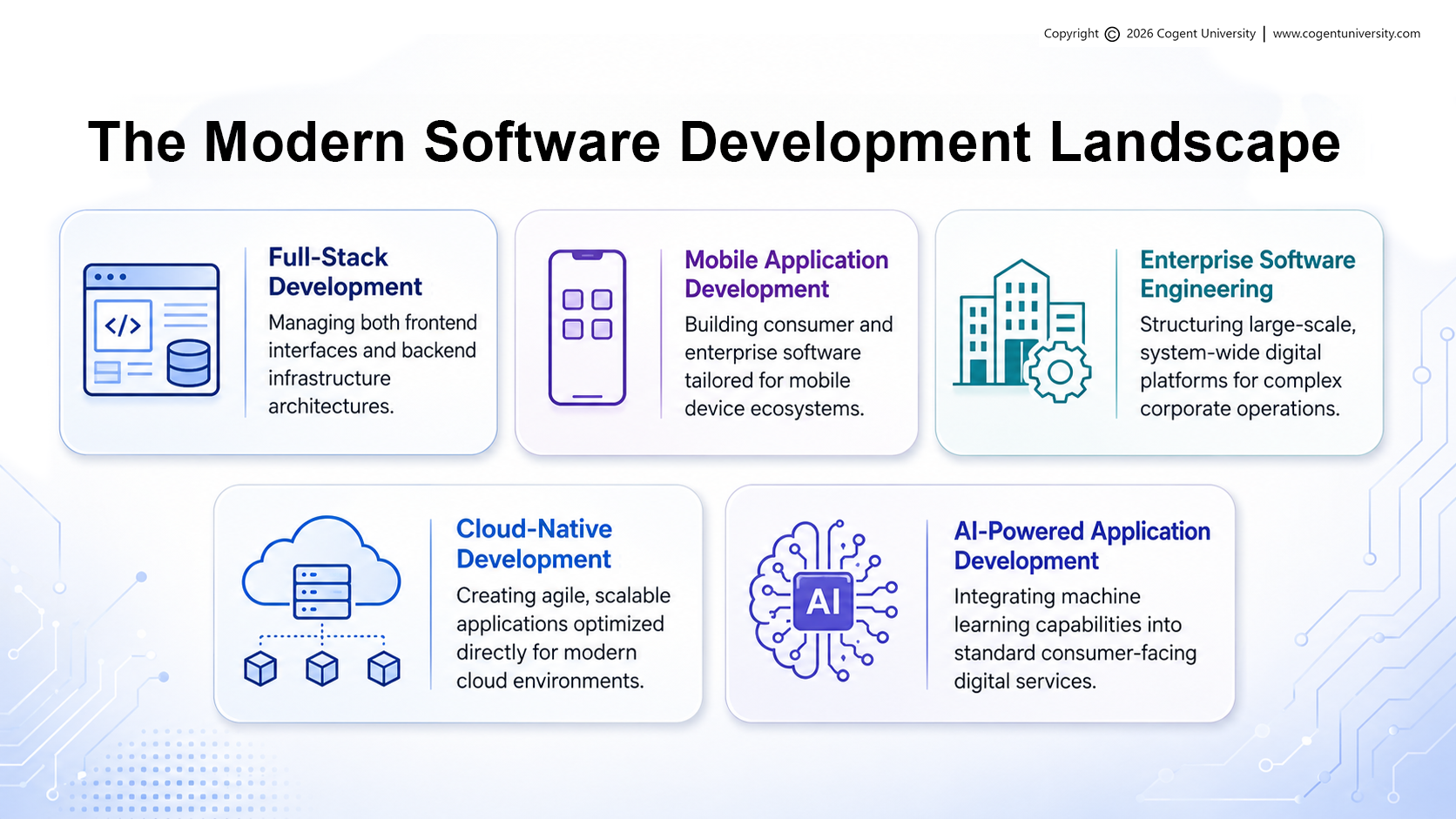
Today's opportunities include full-stack development, mobile application development, enterprise software engineering, cloud-native development, and AI-powered application development.
The ability to solve problems, adapt to new technologies, and create valuable digital experiences ensures software developers remain highly sought after across industries.
In today's digital environment, customers expect applications and services to be available at all times. A website outage, application failure, or system slowdown can quickly lead to lost revenue, customer frustration, and reputational harm. This need for reliability has fueled demand for DevOps and Site Reliability Engineering (SRE) professionals.
DevOps specialists help bridge the gap between software development and IT operations. They focus on improving collaboration, automating processes, accelerating deployment cycles, and enhancing system performance. Site Reliability Engineers take a similar approach while emphasizing reliability, scalability, and operational excellence.
Employers increasingly value professionals who understand automation, cloud infrastructure, continuous integration, continuous deployment, monitoring systems, and performance optimization.
As organizations continue expanding their digital operations, these roles have become essential to maintaining seamless customer experiences.
When people discuss artificial intelligence and analytics, they often focus on data scientists and machine learning experts. Yet none of those initiatives can succeed without strong data infrastructure. That infrastructure is built and maintained by data engineers.
Data engineers design systems that collect, organize, store, and process massive amounts of information. They develop data pipelines, manage databases, and ensure that information remains accurate, accessible, and reliable. Their work creates the foundation that enables analytics teams, business leaders, and AI systems to function effectively.
As organizations invest more heavily in artificial intelligence, demand for skilled data engineers continues rising rapidly. Industries including finance, healthcare, retail, manufacturing, and technology all depend on professionals who can manage increasingly complex data ecosystems.
Technology success depends on more than functionality. It also depends on how people experience and interact with digital products.
Customers have little patience for confusing interfaces, frustrating navigation, or poor digital experiences. As a result, organizations increasingly recognize the value of user-centered design. UX (User Experience) and UI (User Interface) professionals help ensure digital products are intuitive, accessible, and enjoyable to use.
Their work often includes researching user behavior, identifying customer needs, creating wireframes, testing designs, and refining digital experiences based on feedback. Strong UX/UI professionals combine creativity with analytical thinking. They understand design principles while also appreciating business goals and user psychology.
As digital products become increasingly important across industries, opportunities for experience designers continue expanding.
Behind every successful technology product is someone responsible for aligning customer needs, business objectives, and technical execution. That person is often a product manager.
Product managers serve as strategic leaders who guide products from concept to launch and beyond. They work closely with developers, designers, marketers, executives, and customers to ensure products deliver meaningful value.
As technology products become more sophisticated, organizations increasingly rely on skilled product managers to coordinate efforts across multiple teams. Success in this field requires strong communication, leadership, strategic thinking, analytical skills, and a deep understanding of customer needs.
The growing emphasis on innovation and customer-centered development continues driving demand for product management professionals.

While established technology roles remain strong, several emerging career paths are gaining significant attention.
Generative AI specialists are helping organizations implement advanced AI capabilities and develop practical applications for emerging technologies.
AI workflow and automation experts are streamlining business operations through intelligent automation systems.
Robotics and intelligent systems professionals are supporting innovation in manufacturing, healthcare, logistics, and industrial automation.
AR, VR, and spatial computing specialists are finding opportunities as immersive technologies expand beyond gaming and entertainment into training, education, healthcare, and workplace collaboration.
Blockchain and decentralized technology professionals continue exploring new applications related to security, digital identity, financial systems, and trusted transactions.
These fields may still be evolving, but they offer exciting possibilities for professionals interested in shaping the next generation of technology.
While technical expertise remains essential, employers increasingly look for a combination of technical and human-centered skills.
Technical knowledge helps candidates enter the field. Familiarity with industry tools, programming languages, cloud platforms, security frameworks, data systems, and certifications can significantly improve employability. However, technical abilities alone are rarely enough for long-term career success.
Organizations also value communication, collaboration, adaptability, critical thinking, creativity, leadership, and emotional intelligence. Technology professionals must frequently explain complex concepts, work across departments, and solve business challenges that extend beyond technical considerations.
Perhaps most importantly, employers seek individuals who demonstrate a commitment to continuous learning. Technology evolves rapidly, and professionals who consistently update their skills are often best positioned for advancement.
Entering the technology field no longer requires following a single traditional path. Many successful professionals begin through degree programs, certifications, boot camps, self-directed learning, or combinations of multiple educational experiences.
The key is developing practical, career-ready skills that align with employer needs.
Students should focus on building strong technical foundations while gaining hands-on experience through projects, internships, labs, and portfolio development. Real-world application often carries significant weight during the hiring process.
Professional networking can also play an important role. Building relationships with mentors, industry professionals, instructors, and peers can create valuable opportunities for learning and career advancement.
Equally important is developing confidence in communication and personal branding. Candidates who can clearly articulate their skills, accomplishments, and problem-solving abilities often stand out in competitive hiring environments.
Ultimately, employers want evidence that candidates can contribute value, adapt to change, and continue growing throughout their careers.
The future of technology careers is exceptionally promising.
Artificial intelligence will continue reshaping industries, but it will also create entirely new categories of work. Existing roles will evolve, and opportunities that do not currently exist will emerge as technology advances. In this environment, adaptability may become the most valuable skill of all.
The professionals who thrive will not necessarily be those who master a single technology. They will be those who remain curious, continuously learn, and successfully adapt to changing industry demands.
Building transferable skills such as problem-solving, communication, collaboration, and critical thinking will help professionals remain valuable even as technologies evolve.
The future belongs to lifelong learners who embrace change rather than resist it.
.png)
Technology careers are no longer limited to the technology sector. Organizations across healthcare, finance, retail, education, manufacturing, government, and countless other industries depend on skilled professionals who can drive digital innovation.
From artificial intelligence engineers and data scientists to cybersecurity specialists, cloud professionals, software developers, product managers, and UX designers, today's most in-demand tech roles are shaping the future of work. While technical expertise opens doors, long-term success comes from combining those skills with adaptability, continuous learning, and strong professional capabilities.
For students, working professionals, and career changers, there has never been a better time to invest in technology-focused education and skill development.
At Cogent University, learners can build the practical knowledge, industry-relevant skills, and professional confidence needed to pursue rewarding careers in today's rapidly evolving technology landscape.
The opportunities of tomorrow are being created today. The best time to prepare for them is now.
The future is full of opportunities. Build the skills to make the most of them with Cogent University.
.png)
Dedicated to your professional growth, Cogent University offers comprehensive tech training. We combine practical, project-based learning with elite career support to build tomorrow's developers.