

Introduction
In today’s fast-paced software landscape, businesses constantly seek ways to accelerate delivery without sacrificing quality or security. As products scale and development teams grow, the complexity of infrastructure, tooling, and workflows can become a significant bottleneck. That’s where platform engineering comes into play, a discipline that promises to free developers from repetitive operational burdens and let them focus on what they do best: writing code and delivering features.
In essence, platform engineering involves building and maintaining a unified, internal layer, commonly referred to as an Internal Developer Platform (IDP), that centralizes infrastructure, tooling, and best practices. Internal platforms provide self-service capabilities, streamlined workflows, and standardization. As a result, development teams enjoy faster deployments, reduced errors, improved developer experience (DevEx), and often better alignment between engineering output and business goals.
This blog explores why, by 2026, dedicated internal platforms will likely revolutionize developer velocity. We’ll break down what platform engineering is, why it matters, its key benefits, how companies are implementing it, challenges to watch for, and best practices for success.
What Is Platform Engineering (And What Is an IDP)?
At its core, platform engineering is a discipline that builds and manages an Internal Developer Platform (IDP), a self-service layer that abstracts away complexity and provides developers with a consistent, streamlined set of tools and workflows. The IDP acts like an internal “tool-shop” or workspace that developers can use to build, deploy, and operate applications without having to deal with infrastructure, configuration, or deployment plumbing every time.
Unlike traditional infrastructure or ad-hoc DevOps setups, platform engineering approaches the development lifecycle with a product mindset. The platform team treats the IDP as a product and considers developers as customers. They gather feedback, iterate, and improve the platform over time, prioritizing usability, scalability, security, and governance, while maximizing developer productivity.
This approach contrasts with the more fragmented, manual approach to managing infrastructure typical of traditional DevOps or SRE setups, where developers often juggle many responsibilities beyond coding, including provisioning environments, deployment, configuration management, monitoring, and more. Platform engineering abstracts and automates these tasks, letting developers focus on delivering features and value.
Why Platform Engineering Matters in 2026: The Trends Driving Adoption
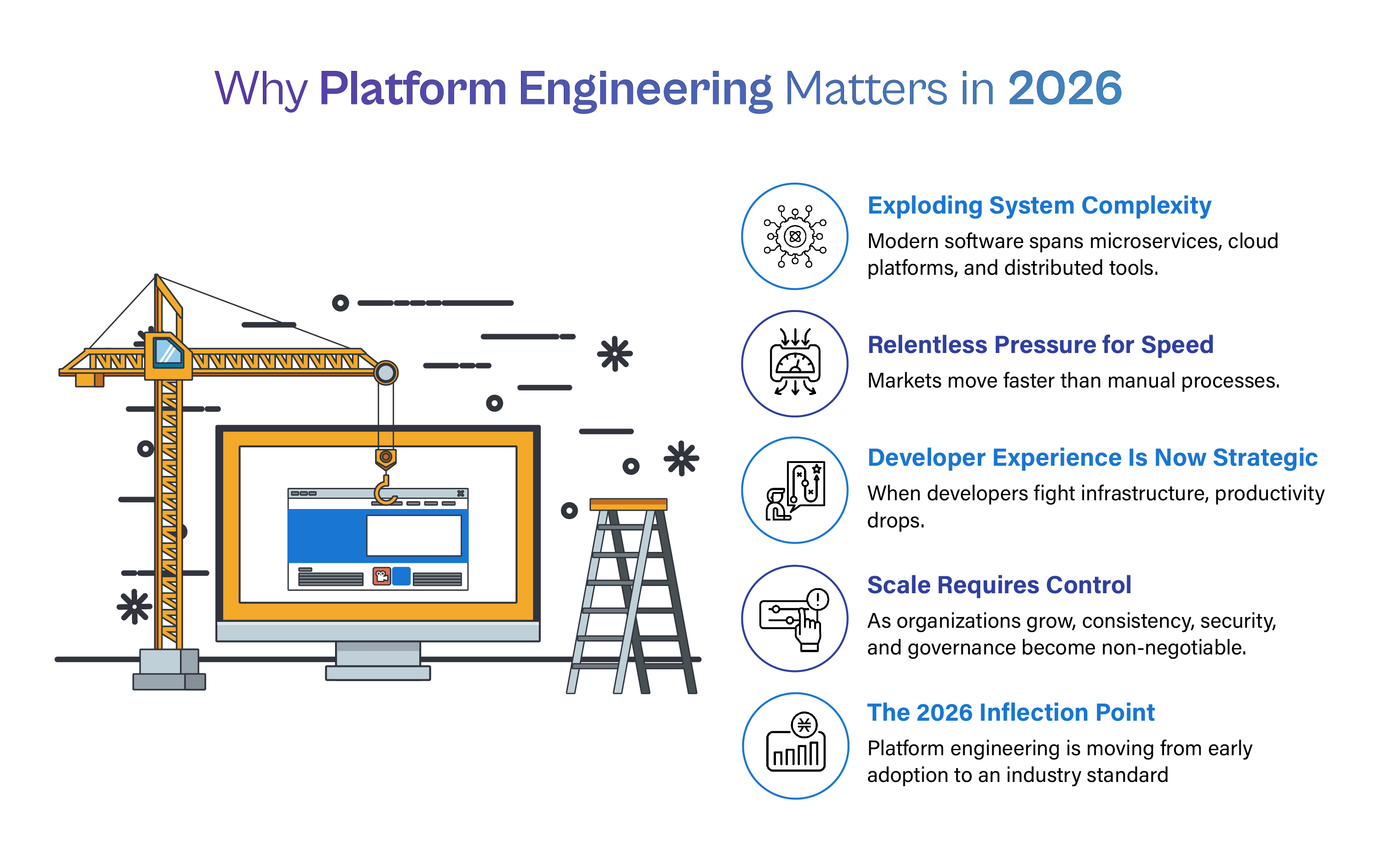
1. Exploding Complexity of Modern Software Systems
Modern applications increasingly rely on microservices, cloud-native architectures, multi-cloud deployments, distributed systems, and a diverse stack of tools and dependencies. Managing such complexity manually poses a considerable challenge. In such a context, building all infrastructure and workflows from scratch for each project becomes inefficient, error-prone, and costly. Many organizations find themselves reinventing the wheel repeatedly, leading to slowdowns and inconsistencies.
An internal platform addresses that complexity by offering “paved roads” or “golden paths” predefined, well-documented, automated workflows that encapsulate best practices. This dramatically reduces developers' cognitive load and mitigates the risk posed by misconfigurations, inconsistent environments, or security gaps.
2. Demand for Speed - Faster Time-to-Market & Frequent Releases
As market demands accelerate, companies that deliver features faster and more reliably gain a competitive edge. Platform engineering reduces the overhead of deploying new services or updates, speeding up release cycles. By enabling self-service provisioning of environments, CI/CD pipelines, monitoring, and other necessary workflows, teams avoid the costly back-and-forth between development and operations. This speed-to-market translates into agility, better customer responsiveness, and faster iteration.
3. Improved Developer Experience (DevEx) and Productivity
A critical benefit of internal platforms lies in improving developer satisfaction and reducing burnout. When developers don’t have to wrestle with infrastructure, repetitive tasks, or complex deployment configurations, they can focus on writing meaningful code. This enhances productivity, lowers friction, and lets teams deliver higher-quality software while reducing errors. The best platforms adopt a user-centric, product-oriented mindset; they treat developers as customers and build tooling accordingly.
4. Scalability, Reliability & Governance at Enterprise Scale
For small teams, ad-hoc infrastructure may suffice. But as organizations scale with dozens of development teams, microservices, and cloud-native workloads, maintaining consistency, compliance, and reliability becomes critical. Internal platforms help standardize environments, enforce security and compliance policies, and manage shared infrastructure. That ensures teams adhere to governance while enjoying speed and autonomy.
5. Industry Momentum & Growing Adoption: The 2026 Inflection Point
Industry analysts and surveys highlight a clear trend: platform engineering is gaining widespread adoption. Many organizations view it as the next evolutionary step beyond DevOps and SRE. A significant number of companies are already building dedicated platform teams, and the number continues to grow. Experts forecast substantial adoption of platform engineering by 2026, making internal platforms the norm rather than the exception.
Given these converging forces, complexity, speed requirements, scale, and organizational growth, 2026 seems poised to be a pivotal year when platform engineering moves from “best practice for some” to “standard practice for most” in software-driven organizations.
Core Benefits of Dedicated Internal Platforms
Dedicated internal platforms reshape how development teams operate by removing friction from everyday workflows and replacing fragmented processes with a structured, self-service environment that supports speed, consistency, and control. Instead of navigating disconnected tools, manual configurations, and time-consuming dependencies, teams gain access to a centralized foundation that simplifies complex tasks and streamlines the entire development lifecycle. This shift not only enhances productivity but also aligns engineering efforts more closely with business goals, allowing organizations to scale efficiently while maintaining stability, quality, and operational clarity. Here’s a closer look at what organizations can achieve by embracing dedicated internal platforms:
- Dramatically Reduced Cognitive Load & Developer Toil
By centralizing infrastructure, tooling, workflows, and providing self-service capabilities, IDPs remove many tedious, repetitive tasks from developers’ plates. That means less time wasted on provisioning, configuration, bug-prone scripts, manual deployments, or environment inconsistencies, leaving more time for feature development and creative engineering.
- Faster Time to Market & More Frequent Releases
With pre-configured environments, deployment automation, CI/CD pipelines, and golden paths, teams can ship new features or fixes rapidly, often multiple times per day or week, depending on maturity. This improved velocity gives businesses a competitive advantage by enabling quicker feedback, iteration, and user value delivery.
- Better Developer Experience, Satisfaction, and Retention
Developers often leave behind frustrating tooling and slow processes. Internal platforms improve developer experience by offering consistent, reliable, and easy-to-use interfaces. This translates to higher job satisfaction, lower attrition, and better focus on value-driven work.
- Standardization, Compliance, and Governance at Scale
At enterprise scale, compliance, security, and maintainability matter. Internal platforms enable organizations to embed best practices (such as security, role-based access, observability, and compliance) by default. They ensure that all services across teams adhere to consistent standards, reducing risk and technical debt.
- Cost-Efficiency and Resource Optimization
By reusing shared infrastructure components and streamlining workflows, companies can avoid redundant work, reduce environmental sprawl, and achieve better resource utilization. Internal platforms make it easier to manage cloud resources, track usage, and optimize costs.
Real-World Implementation: How Companies Approach Platform Engineering
Adopting platform engineering isn’t simply about installing a suite of tools. It involves cultural shift, organizational commitment, and a product mindset towards internal infrastructure. Here’s how companies are making it work:
1. Treat the Platform as a Product, Developers as Customers
Successful platform teams treat their internal platform as a software product. They gather feedback from developers (“customers”), iterate, and evolve the platform based on actual usage patterns. That means building self-service, intuitive developer portals, service catalogs, automated workflows, observability tools, and golden paths that reflect developers' true needs.
2. Start with a Minimum Viable Platform (MVP); Build Incrementally
Rather than attempting a monolithic “big-bang” rollout, most mature platform engineering initiatives begin with a minimal viable platform that covers a core set of workflows, such as environment provisioning, CI/CD, monitoring, and deployment. Over time, they add more capabilities based on developer feedback and evolving needs, growing the platform iteratively.
3. Provide Golden Paths But Allow Flexibility
Golden paths are predefined workflows, the recommended “fast-track” for everyday tasks. But a good platform doesn’t lock developers into rigid paths. It allows exceptions and customizations when needed, balancing standardization with flexibility. This ensures teams don’t feel constrained by the platform when they need to innovate or take unconventional approaches.
4. Bake in Security, Compliance, Observability & Governance from Day One
Platform engineering must incorporate policies, role-based access controls, automated security checks, consistent environments, logging, and monitoring, all of which are foundational rather than afterthoughts. This ensures consistent compliance across teams, reduces security risks, and enables fast deployments.
5. Align Platform Strategy with Business Goals & Developer Needs
Platform initiatives succeed when they align with broader business objectives (faster time-to-market, cost efficiency, scalability) and address real developer pain points. Platform teams should work closely with engineering leadership, product teams, and developers to understand workflows and prioritize what the IDP should support.
Forecast for 2026: Why This Year Could Mark a Turning Point
Growing industry momentum and emerging insights indicate that 2026 will mark a significant turning point in the adoption and business impact of platform engineering.
- Analysts expect broad adoption: As more organizations recognize the value of platform engineering, many large enterprises will establish dedicated platform teams, providing reusable services, components, and tools at scale.
- Growing need for developer velocity: Market pressure and competition demand faster iterations, continuous delivery, and a rapid innovation cycle that internal platforms directly address.
- Maturation of tooling and platform ecosystem: With open-source projects, managed cloud services, and mature platform engineering practices becoming more accessible, the barrier to entry is lower, making IDPs feasible even for mid-sized companies.
- Demand for DevEx in talent markets: With developer burnout and retention becoming critical concerns, organizations investing in internal platforms gain a competitive advantage in hiring and retaining talent.
- Alignment with broader trends such as cloud-native migration, microservices, DevSecOps, and increased regulation (security/compliance), all of which demand standardized, scalable, and governed infrastructure.
Taken together, these dynamics set the stage for internal platforms to shift from early adopters to mainstream foundational infrastructure. In 2026, we expect many more organizations to operate with platform engineering as a core pillar, fundamentally transforming how software development and delivery happen.
Challenges and Risks and What to Watch Out For
While platform engineering brings powerful advantages, it does not guarantee success without careful planning and execution. As organizations move toward dedicated internal platforms, they must acknowledge that this shift introduces its own complexities, operational considerations, and strategic risks. Organizations should be mindful of the following challenges:
Over-Engineering or “Inner-Platform Effect”
There is a risk of over-building the platform to the point that it becomes a complex, hard-to-maintain ecosystem, sometimes recreating the complexity it was meant to hide. This phenomenon, sometimes referred to as the “inner-platform effect”, can lead to inefficiencies and slowdowns if not carefully managed.
One-Size-Fits-All Approach May Not Work for All Teams
Different teams often have different needs. A monolithic, overly rigid platform may fail to meet the unique requirements of some teams, leading them to bypass the platform altogether. Therefore, striking a balance between standardization and flexibility is critical.
Organizational Resistance or Cultural Barriers
Platform engineering requires a shift in mindset, from treating infrastructure as a set of tasks to treating it as a product. Without leadership buy-in and developer trust, adoption may falter. Teams must be prepared for change management, documentation, and consistent governance.
Maintenance Overhead and Ownership Gaps
An internal platform must evolve, adding new capabilities, patching security, integrating new tools, and onboarding new teams. Without dedicated ownership and continuous investment, the platform can degrade, experience technical debt, or fail to scale properly.
Risk of Lock-in or Poor Abstraction
If the platform abstracts too much, teams may lose flexibility or become dependent on specific internal tooling. That can hamper innovation or make it harder to adopt new tools or technologies later.
Best Practices for Building Effective Internal Platforms
Building an internal platform that delivers real business and developer value requires more than technical expertise, as it demands strategic planning, continuous improvement, and a deep understanding of how developers actually work. Success depends on creating a structured approach that balances agility with stability, innovation with governance, and automation with usability.
By following proven best practices, organizations can ensure their internal platforms remain scalable, adaptable, and aligned with both engineering needs and broader business objectives, ultimately turning them into long-term catalysts for productivity, efficiency, and sustainable growth.
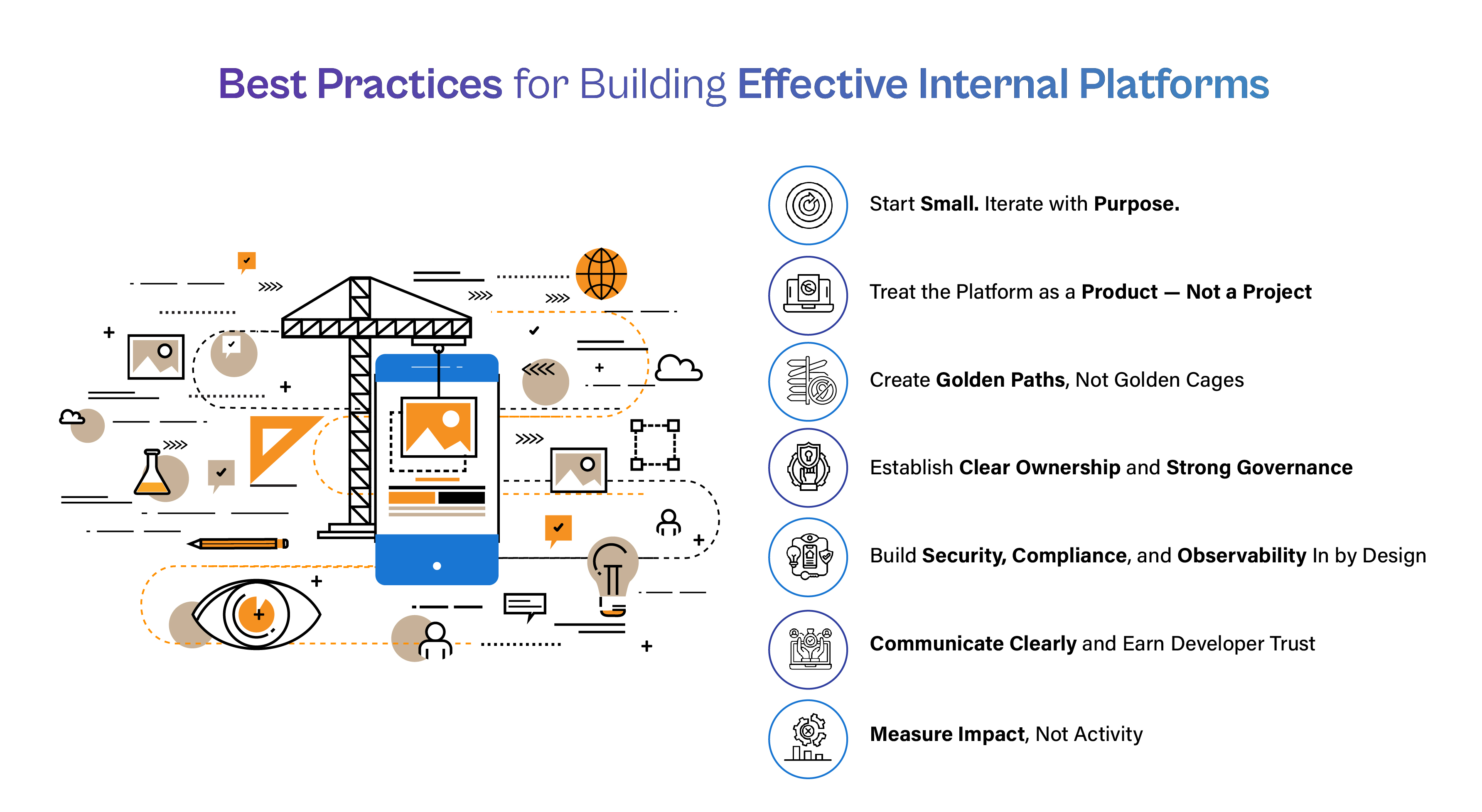
- Start small and iterative: Build a minimum viable platform covering core workflows (environment provisioning, CI/CD, monitoring). Grow incrementally based on real-world usage.
- Treat the platform as a product; listen to developers: Solicit feedback, iterate, and evolve the platform based on what developers need, not what leadership assumes they need.
- Design golden paths, but allow escape hatches: Provide opinionated, efficient defaults for most use cases, while enabling flexibility for teams with special requirements.
- Ensure strong ownership and governance: Assign a dedicated platform team to maintain, update, secure, ensure compliance, and document.
- Bake in observability, security, and compliance early: Don’t leave these as afterthoughts. Build them into the platform’s foundation to ensure reliability and governance.
- Communicate and evangelize internally: Promote the platform, advocate its benefits, and ensure developers understand why and how to use it. Adoption depends heavily on trust and buy-in.
- Measure impact with meaningful metrics: Track developer experience, deployment frequency, lead time, defect rates, and resource utilization to prove ROI and guide further investment.
Why Platform Engineering Matters for Organizations and Enterprises Globally
In an increasingly competitive and technology-driven global landscape, platform engineering has emerged as a strategic enabler for organizations seeking to scale efficiently while maintaining agility, control, and innovation. As enterprises expand across distributed teams, cloud environments, and complex service ecosystems, they require a unified foundation that supports rapid development without compromising governance or stability.
Platform engineering provides this foundational layer by aligning technical operations with business priorities, strengthening organizational resilience, and promoting operational consistency at scale. The following points illustrate why this approach now plays a critical role in helping organizations remain competitive, adaptable, and future-ready across global markets:
- Faster innovation cycles: markets change rapidly; companies that ship features quickly can stay ahead. IDPs accelerate release cycles and enable continuous delivery.
- Cost control, scalability, and efficient cloud resource usage: internal platforms help optimize infrastructure use and reduce waste, a key concern for cloud-heavy operations.
- Compliance, security, and governance: given increasingly stringent data security and regulatory requirements (especially around data privacy, industry compliance, and audits), a well-governed platform that enforces controls by default becomes a valuable asset.
- Developer recruitment and retention: top engineering talent values efficiency, modern tooling, and developer-friendly workflows. A strong internal platform improves developer satisfaction and reduces friction.
- Sustainability and future readiness: as organizations adopt microservices, multi-cloud or hybrid environments, AI/ML workloads, and composable architectures, an internal platform provides the backbone to reliably support these evolving needs.
In competitive markets like the U.S., platform engineering can help organizations stay agile, secure, and efficient while focusing on delivering business value rather than firefighting infrastructure issues.
Conclusion
Platform engineering represents a paradigm shift in how organizations deliver software. By building and maintaining Internal Developer Platforms, with self-service capabilities, golden paths, automated workflows, and strong governance, companies unlock developer productivity, accelerate time-to-market, reduce operational overheads, and deliver higher-quality software consistently.
As complexity grows, markets demand speed, and scale becomes a necessity, platform engineering stands out as an indispensable practice. With analysts predicting widespread adoption as early as 2026, internal platforms are poised to become the backbone of modern software organizations.
To harness this revolution, organizations must embrace a product mindset towards their internal tools, build incrementally, invest in ownership and governance, and treat developers as customers. Those who adopt platform engineering successfully will not just deliver software, they will elevate developer experience, drive business agility, and stay ahead in a fast-changing digital world.
If you’re part of a growing engineering organization, or planning to scale, now is the time to consider building your own internal platform. The payoff is high: speed, scale, security, and satisfaction.



.png)