

You update your resume. You create accounts on every major job board. You spend evenings scrolling through openings, tailoring applications, and clicking "Submit" over and over again.
At first, the process feels hopeful. Every application represents a possibility. Every job posting feels like it could be the opportunity that finally launches your career or helps you take the next step professionally.
Then weeks pass. You check your inbox constantly. Nothing. You refresh your application dashboards. Still nothing. You apply to 20 more jobs, then 50 more, then 100 more. And somehow, despite all the effort, interview invitations never seem to arrive.
If this sounds familiar, you're far from alone.
Across the United States, job seekers and recent graduates are experiencing one of the most frustrating hiring environments in recent years. Headlines often talk about unemployment rates, labor shortages, and companies hiring aggressively, but many candidates are discovering a different reality. While opportunities exist, competition for those opportunities has become more intense, and getting noticed has become significantly harder.
The good news is that a lack of interview calls does not necessarily mean you are unqualified. In many cases, talented candidates are being overlooked because the hiring process itself has changed. Understanding those changes is often the first step toward improving your results.
The Job Market Looks Stronger Than It Feels
One of the most confusing aspects of today's job market is the disconnect between what people hear and what they experience.
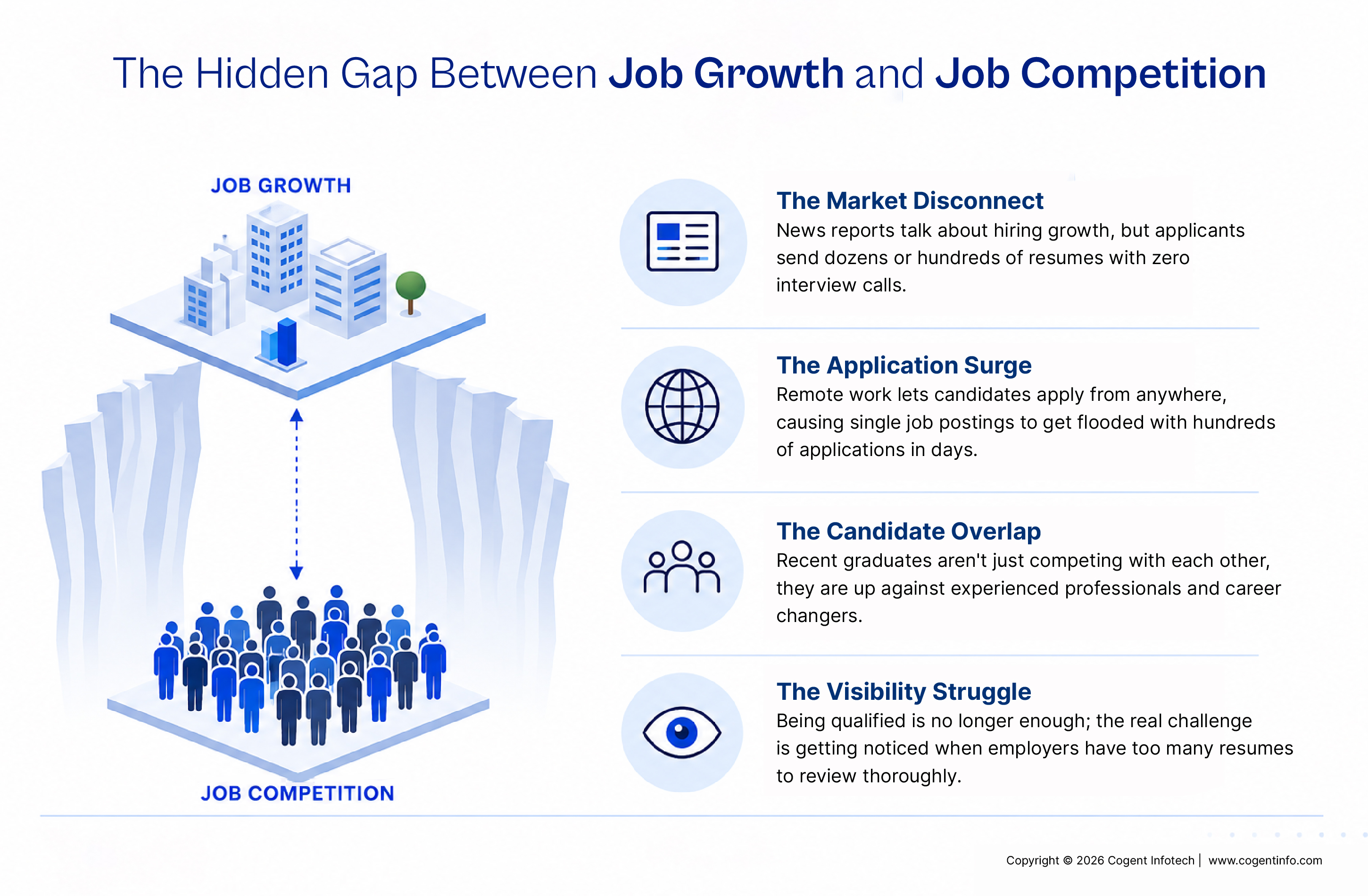
News reports frequently discuss hiring growth and new job creation. Yet many applicants report submitting dozens or even hundreds of applications without receiving a single interview request.
The reason is simple: hiring activity and hiring competition are not the same thing.
Many employers are still hiring, but they are receiving significantly more applications than they did just a few years ago. Remote work opportunities have expanded the candidate pool dramatically. A marketing coordinator position in Chicago can attract applicants from Texas, California, Florida, and dozens of other states. An entry-level business analyst role may receive hundreds of applications within days of being posted.
For job seekers, this means the challenge is no longer just being qualified. The challenge is getting noticed among hundreds of other qualified candidates.
That reality can be especially difficult for recent graduates who are entering the workforce for the first time. Many are competing not only against fellow graduates but also against experienced professionals seeking career transitions or re-entering the workforce after layoffs.
The result is a hiring environment where strong candidates are often overlooked simply because employers have too many applications to review thoroughly.
Applying More Is not Always the Answer
Many people approach job searching with a simple assumption: if ten applications don't work, send twenty. If twenty don't work, send fifty. Eventually, the strategy becomes a numbers game. While volume has some value, it is often misunderstood.
Imagine someone throwing darts at a dartboard while blindfolded. Throwing more darts increases the chances of eventually hitting the target, but removing the blindfold would improve the outcome far more than simply throwing faster. The same principle applies to job applications.
Candidates frequently submit the same resume to dozens of different positions. They apply to jobs that only partially match their experience. They rely on quick-apply features that require minimal effort. The result is a high number of applications but a very low response rate.
Employers today are looking for evidence that candidates understand the role, understand the company, and can clearly communicate why they are a strong fit. Generic applications often fail to make that connection.
A candidate who submits 25 carefully targeted applications may receive more interviews than someone who sends 250 generic ones.
Why Your Resume May Be Blending Into the Crowd
A decade ago, simply having a polished resume gave candidates an advantage.
Today, nearly everyone has access to resume templates, resume builders, online examples, and writing tools. As a result, resumes often look professional on the surface while sounding nearly identical underneath.
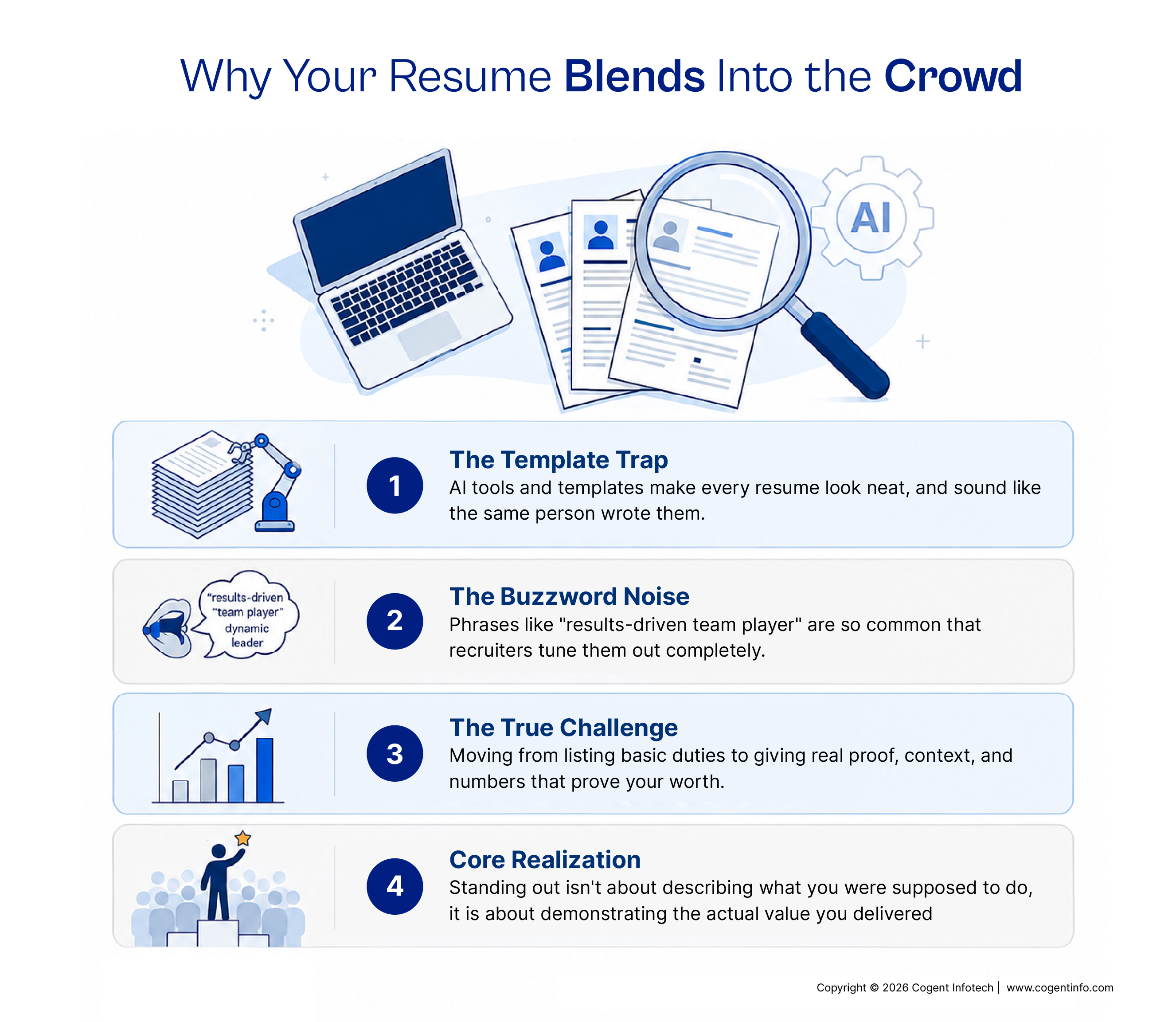
Recruiters routinely encounter phrases such as:
"Results-driven professional."
"Strong communication skills."
"Team player."
"Detail-oriented individual."
While these statements are not necessarily wrong, they are so common that they fail to differentiate one candidate from another. Consider two graduates applying for the same entry-level position.
The first writes:
"Worked with a team to manage projects and improve communication."
The second writes:
"Led a team of six students to organize a campus fundraiser that generated $12,000 for local community programs while coordinating event logistics and volunteer schedules."
Both candidates may possess similar abilities, but the second candidate provides context, impact, and credibility. Hiring managers remember stories. They remember accomplishments. They remember outcomes. They rarely remember buzzwords. The strongest resumes do more than describe responsibilities. They demonstrate value.
Employers Want Evidence, Not Claims
One of the biggest mistakes job seekers make is focusing on what they believe about themselves rather than what they can prove.
Anyone can say they are hardworking. Anyone can claim to be a leader. Anyone can describe themselves as motivated. Employers are far more interested in evidence.
Think about how people make decisions in everyday life. If someone tells you they are a great cook, you might be interested. If they tell you they won a local cooking competition and catered events for 200 people, you become convinced. The same principle applies during hiring. Recruiters are looking for examples that support your claims.
This becomes particularly important for recent graduates who worry they lack professional experience. In reality, experience comes in many forms.
A student who managed a campus organization, completed a capstone project, coordinated volunteers, worked part-time while attending school, or organized community events has already developed valuable workplace skills.
The challenge is presenting those experiences in a way that highlights outcomes rather than simply listing duties.
The Rise of "Experience Inflation"
Many graduates become discouraged when they encounter entry-level jobs asking for one, two, or even three years of experience. It feels unfair. How can someone gain experience if every opportunity requires experience first? While this frustration is understandable, the reality is often more flexible than job descriptions suggest. Many employers use ideal candidate profiles rather than strict requirements.
What they truly want is evidence that a candidate can contribute quickly and adapt effectively. Internships, volunteer work, freelance projects, student leadership positions, and practical coursework can often help bridge this gap.
For example, a recent communications graduate who managed social media accounts for a student organization may have more relevant experience than they realize. A business student who coordinated fundraising initiatives may already possess project management skills. A computer science graduate who built applications outside the classroom may demonstrate stronger practical abilities than candidates with more traditional experience.
Employers increasingly recognize these alternative forms of experience, particularly when candidates clearly explain their impact.
Networking Matters More Than Most People Think
Many job seekers view networking as something reserved for executives, sales professionals, or people with extensive industry connections. In reality, networking is simply building relationships. And in today's hiring environment, relationships often create opportunities that applications alone cannot. Consider two candidates applying for the same position.
The first submits an application through a job board. The second submits an application after attending an industry webinar, connecting with an employee on LinkedIn, and participating in a conversation about the company. Both candidates may be equally qualified. But one candidate is already familiar.
That familiarity can make a significant difference.
Networking does not mean asking strangers for jobs. It means engaging with professionals, learning about industries, seeking advice, and creating authentic connections.
A recent graduate who reaches out to alumni, attends local professional events, joins industry associations, or participates in career-focused communities can dramatically expand their visibility.
Many opportunities arise not because someone had the perfect resume but because someone remembered their name.
The Hidden Competition You Never See
One reason job searching feels discouraging is that candidates only see part of the hiring process. When you apply online, it can feel as though your application is competing against a manageable number of people. The reality is often very different. Many openings receive hundreds of applications within days. Some applicants already have internal referrals. Some are former employees returning to the company. Some have direct recommendations from hiring managers. Others may have previously interned with the organization.
Job seekers rarely see this hidden competition, which can make rejection feel personal when it often is not.
You may lose an opportunity not because you were unqualified but because another candidate had a relationship with the organization, specialized experience, or previous familiarity with the role. Understanding this reality helps put the process into perspective. A rejection is not always a judgment of your abilities. Sometimes it is simply the outcome of a highly competitive environment.
Your Online Presence Matters More Than Ever
Recruiters increasingly research candidates beyond their resumes.
Before scheduling interviews, many hiring teams review LinkedIn profiles, portfolios, personal websites, and professional social media activity. For job seekers, this creates both a challenge and an opportunity. An incomplete online presence can make candidates appear less engaged or less established. A strong online presence, however, can reinforce credibility and provide additional context that a one-page resume cannot.
For example, a marketing graduate who shares insights about industry trends, a graphic designer who showcases creative work, or a finance graduate who discusses market developments can demonstrate enthusiasm and expertise before speaking with a recruiter. Your online presence should support the professional story your resume is telling.
Consistency builds confidence.
Why Recruiter Silence Isn't Always About You
One of the most emotionally difficult parts of job searching is the silence. Applications disappear into what feels like a black hole. Days become weeks. Weeks become months. Many candidates interpret that silence as proof they are doing something wrong. But today's hiring process is often slower and more complicated than candidates realize.
Recruiters frequently manage dozens of open positions simultaneously. Hiring managers juggle interviews alongside their regular responsibilities. Budget approvals can change unexpectedly. Business priorities can shift overnight.
Some companies leave job postings active while reviewing applicants. Others pause hiring entirely without removing listings.
The result is a system where qualified candidates often receive little communication.
While frustrating, this silence is usually a reflection of organizational processes rather than individual shortcomings.
The Candidates Who Eventually Break Through
When you examine job seekers who successfully land interviews after long periods of frustration, a pattern often emerges. They stop focusing exclusively on quantity. Instead, they focus on quality. They refine their resumes to emphasize measurable accomplishments. They research companies before applying. They build relationships within their industries. They seek feedback on their application materials. They continuously adjust their strategy rather than repeating the same process indefinitely.
Most importantly, they recognize that job searching is not merely an administrative task. It is a marketing challenge. You are communicating your value to employers who have limited time and countless options.
The candidates who stand out are those who make that value easy to understand.
Turning Applications Into Opportunities
If you've applied to more than 100 jobs without receiving interview calls, it may be time to pause before sending another hundred. Instead of asking, "How many more jobs can I apply to?" ask a different question:
"What can I improve about the way I'm presenting myself?"
That shift in thinking can change everything.
Sometimes the answer involves refining your resume. Sometimes it means building professional connections. Sometimes it means gaining experience through projects, internships, volunteer work, or certifications. Sometimes it simply means becoming more intentional about where and how you apply.
The most successful job seekers are rarely those who submit the highest number of applications. They are the ones who learn how to position themselves effectively in a competitive market.
The Bottom Line
Applying to 100 or more jobs without receiving interview calls can feel discouraging, especially when you've invested significant time and effort into your search. But a lack of responses does not mean you're incapable, unqualified, or destined to remain stuck.
Today's hiring landscape is crowded, competitive, and constantly evolving. Employers receive more applications than ever before, making visibility just as important as qualifications. Success often comes from understanding how hiring has changed and adapting your approach accordingly.
The candidates who eventually secure interviews are not always the most experienced or the most connected. More often, they are the ones who learn how to communicate their value clearly, demonstrate their impact, build meaningful professional relationships, and stay persistent even when progress feels slow.
The job market may be challenging, but opportunities still exist. Every interview invitation begins with a candidate finding a way to stand out. By focusing on strategy instead of volume, you can move from sending applications into the void to having real conversations with employers and those conversations are where careers begin.
Ready to Stand Out?
Build the skills, experience, and confidence to turn job applications into real opportunities with Cogent University.
Prepare for your career. Stand out from the crowd.




.png)
