
TL;DR
- ATS Fatigue is the mental exhaustion caused by repeatedly adapting to modern hiring systems.
- It isn't just ATS, ghost jobs, AI-driven application volume, and limited recruiter feedback all contribute.
- Understanding how ATS actually works can help you focus on smarter applications instead of applying to more jobs.
- A targeted, sustainable job search is more effective than high-volume applying.
By the time most people hit their hundredth job application, the search stops feeling like a search and starts feeling like a second, unpaid job with no manager and no end date. You're still customizing the resume. You're still writing a new cover letter each time. But the process has started to feel different, and it's not in your head.
That shift has a name: ATS fatigue. While it isn't a formal psychological diagnosis, it has become a widely used way to describe the mental exhaustion many job seekers experience after repeatedly tailoring resumes, navigating Applicant Tracking Systems (ATS), and receiving little or no feedback. Modern hiring has quietly changed over the last few years, and most candidates are feeling the effects long before they understand what's causing them.
This piece explores why ATS fatigue has become such a common experience, what role Applicant Tracking Systems actually play in today's hiring process, which widely shared beliefs about ATS are accurate and which aren't, and how to build a job search that doesn't leave you mentally drained.
What ATS Fatigue Actually Feels Like
ATS fatigue isn't just being tired of job hunting. It's the specific, compounding exhaustion of putting in real effort: tailoring, formatting, rewriting, following up, and getting back almost nothing in return. No feedback. No explanation. Just an automated "we've decided to move forward with other candidates" or, more often, silence.
Career experts and hiring professionals have increasingly recognized this pattern because it has become so common across modern recruitment. Job seekers describe growing anxiety, second-guessing every resume edit, and wondering whether each application disappeared into a system they'll never fully understand. Over time, that uncertainty often turns into cynicism, frustration, and eventually disengagement from the search itself.
It isn't a weakness, and it isn't simply a lack of resilience. It's a natural response to a hiring process that demands repeated effort while offering very little visibility into what happens after clicking Apply.
Where the Exhaustion Really Comes From
A few forces are colliding at once, and each one alone would be manageable. Together, they're exhausting.
Searches are taking longer than they used to. For many professionals, finding a new role now stretches across weeks or even months, meaning the job search becomes something they live inside rather than simply work through.
Rejection has gone quiet. Ghosting, rather than a straightforward "no," has become one of the biggest frustrations candidates report. Not hearing back at all often creates more stress than rejection because there's no way to know whether the application was reviewed, filtered out, or never reached a recruiter.
The math has gotten worse. AI-assisted applying has dramatically increased the number of applications recruiters receive, making every role more competitive than before. Candidates respond by applying to even more jobs, customizing more resumes, and spending more hours trying to stand out.
None of this means your resume is broken or your experience isn't good enough. It means today's hiring process has become more complex, more competitive, and far less transparent than it used to be. ATS fatigue isn't caused by one piece of software, it's the cumulative effect of trying to navigate that entire system day after day.
Separating ATS Facts from ATS Myths
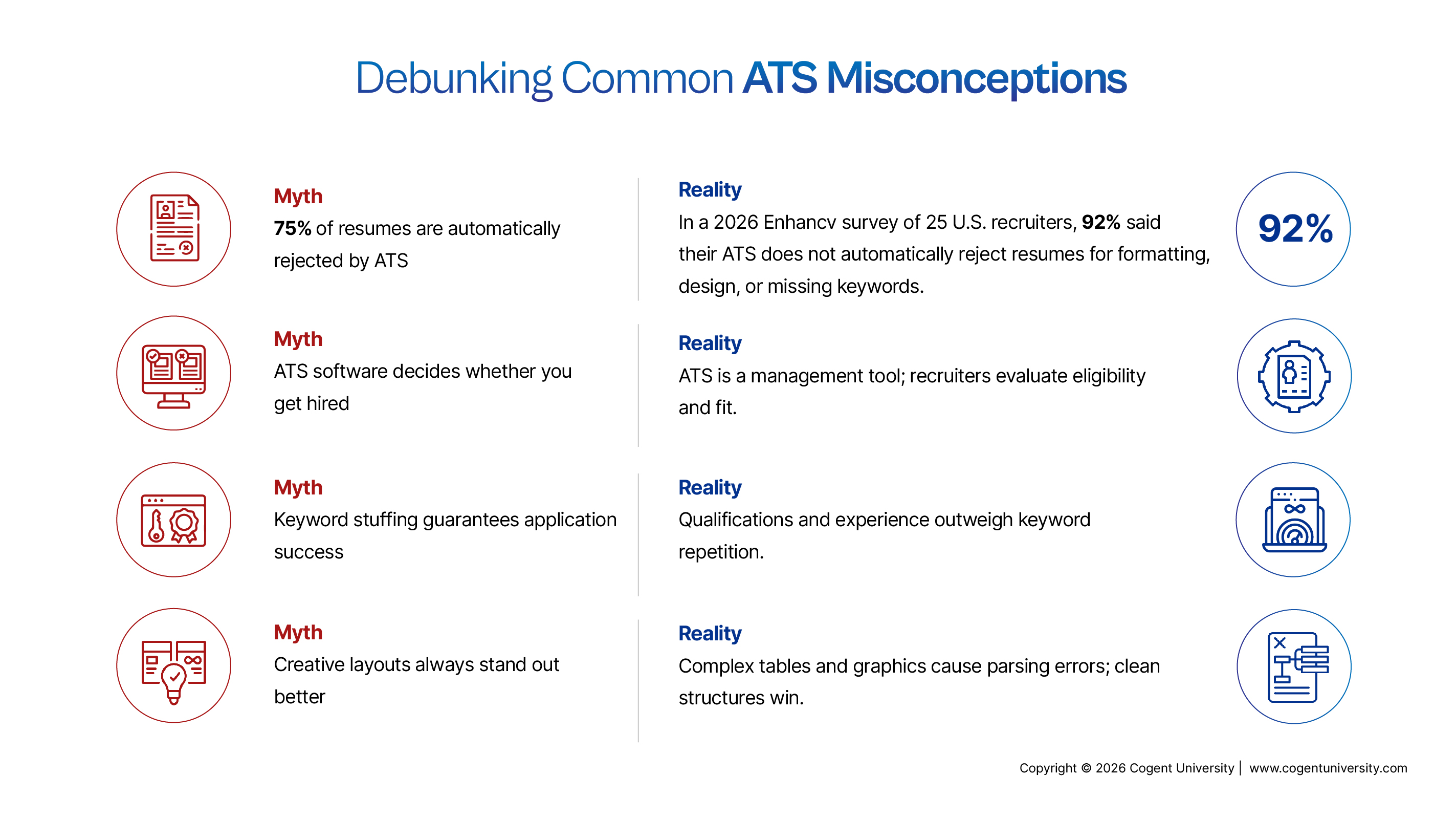
One of the reasons ATS Fatigue has become so widespread is that very little is visible after you click Apply. That uncertainty has given rise to countless theories about how Applicant Tracking Systems work. Some are grounded in reality. Others have been repeated so often that they've become accepted as fact.
So what's really happening? A 2025 investigation of U.S. recruiters and talent professionals found that more than 90% said their systems don't automatically reject candidates. (Source: https://enhancv.com/blog/does-ats-reject-resumes/) Instead, Applicant Tracking Systems organize and rank applications, while recruiters make the final hiring decisions, except in cases involving basic eligibility requirements like work authorization or licensing.
The statistic may be inaccurate, but the concern behind it isn't. Resumes with cluttered layouts, missing keywords, or unusual file formats genuinely can get mangled during parsing, which looks exactly like an automatic rejection even when a human eventually sees the (garbled) result. The fix for that isn't dread, it's formatting discipline, which we'll get to shortly.
The Postings That Were Never Real
Here's a harder truth to sit with: some of the silence you're experiencing isn't about you, your resume, or the ATS at all. Not every job posting leads to an actual hire. Studies and surveys consistently suggest that a significant number of listings are posted to build talent pipelines, gauge market interest, or meet internal hiring requirements rather than fill an immediate role.
It doesn't make the time you spent tailoring your application any less frustrating, but it does explain why the lack of response isn't always a reflection of your qualifications. Repeated experiences like these are one of the many reasons ATS Fatigue builds over time, making every application feel like another effort with an uncertain outcome.
Why Everyone's Inbox Feels Like a Flood
Part of what makes the process so draining right now is simple volume, and that volume has a clear, recent driver: generative AI has made mass-applying almost effortless.
Recruiters describe the shift bluntly. Postings that once drew a handful of quality resumes can now attract hundreds of applications within a day. A growing number of candidates use AI tools to generate resumes, write cover letters, and speed up applications, making every opening significantly more competitive than before.
This creates a loop nobody designed on purpose: AI makes it easier to apply to more jobs, which floods recruiters with applications, which pushes hiring teams to rely even more on Applicant Tracking Systems and faster screening methods. Candidates, in turn, feel the need to apply to even more roles just to improve their chances. Everyone ends up putting in more effort for fewer visible results, and over time, that constant cycle becomes one of the biggest drivers of ATS Fatigue.
What Recruiters Actually Do With Your Resume
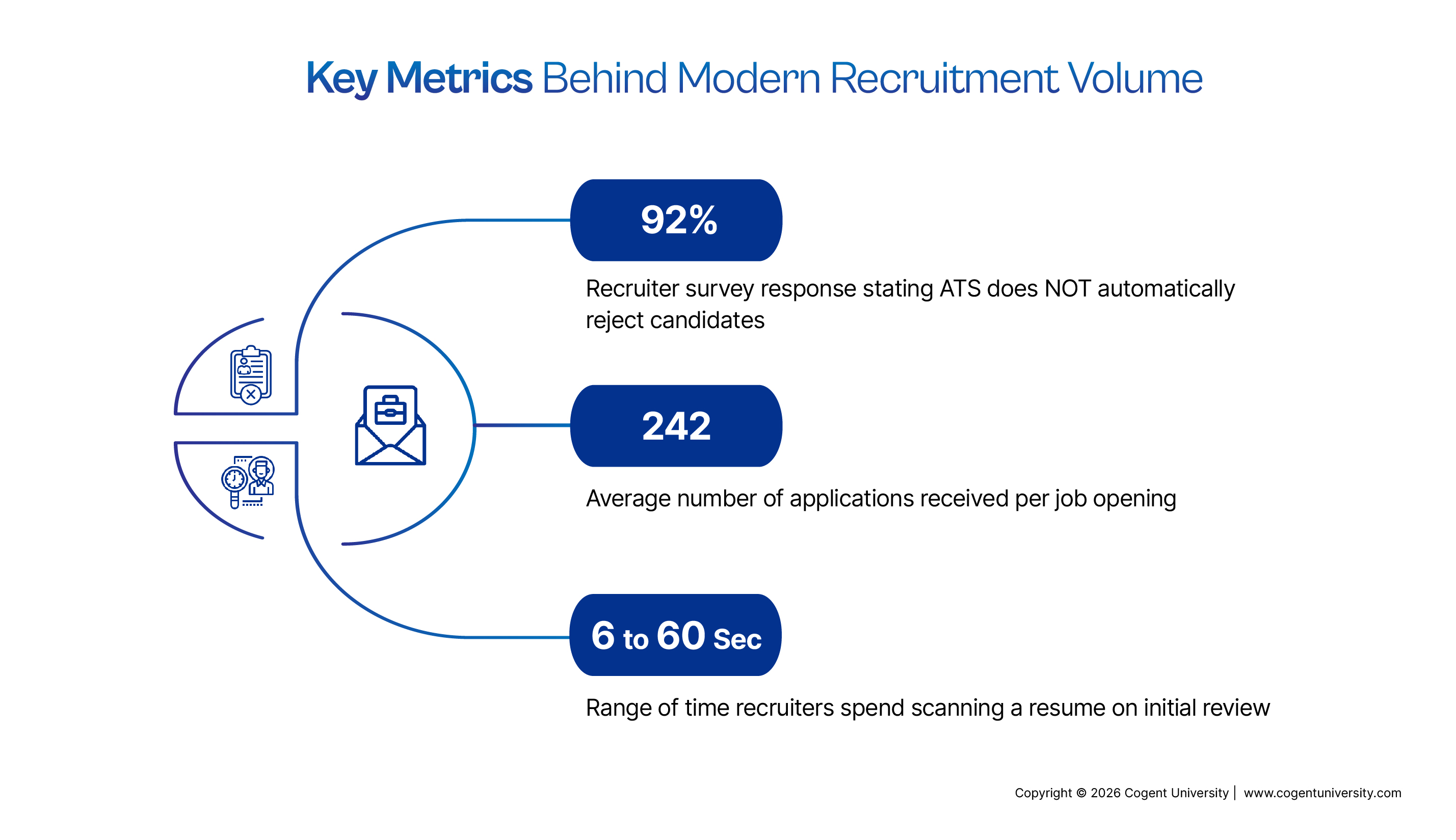
The other famous line, "recruiters spend six seconds on your resume", is nearly as oversimplified as the 75% myth. Different studies, using different methods, land on different numbers: some eye-tracking research clocks the initial scan closer to seven seconds, while other survey-based studies find most recruiters spending anywhere from thirty seconds up to a full minute before moving on. (Source: https://standout-cv.com/pages/recruiters-spend-looking-at-a-cv)
The honest version sits somewhere in between: the first pass is genuinely fast, a quick triage of whether you're even in the right ballpark, before anyone commits real time to reading closely. That's not a reason to panic. It's a reason to make sure the top third of your resume does the heaviest lifting.
Recognizing It in Yourself
Burnout from job hunting rarely arrives all at once. It tends to creep in.
The emotional signs
- Feeling drained even after a good night's sleep
- A growing sense of dread before opening a job board
- Snapping at people close to you, or pulling away from them
- Trouble focusing long enough to tailor even a single application
- Constantly second-guessing whether your resume is "good enough"
The behavioral signs
- Applying to roles you don't actually want, just to hit a number
- Spending more time rewriting your resume than applying
- Sending the same generic resume everywhere, even knowing it isn't landing
- Compulsively checking your inbox out of anxiety rather than genuine expectation
- Feeling guilty whenever you take a break from job searching
If a few of these sound familiar, you're not alone. ATS Fatigue doesn't happen overnight, it builds gradually as repeated effort goes unanswered. Recognizing it early is often the first step toward changing how you approach your search.
Breaking the Cycle
Step 1: Focus on quality, not quantity.
Target roles that genuinely match your skills instead of applying to every opening you see.
Step 2: Keep your resume ATS-friendly.
Use a clean format, relevant keywords, and tailor your resume to the job description without overloading it.
Step 3: Apply strategically.
Prioritize recently posted roles and apply directly through company career pages whenever possible.
Step 4: Protect your energy.
Set dedicated hours for job searching, take regular breaks, and remember that rest is part of a sustainable job search, not a distraction from it.
Conclusion
ATS Fatigue isn't something you overcome by applying to more jobs or endlessly rewriting your resume. While you can't control today's hiring process, you can control how you navigate it. Focusing on the right opportunities, tailoring your resume thoughtfully, and applying strategically will always be more effective than chasing volume.
Just as importantly, protect your time and energy. A sustainable job search includes taking breaks, staying focused, and remembering that the goal isn't to outwork the system, it's to navigate it with confidence.
Ready to take the stress out of job searching? Explore career opportunities and expert support with Cogent University.
FAQs
Does a fancy resume design actually hurt my chances?
Sometimes, yes. Not because Applicant Tracking Systems automatically reject creative resumes, but because some systems can struggle to accurately read complex layouts, tables, multiple columns, or embedded graphics. A clean, well-structured resume is generally easier for both ATS software and recruiters to review.
Should I use AI tools to apply faster?
AI can save time when used thoughtfully, but relying on it to mass-apply for hundreds of jobs usually isn't the best approach. Personalized applications that genuinely reflect your experience are still more likely to stand out than high-volume submissions.
How can I tell if a listing is a ghost job before applying?
Look for postings that stay live for unusually long periods, vague or recycled job descriptions, or roles that seem to reopen repeatedly without ever being filled. None of these guarantee it's a ghost job, but together they can be useful warning signs.
Why haven't I heard back from a job I was clearly qualified for?
There isn't always one explanation. Recruiters may be reviewing hundreds of applications, an internal candidate may already be under consideration, hiring priorities may have changed, or the role may no longer be actively hiring. A lack of response doesn't automatically mean you weren't qualified.
Is ATS Fatigue real?
While ATS Fatigue isn't a formal medical diagnosis, it has become a widely used term to describe the mental and emotional exhaustion many job seekers experience after repeatedly navigating modern hiring systems. If the stress from your job search begins affecting your sleep, confidence, relationships, or daily life, it's worth stepping back, adjusting your approach, or speaking with a professional if needed.



.png)
