
Introduction
In 2026, it is easy to feel like the world of work is moving faster than you can keep up.
Every week, there is a new AI tool. A new automation platform. A new productivity hack. A new job title that did not exist a few years ago. One person is building apps with AI. Another is using agents to manage workflows. Someone else is learning data analytics, cloud, cybersecurity, or full-stack development because they know the market is changing.
And in the middle of all this, you may be asking a very real question:
What skill will actually keep me valuable?
Not for one trend cycle. Not for one software update. Not for one job description.
But for the long run.
The answer is not just “learn AI.” It is not just “learn coding.” It is not just “get certified.”
Those things matter. But they are not the full picture.
The real human edge in 2026 is foundational problem-solving.
It is your ability to look at a messy situation, understand what is really going on, ask better questions, break the problem down, test your thinking, and create a solution that works in the real world.
That skill has always mattered. But now, it matters more.
Because tools are getting smarter. Work is getting more complex. And the people who win are not simply the ones who know which button to click. They are the ones who know what problem they are trying to solve in the first place.
AI Has Changed the Game, But Not the Goal
There is no serious debate anymore about whether AI is changing work. It is.
The World Economic Forum’s Future of Jobs Report 2025 predicts that structural labor market change between 2025 and 2030 will affect the equivalent of 22% of today’s jobs. That includes 170 million new jobs created and 92 million jobs displaced, with a net gain of 78 million jobs.
That is a big shift.
The same report says that 39% of workers’ existing skill sets are expected to change or become outdated by 2030. It also estimates that if the global workforce were 100 people, 59 would need training before 2030.
So yes, the message is clear: you cannot stand still.
But here is what many people miss.
The most valuable workers of the future will not be the ones who chase every tool. They will be the ones who can adapt across tools.
A tool can help you write code. But it cannot fully understand your user’s frustration.
A tool can generate a dashboard. But it cannot decide which business question actually matters.
A tool can summarize data. But it cannot take responsibility for a flawed decision.
A tool can give you an answer. But it cannot replace your judgment.
That is where your human edge begins.
The Problem Is Not Lack of Tools. It Is Lack of Thinking.
Many learners make the same mistake when preparing for a tech career.
They focus only on the visible skills.
Java. Python. SQL. React. AWS. AI prompts. Data visualization. Cybersecurity tools.
These are important. You need practical skills. You need hands-on training. You need to know how modern systems work.
But tools without thinking are fragile.
Imagine you are building an application and the code breaks. A surface-level learner asks, “What command do I run to fix this?”
A problem-solver asks better questions.
What changed?
Where is the failure happening?
Is this a logic issue, a data issue, a dependency issue, or a design issue?
Can I reproduce the error?
What assumption did I make that might be wrong?
That is a different level of thinking.
The same applies to data analytics. A beginner might ask, “How do I make this chart?” A problem-solver asks, “What decision will this chart support?”
In cybersecurity, a beginner might ask, “Which tool detects threats?” A problem-solver asks, “Where is the system vulnerable, what behavior looks abnormal, and what risk matters most?”
In AI, a beginner might ask, “What prompt should I use?” A problem-solver asks, “What is the quality bar, what context is missing, and how do I verify the output?”
This is the difference between being tool-dependent and being career-ready.
Employers Are Still Betting on Human Skills
The numbers support this.
According to the World Economic Forum, analytical thinking remains the most sought-after core skill among employers, with seven out of ten companies considering it essential in 2025. It is followed by resilience, flexibility, agility, leadership, and social influence.
That list is worth paying attention to.
Even in a world obsessed with automation, employers are not saying, “We only need people who can use tools.” They are saying, “We need people who can think, adapt, collaborate, and lead.”
AI and big data are among the fastest-growing skills. That makes sense. But they are rising alongside creative thinking, curiosity, lifelong learning, resilience, and leadership.
In other words, the future is not technical skills versus human skills.
The future belongs to people who can combine both.
You need technical fluency. But you also need clarity.
You need AI literacy. But you also need judgment.
You need speed. But you also need accuracy.
You need the ability to build. But you also need the ability to understand why you are building.
That is why foundational problem-solving still wins.
AI Makes Problem-Solving More Important, Not Less
Some people assume that as AI gets better, human thinking becomes less important.
That sounds logical at first. But in practice, the opposite is happening.
Microsoft’s 2026 Work Trend Index found that 49% of Microsoft 365 Copilot conversations supported cognitive work, such as analyzing information, solving problems, evaluating, and thinking creatively. That means people are not only using AI to write faster emails. They are using it inside the thinking process itself.
But that creates a new challenge.
When AI becomes part of your thinking process, you need stronger thinking, not weaker thinking.
You need to know when the output is useful. You need to catch mistakes. You need to see when the answer sounds confident but misses the point. You need to decide what should be delegated to AI and what should stay human.
Microsoft’s report also found that 86% of surveyed AI users treat AI output as a starting point, not a final answer. They stay responsible for the thinking.
That sentence should define the future of work.
AI can start the answer. You still own the outcome.
And ownership requires problem-solving.
What Foundational Problem-Solving Really Means
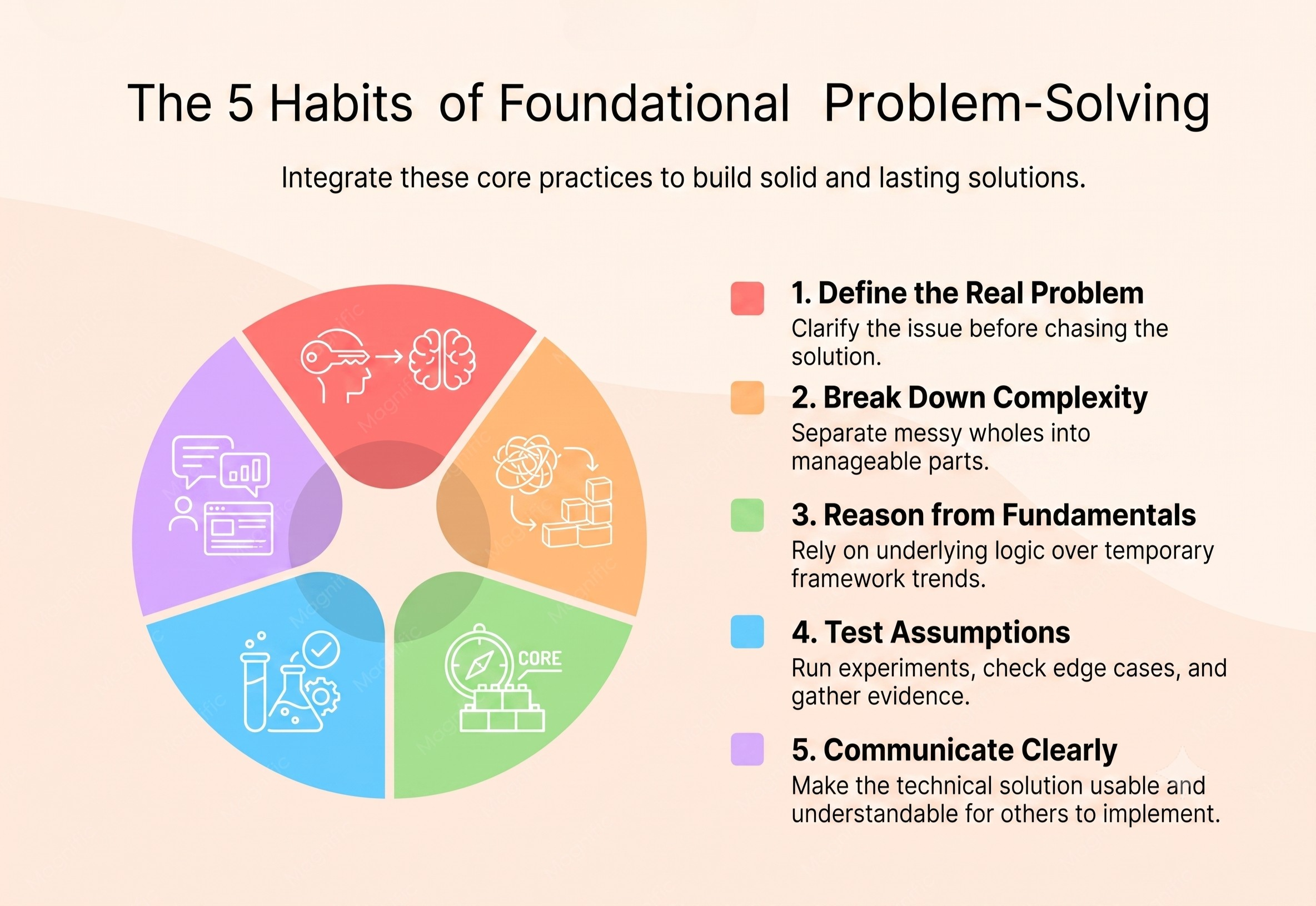
Foundational problem-solving is not one skill. It is a set of habits.
The first habit is defining the real problem.
Most people rush into solutions too quickly. They hear a complaint, see an error, or receive a task, and they immediately try to fix it. But the first version of a problem is often not the real problem.
A user says the app is slow. Is it a front-end issue, a database issue, a network issue, or a user experience issue?
A company says it needs more leads. Is the problem marketing, sales follow-up, product positioning, or customer trust?
A student says they are bad at coding. Is the problem logic, syntax, practice, confidence, or the way they are studying?
The best problem-solvers pause before they move. They clarify the problem before they chase the solution.
The second habit is breaking complexity into parts.
Big problems feel overwhelming because they arrive as a messy whole. A strong thinker can separate the pieces.
What do we know?
What do we not know?
What can be tested?
What depends on something else?
What is urgent, and what is only noisy?
This is how developers debug. It is how analysts investigate data. It is how engineers design systems. It is how leaders make decisions under pressure.
You do not solve complexity by panicking. You solve it by structuring it.
The third habit is reasoning from fundamentals.
Technology changes fast. Fundamentals move slower.
Programming languages evolve. But logic still matters.
Frameworks change. But clean architecture still matters.
AI tools improve. But context, verification, and judgment still matter.
Business platforms change. But customers still want value, trust, speed, and clarity.
When you understand fundamentals, you are not trapped by one tool. You can learn the next one faster because you understand the ideas underneath it.
This is why a good tech education should not only teach you what to do. It should teach you why it works.
The fourth habit is testing assumptions.
Every solution carries assumptions.
You assume the user wants a certain feature.
You assume the data is clean.
You assume the AI output is accurate.
You assume the bug is in one part of the system.
You assume the customer understands your message.
Strong problem-solvers do not worship their assumptions. They test them.
They look for evidence. They ask for feedback. They run experiments. They check edge cases. They compare what they expected with what actually happened.
That mindset protects you from one of the biggest risks in modern work: moving fast in the wrong direction.
The fifth habit is communicating clearly.
A solution is not complete until people understand it.
You may write excellent code, but if your team cannot maintain it, the problem is not fully solved.
You may find a powerful insight in data, but if a business leader cannot act on it, the insight loses value.
You may use AI to build something impressive, but if you cannot explain the risk, the logic, and the outcome, you have not created trust.
Communication is not a soft extra. It is part of problem-solving.
The best professionals do not just solve problems in their own heads. They make the solution usable for others.
What This Means for You as a Learner
If you are preparing for a tech career, your goal is not to memorize your way into the future.
Your goal is to become adaptable.
That means when you learn Java, do not only memorize syntax. Understand object-oriented thinking. Understand how data moves. Understand how errors happen. Understand why structure matters.
When you learn data analytics, do not only learn charts. Understand business questions. Understand patterns. Understand bias. Understand how a metric can mislead.
When you learn AI, do not only collect prompts. Understand context. Understand evaluation. Understand what good output looks like. Understand where human judgment must stay in the loop.
When you build projects, do not only ask, “Does it work?” Ask, “What problem does it solve? Who is it for? What trade-offs did I make? How would I improve it?”
That is how you build confidence that lasts.
At Cogent University, this mindset matters because career readiness is not just about completing a course. It is about becoming the kind of professional who can enter a real workplace and contribute.
Real workplaces are not clean textbooks. They are full of unclear requirements, changing priorities, legacy systems, incomplete data, business pressure, and human expectations.
Your advantage is not that you know everything. No one does.
Your advantage is that you know how to think when the answer is not obvious.
The Future Belongs to Problem-Solvers Who Can Use AI Well
Let’s be clear: this is not an argument against AI.
You should use AI. You should learn it. You should experiment with it. You should understand how it changes software development, analytics, operations, customer service, cybersecurity, and business strategy.
But do not confuse AI usage with AI readiness.
Typing prompts is easy. Thinking clearly is harder.
Generating output is easy. Evaluating output is harder.
Moving quickly is easy. Moving wisely is harder.
The professionals who stand out in 2026 will not be the ones who say, “AI will do it for me.” They will be the ones who say, “AI can help me think, build, test, and improve, but I am still responsible for the result.”
That is the mature mindset.
It is also the employable mindset.
Because employers do not only need people who can operate tools. They need people who can create outcomes.
They need someone who can look at a broken process and improve it.
Someone who can look at confusing data and find the signal.
Someone who can look at a customer problem and design a better experience.
Someone who can look at AI output and say, “This is useful, but it is incomplete.”
Someone who can learn the next technology without starting from zero.
That someone can be you.
The Human Edge Is Not Going Away
In 2026, the market will continue to change. Some roles will grow. Some will decline. Some will be redesigned. New tools will appear. New expectations will follow.
But the deeper pattern is already visible.
When work becomes more automated, human judgment becomes more important.
When information becomes easier to generate, clarity becomes more valuable.
When tools become more powerful, responsibility matters more.
When change becomes constant, foundational skills become your anchor.
That is why problem-solving still wins.
It helps you learn faster. It helps you adapt better. It helps you use technology with purpose. It helps you build trust. It helps you stay valuable even when the tools around you change.
So yes, learn the platforms. Learn the languages. Learn AI. Build projects. Earn credentials. Stay curious.
But do not stop there.
Train your mind to ask better questions. Practice breaking down hard problems. Learn to test your assumptions. Get comfortable with feedback. Build the discipline to explain your thinking clearly.
Because the future does not belong to people who simply follow instructions.
It belongs to people who can figure things out.
And in 2026, that is still the most powerful human edge you can build.
Build the skills that outlast every trend. Explore career-focused programs at Cogent University and prepare for the future of work.


.png)