

Landing interviews should feel like a sign that you're getting closer to your dream job. After all, getting past the application stage means recruiters have reviewed your resume, found your qualifications relevant, and decided you're worth speaking with.
Yet many job seekers find themselves stuck in a frustrating cycle. They apply for jobs, receive interview invitations, complete multiple rounds of conversations, and then hear the same disappointing response: “We’ve decided to move forward with another candidate.”
If this sounds familiar, you're not alone.
The hiring landscape is increasingly focused on what candidates can demonstrate, not simply what they have listed on their resumes. According to the National Association of Colleges and Employers (NACE), 70% of employers surveyed use skills-based hiring, up from 65% the previous year. Among those employers, 87% use skills-based hiring during interviews, making the interview itself a critical opportunity to demonstrate what you can actually do.
That shift helps explain why strong credentials don't always translate into job offers. Employers are increasingly looking for candidates who can communicate clearly, solve problems, provide relevant examples, and connect their experience to the needs of the role. NACE also recommends demonstrating skills through specific examples of situations where you have applied them to solve problems.
The good news is that if you're consistently getting interviews, you've already overcome one major hurdle. Your challenge is no longer simply getting noticed; it's turning those interview opportunities into offers.
Understanding where your interview performance may be falling short is the first step toward improving it.
The Job Market Has Changed
A few years ago, candidates could often secure positions simply by meeting the basic qualifications. Today, employers have more options than ever.
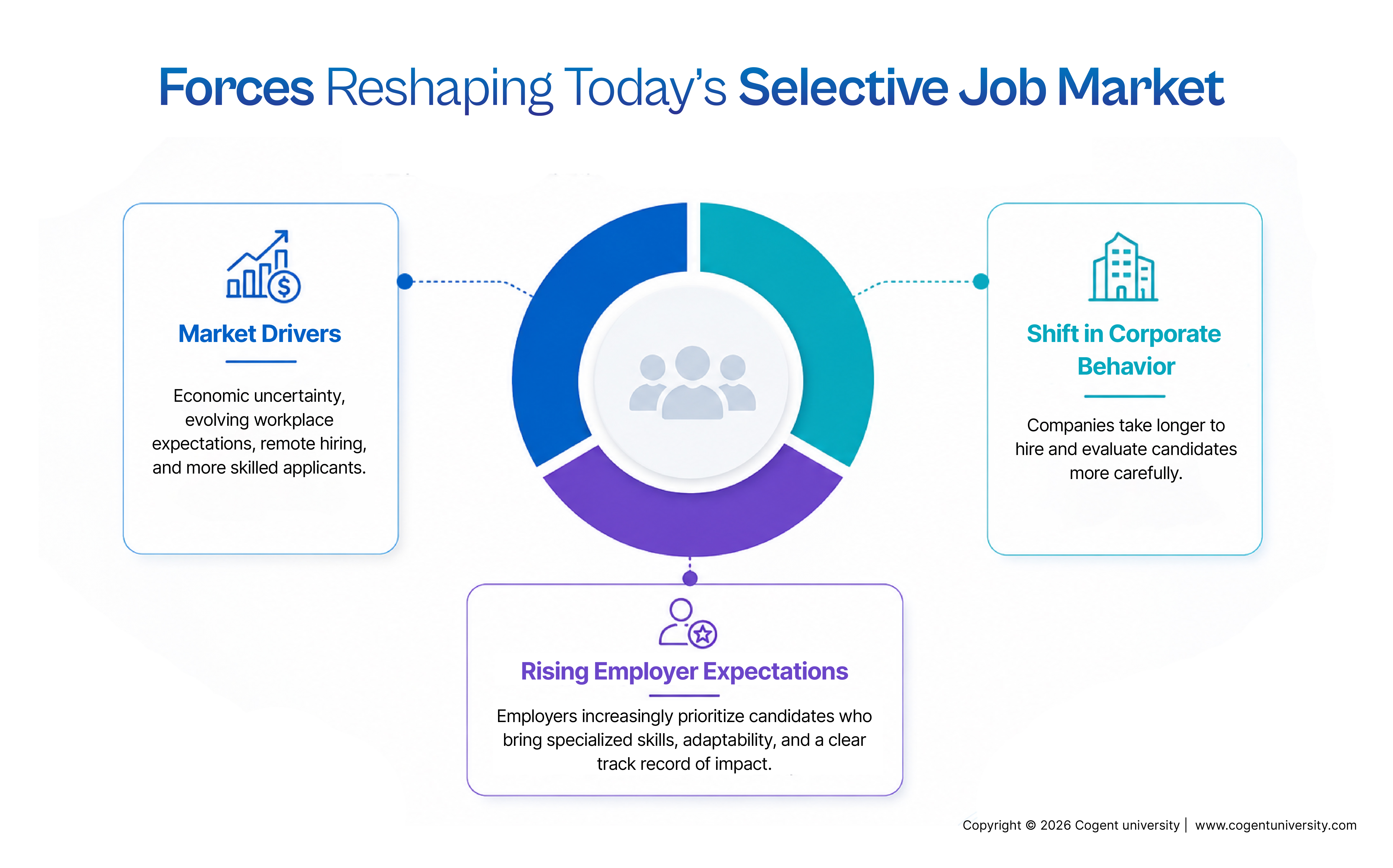
Economic uncertainty, evolving workplace expectations, remote hiring practices, and an increase in skilled applicants have made hiring decisions more selective. Companies are taking longer to hire and are evaluating candidates more carefully.
In many cases, interviewers are not just asking, "Can this person do the job?"
They're asking:
- Will this person fit our team?
- Can they adapt quickly?
- Do they communicate effectively?
- Are they genuinely interested in the role?
- Will they stay long enough to justify the investment?
When several candidates possess similar qualifications, these factors often determine who receives the offer.
You Haven’t Clearly Connected Your Experience to Their Needs
One of the biggest mistakes candidates make during interviews is talking too much about themselves and not enough about the employer's needs.
Many applicants spend interviews listing previous responsibilities, academic achievements, or projects they've completed. While this information matters, hiring managers are ultimately focused on one question:
"How will this person help us solve our problems?"
For example, a candidate might say:
"I managed social media accounts during college."
A stronger response would be:
"I managed social media accounts for a student organization and increased engagement by 40%, which helped attract more event attendees. I believe those skills can help your team strengthen audience engagement as well."
The difference is subtle but powerful. One statement describes experience. The other demonstrates value.
Employers are not simply buying skills; they are investing in outcomes.
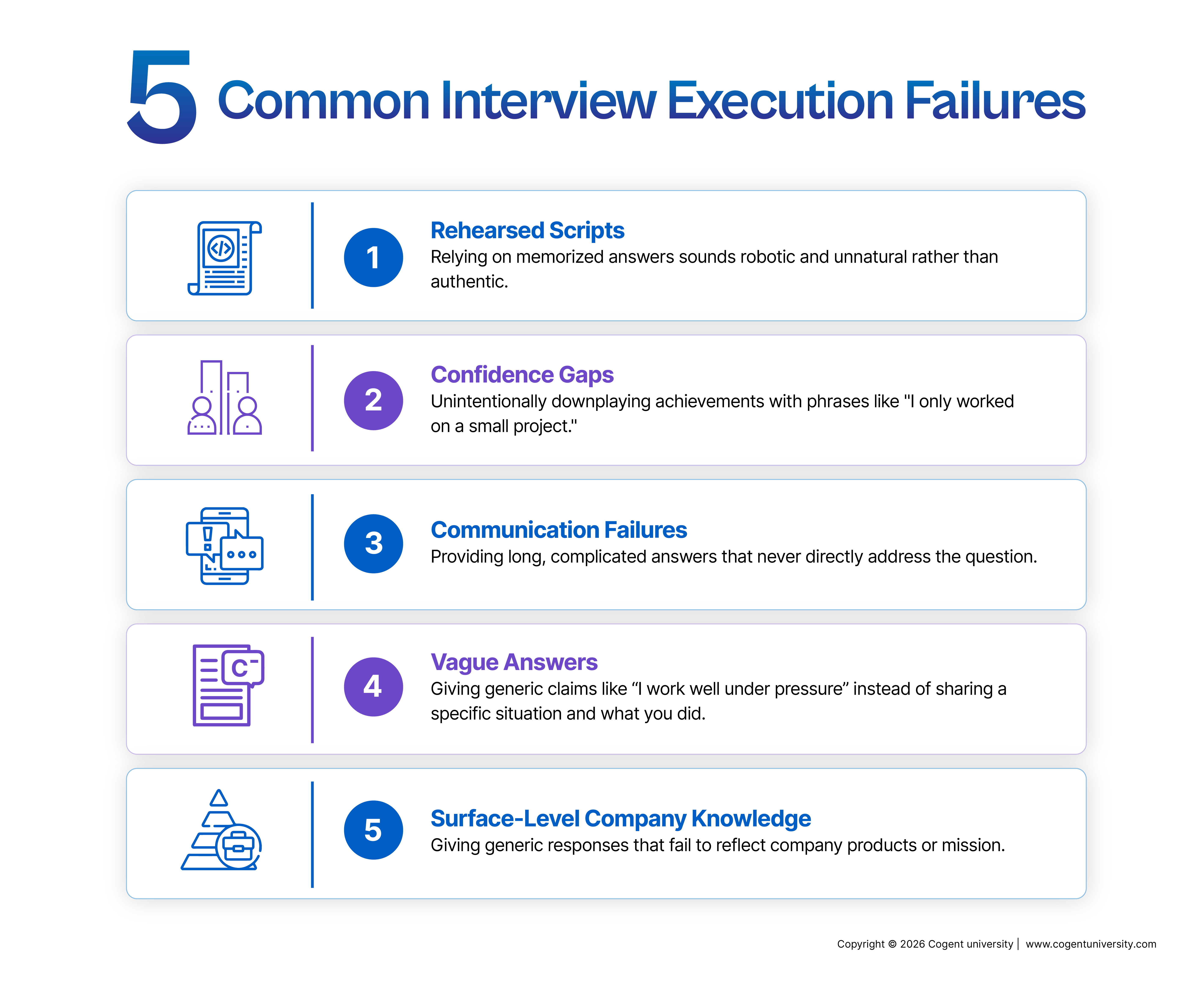
Your Interview Answers Sound Rehearsed
Interview preparation is essential, but over-preparation can sometimes work against candidates.
Hiring managers often interview dozens of applicants for a single role. Many answers begin to sound identical.
When candidates rely heavily on memorized scripts, responses can feel robotic, unnatural, or disconnected from the conversation.
Interviewers want authenticity. They want to understand how you think, solve problems, and communicate under real-world conditions.
Instead of memorizing entire answers, focus on preparing stories and experiences that demonstrate your abilities.
A genuine conversation usually leaves a stronger impression than a perfectly rehearsed speech.
You're Not Demonstrating Confidence
Confidence and experience are not the same thing.
Many early-career professionals assume they must compete with candidates who have years of industry experience. As a result, they unintentionally downplay their accomplishments.
Statements such as:
- "I only worked on a small project."
- "I'm not sure if this counts as experience."
- "I don't have much expertise yet."
can create doubt in the interviewer's mind.
The reality is that confidence comes from communicating what you have done effectively, not pretending to know everything.
Employers understand that graduates and early-career candidates are still learning. They want to see a willingness to learn, a positive attitude, and confidence in your potential.
Candidates who communicate their achievements with clarity often outperform those with stronger resumes but weaker confidence.
Your Communication Skills Need Improvement
Communication skills influence many hiring decisions.
Even in non-customer-facing roles, employees must collaborate with teammates, explain ideas, participate in meetings, and solve problems together.
Interviewers pay close attention to:
- How clearly you answer questions
- Whether you stay focused
- How well you organize your thoughts
- Your ability to explain experiences
- Your listening skills
Sometimes candidates have excellent qualifications but struggle to communicate them effectively.
A common example occurs when candidates provide long, complicated answers that never directly address the question being asked.Strong communicators make interviews easier for interviewers.
If interviewers can easily understand your value, they are more likely to remember you when making hiring decisions.
You're Failing the Behavioral Interview
Behavioral interviews have become increasingly important. Employers believe that past behavior is often one of the strongest indicators of future performance.
Questions like:
- Tell me about a time you faced a challenge.
- Describe a conflict you resolved.
- Give an example of a mistake you learned from.
- Tell me about a time you worked under pressure.
are designed to evaluate more than technical competence.
They assess emotional intelligence, problem-solving ability, accountability, resilience, and teamwork. Many candidates struggle because they provide vague answers.
Instead of saying:
"I work well under pressure."
Describe a specific situation, explain the challenge, outline your actions, and discuss the results. Concrete examples create credibility.
You're Not Researching the Company Enough
Employers want candidates who genuinely want the role. One of the quickest ways to lose momentum during an interview is to appear unfamiliar with the organization.
Interviewers notice when candidates:
- Cannot explain why they applied
- Know little about the company's products or services
- Fail to understand the role
- Give generic answers that could apply anywhere
Before every interview, spend time understanding:
- What the company does
- Its mission and values
- Recent announcements
- Industry trends
- Major challenges it may be facing
Candidates who demonstrate genuine interest often stand out, even when competing against applicants with stronger credentials.
You're Focusing Too Much on Credentials
Many job seekers believe degrees, certifications, and academic achievements will automatically secure offers. While credentials help open doors, they rarely close the deal.
Hiring managers frequently choose candidates who demonstrate practical thinking, adaptability, and communication skills over candidates with impressive qualifications but limited interpersonal strengths.
This trend has become especially noticeable as employers increasingly prioritize skills and workplace readiness. The interview is your opportunity to prove that you can apply what you've learned in real situations.
Knowledge gets you considered. Application gets you hired.
Your Enthusiasm Is not Showing
Employers prefer candidates who genuinely want the opportunity. Sometimes candidates become so focused on appearing professional that they accidentally hide their enthusiasm.
Interviewers often remember candidates who:
- Ask thoughtful questions
- Show excitement about the work
- Engage naturally in conversation
- Demonstrate curiosity
Energy can be contagious. If one candidate appears interested and another appears indifferent, the hiring team will often lean toward the more engaged individual.
This doesn't mean being overly enthusiastic or forced. It means showing authentic interest in the role and organization.
You're Not Asking Strong Questions
Toward the end of many interviews, candidates hear:
"Do you have any questions for us?"
Unfortunately, many respond with:
"No, I think you've covered everything."
This is a missed opportunity.
Thoughtful questions demonstrate preparation, curiosity, and engagement.
Consider asking questions such as:
- What does success look like in this role during the first six months?
- What challenges is the team currently facing?
- What qualities do your top-performing employees share?
- How does the company support professional development?
Strong questions help create meaningful conversations and leave a lasting impression.
Another Candidate Was Simply a Better Fit
This is perhaps the hardest reality for job seekers to accept. Sometimes you perform well and still don't receive an offer. Hiring decisions are often influenced by factors outside your control.
The selected candidate may have:
- More relevant experience
- Industry-specific knowledge
- Previous relationships with the company
- Specialized skills
- Internal referrals
This doesn't necessarily mean you performed poorly.
In many hiring processes, multiple candidates meet the requirements. The final decision may come down to very small differences.
Rejection is not always evidence of failure. Sometimes it simply reflects competition.
You're Not Learning From Previous Interviews
Many candidates approach each interview as an isolated event. The most successful job seekers treat interviews as learning opportunities.
After every interview, ask yourself:
- Which questions felt difficult?
- Where did I hesitate?
- Which answers seemed strongest?
- What feedback can I gather?
- What would I do differently next time?
Over time, these reflections create measurable improvements.
Interviewing is a skill, and like any skill, it improves through deliberate practice. The candidates who consistently evaluate and refine their performance often see better results over time.
Virtual Interviews Have Created New Challenges
Remote hiring remains common across many industries. While virtual interviews offer convenience, they introduce new obstacles.
Candidates may struggle with:
- Maintaining eye contact
- Managing distractions
- Technical issues
- Reading interviewer reactions
- Building rapport through a screen
Strong virtual interview performance requires preparation. Testing your technology, choosing a professional environment, and practicing virtual communication can significantly improve your chances.
In many cases, interviewers form impressions within the first few minutes. A smooth virtual experience helps create confidence and professionalism from the beginning.
The Importance of Emotional Intelligence
Technical skills may earn an interview, but emotional intelligence often influences hiring decisions.
Employers value individuals who can:
- Collaborate effectively
- Handle feedback professionally
- Manage workplace challenges
- Resolve conflicts constructively
- Build positive relationships
During interviews, emotional intelligence appears in subtle ways.
How you discuss former employers, respond to difficult questions, handle uncertainty, and describe challenges all provide clues about how you might behave in the workplace.
Candidates who demonstrate maturity and self-awareness often leave stronger impressions than those who focus solely on qualifications.
Turning Interviews Into Offers
If you're getting interviews, you're already doing something right. Your resume is working. Your background is generating interest. Employers see potential.
The gap between interviews and offers often comes down to communication, preparation, confidence, and the ability to demonstrate value.
Rather than sending more applications, it may be time to focus on improving interview performance.
Practice answering behavioral questions. Research companies more thoroughly. Refine your storytelling. Build confidence through preparation. Learn from every interview experience.
The goal isn't to become a perfect candidate. The goal is to become better at showing employers why you're the right candidate.
Final Thoughts
Getting interviews but not offers can be one of the most discouraging parts of the job search journey. It creates the feeling that success is close but somehow remains out of reach.
However, interviews themselves are evidence that employers see potential in you. They are invitations to prove that your skills, mindset, and personality align with their needs.
In today's competitive hiring environment, qualifications alone are rarely enough. Employers want individuals who can communicate clearly, adapt quickly, collaborate effectively, and contribute meaningfully from day one.
The encouraging reality is that these are skills that can be developed.
Every interview provides experience. Every rejection offers insight. Every conversation helps you become a stronger candidate.
The candidates who eventually receive offers are not always the smartest, most experienced, or most qualified. Often, they are simply the ones who learn, adapt, and improve with each opportunity.
Keep refining your approach, stay persistent, and remember that getting interviews means you're already closer than you think. The next conversation could be the one that turns into the offer you've been waiting for.
Turn interviews into opportunities by building the practical skills, confidence, and career readiness employers value.
Explore Cogent University and take the next step toward your career.


.png)